
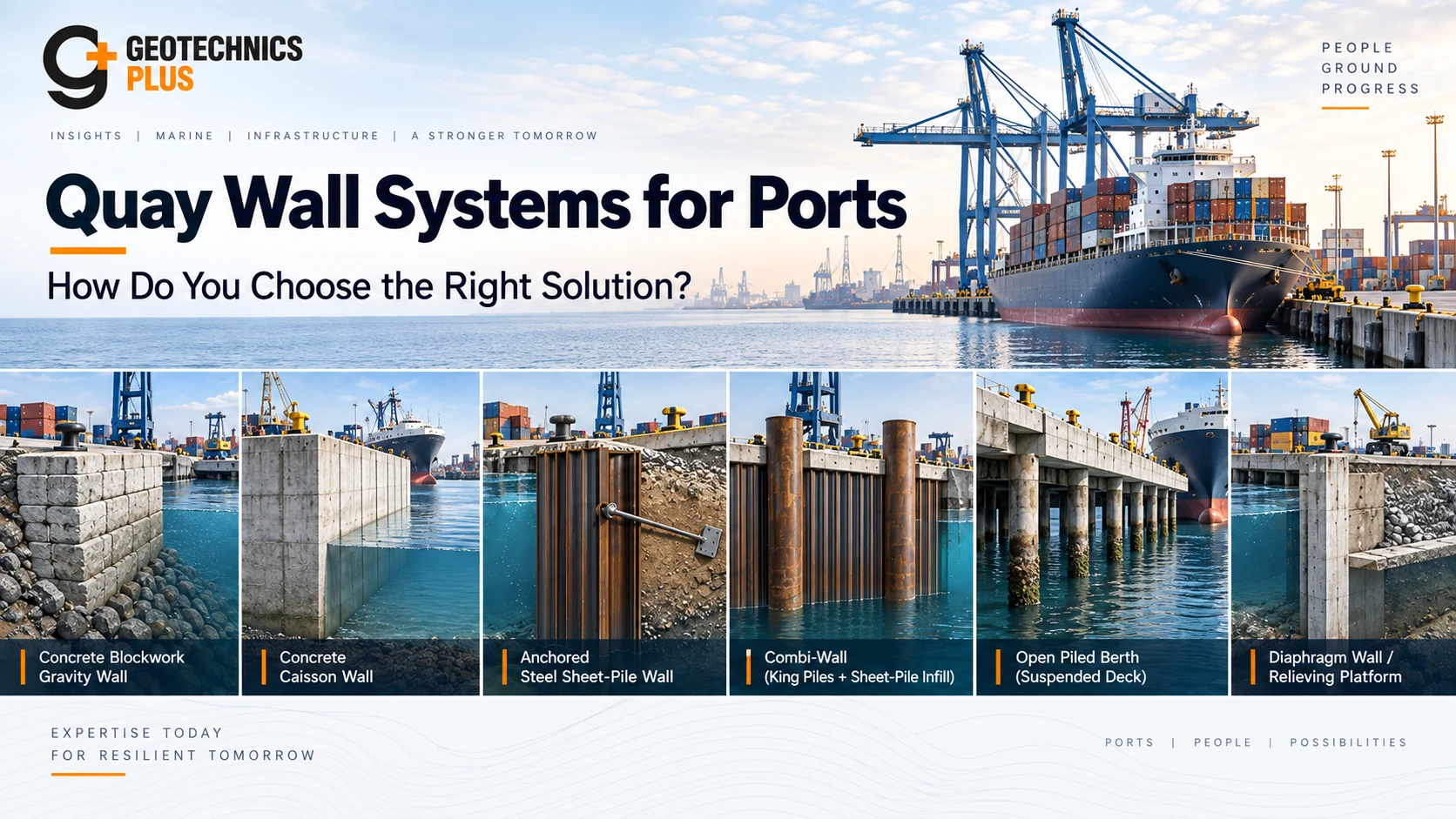
There is no single ‘best’ quay wall for a port.
A blockwork gravity wall can be an excellent solution on competent founding material. A steel sheet-pile wall may be faster and more economical where driving conditions are favourable. A combi-wall can provide the stiffness and capacity needed for deep-water container berths. A diaphragm wall may be justified where deformation control is critical. A caisson can be highly efficient where marine construction access and seabed preparation make it practical. In other cases, the right answer may not be a wall at all, but an open piled berth or a wall combined with a relieving platform.
The right quay system is the one that fits the ground, water depth, retained height, operational demand, deformation tolerance, construction method and whole-life requirements together.
This article compares the principal quay and berth systems commonly considered for ports and explains the engineering questions that should drive the choice.
Start with the main quay-wall families
The specialist reference Quay Walls by de Gijt and Broeken groups major solutions into four broad families: gravity walls, sheet-pile or embedded walls, walls with relieving platforms, and open berth quays. BS 6349-2:2019 similarly provides specific design guidance for embedded retaining walls, gravity walls and suspended-deck structures.
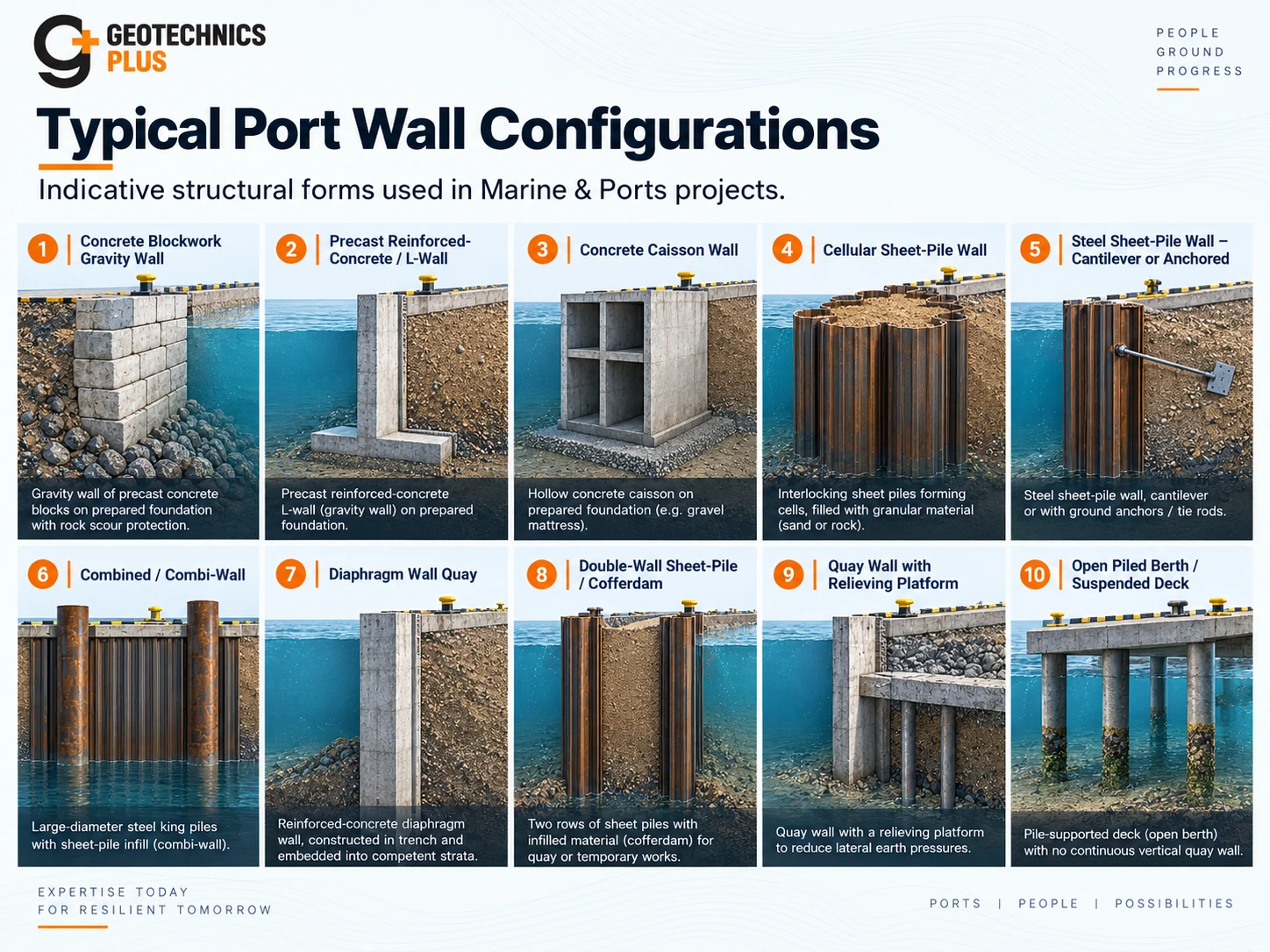
Within those broad families, several systems are routinely used in ports. The ten systems below are the ones most useful to compare during concept selection.
1. Concrete blockwork gravity wall
Blockwork quay walls use large precast mass-concrete blocks stacked to form a gravity retaining structure. Stability is provided primarily by the mass and geometry of the wall together with foundation resistance.
Best suited when: competent founding strata are available at practical excavation depth, large precast units can be handled, and a robust low-maintenance gravity structure is desirable.
Advantages:
- very robust and durable;
- little dependence on buried anchors;
- well suited to locations where driving steel piles into rock or very dense strata would be difficult;
- can accommodate heavy marine exposure with relatively simple structural form.
Watch for: bearing capacity, sliding, overturning, differential settlement, foundation preparation, block handling and marine placement tolerances.
Reference basis: BS 6349-2:2019 §6.2, Concrete blockwork walls.
2. Precast reinforced-concrete gravity / L-wall
Precast reinforced-concrete quay units use structural geometry—often an L-shaped or similar section—to mobilize self-weight and the weight of retained fill while using less concrete than a mass block wall.
Best suited when: founding conditions are predictable, precast construction is practical and a gravity solution is preferred but a lighter structural form is advantageous.
Advantages:
- controlled precast fabrication;
- relatively rapid installation once the foundation is prepared;
- efficient use of concrete;
- good compatibility with modular construction.
Watch for: foundation settlement, base sliding, uplift, joint detailing, backfill placement and construction tolerances.
Reference basis: BS 6349-2:2019 §6.3, Precast reinforced concrete walls.
3. Concrete caisson wall
Caisson quays use large hollow reinforced-concrete units typically fabricated in a dry dock or casting basin, floated to site, sunk onto a prepared seabed foundation and then ballasted or filled.
Best suited when: deep water, heavy berth loads and marine access favour construction from the water, and the seabed can be prepared to provide reliable support.
Advantages:
- high structural mass and robustness;
- efficient for deep-water gravity quays;
- substantial elements can be fabricated away from the final berth line;
- often attractive for major commercial, cruise or industrial terminals.
Watch for: bearing capacity, differential settlement, seabed preparation, flotation and sinking operations, joints between caissons, scour and seismic sliding or rotation.
Reference basis: BS 6349-2:2019 §6.4, Concrete caissons.
4. Cellular sheet-pile wall
Cellular walls use interlocking straight-web steel sheet piles arranged into circular or diaphragm cells and filled with granular material. The completed cells behave primarily as gravity structures.
Best suited when: a large gravity-type marine structure is required but steel cellular construction can be executed efficiently in the wet.
Advantages:
- can be constructed in water without conventional mass-concrete gravity units;
- large structural width provides gravity resistance;
- useful for some deep-water retaining and cofferdam applications.
Watch for: interlock tension, cell geometry, foundation resistance, internal fill, sliding, overturning, shear and progressive distortion of the cell system.
Reference basis: BS 6349-2:2019 §6.5 and USACE EM 1110-2-2503, Design of Sheet Pile Cellular Structures, Cofferdams and Retaining Structures.
5. Steel sheet-pile wall — cantilever or anchored
A conventional steel sheet-pile quay consists of interlocking steel sections driven into the ground to form a continuous embedded retaining wall. Lower retained heights may be feasible as cantilever walls; deeper quays commonly require one or more levels of anchorage.
Best suited when: the ground is driveable, retained height is moderate, construction speed matters and an embedded-wall solution provides adequate stiffness and capacity.
Advantages:
- fast installation;
- adaptable geometry;
- relatively small footprint;
- can be integrated with tie rods, anchor walls or ground anchors.
Watch for: drivability, obstructions, corrosion, toe penetration, passive resistance, anchor-zone geometry, wall deformation, dredging tolerance and seepage.
Reference basis: BS 6349-2:2019 §5, Embedded retaining walls; USACE EM 1110-2-2504, Design of Sheet Pile Walls.
6. Combined wall / combi-wall
Combi-walls use heavy primary king piles—commonly large tubular piles or H-sections—with secondary sheet-pile infill spanning between them. The king piles provide most of the flexural capacity while the infill retains the soil.
Best suited when: deep retained heights, high surcharge, large berthing facilities or stringent deformation requirements exceed the practical capacity of conventional sheet piles.
Advantages:
- high bending stiffness and structural capacity;
- efficient for deep-water container and bulk terminals;
- can accommodate substantial anchor loads;
- can be tailored through king-pile diameter, spacing and embedment.
Watch for: king-pile drivability, toe penetration, infill compatibility, anchor loads, installation tolerances, corrosion and local structural detailing.
Reference basis: BS 6349-2:2019 §5, Embedded retaining walls; de Gijt & Broeken, Quay Walls, Chapters 3 and 12.
7. Diaphragm wall quay
Diaphragm walls are reinforced-concrete embedded walls constructed in slurry-supported panels. In marine applications they can provide a very stiff retaining system and can be combined with anchors, slabs or other structural elements.
Best suited when: high stiffness, deep excavation or retained height, tight deformation control or difficult adjacent-interface conditions justify the more complex construction method.
Advantages:
- high stiffness;
- large structural depth and bending capacity;
- good option where vibration from driven piling must be limited;
- can integrate with major landside structures.
Watch for: specialist plant access, panel continuity, slurry control, excavation stability, joints, reinforcement installation, toe cleanliness and high construction cost.
Reference basis: BS 6349-2:2019 §5, Embedded retaining walls; de Gijt & Broeken, Quay Walls, Chapter 3.
8. Double-wall sheet-pile / cofferdam system
Double-wall systems use two approximately parallel sheet-pile walls tied together, with the zone between them filled to create a wide composite retaining structure.
Best suited when: sufficient footprint is available and a filled double-wall system offers advantages over a single anchored wall or conventional gravity structure.
Advantages:
- substantial structural width;
- can be constructed using steel sheet piling and granular fill;
- useful where a broad retaining mass can be accommodated.
Watch for: tie forces, global stability, internal fill behavior, wall spacing, differential movement, foundation resistance and construction-stage stability.
Reference basis: BS 6349-2:2019 §6.6, Double-wall sheet pile structures.
9. Quay wall with relieving platform
A relieving-platform quay combines an embedded waterside wall with a pile-supported platform extending landward. The platform carries part of the surcharge directly into piles and reduces the horizontal earth-pressure demand acting on the front wall.
Best suited when: operational surcharge is high, conventional wall demand would otherwise become excessive, or a stiff deck is needed for crane or terminal loads.
Advantages:
- reduces earth-pressure demand on the main wall;
- can carry heavy crane and cargo loads on deep foundations;
- can improve deformation performance for major terminals.
Watch for: complex soil–structure interaction, pile loads, wall–platform compatibility, sequencing, differential settlement and three-dimensional load transfer.
Reference basis: BS 6349-2:2019 §5 embedded-wall guidance and de Gijt & Broeken, Quay Walls, Chapters 3 and 12.
10. Open piled berth / suspended deck
An open piled berth is not a continuous retaining wall. Instead, a pile-supported deck is constructed over water or over a stable slope, with the shoreline retained farther inland where necessary.
Best suited when: a full-height retaining wall is unnecessary or uneconomic, poor near-surface ground favors deep foundations, hydraulic openness is beneficial, or construction over water is practical.
Advantages:
- avoids retaining the full soil height at the berth face;
- allows water circulation beneath the deck;
- well suited to jetties, marginal wharves and some deep-water berths;
- heavy loads can be carried directly to deep foundations.
Watch for: lateral pile response, slope stability beneath the deck, scour, berthing loads, deck–pile interaction, seismic ground movement and maintenance access below the deck.
Reference basis: BS 6349-2:2019 §7, Suspended deck structures; de Gijt & Broeken, Quay Walls, Chapter 3.
Other systems should not be forgotten
The ten systems above cover the most useful alternatives for early port selection, but they are not exhaustive. BS 6349-2:2019 also includes guidance for in-situ mass-concrete walls, in-situ reinforced-concrete gravity walls, gravity diaphragm walls and monoliths. Existing ports may also use hybrid or legacy arrangements that do not fit neatly into one category.
The selection process should therefore remain mechanism-based rather than forcing every project into a preferred standard detail.
How should the project team choose between them?
The decision should be made through a structured comparison of the conditions that actually control performance and construction.
1. Foundation conditions and rock level
Gravity walls need reliable bearing support and acceptable settlement. Embedded walls need sufficient penetration and driveability or excavability. Shallow rock may favour blockwork or caisson solutions but make driven walls difficult; deep weak deposits may push the solution toward piles, ground improvement or a hybrid system.
2. Retained height and water depth
As retained height and berth depth increase, bending demand, anchor force and global stability become increasingly important. A conventional sheet-pile wall that is efficient at moderate depth may become uneconomic compared with a combi-wall, caisson, diaphragm wall or relieving-platform system at larger scale.
3. Dredging and scour
Future deepening, over-dredging tolerances and propeller-induced scour can reduce passive support and increase effective retained height. The preferred system should be tested against credible future seabed levels—not only the opening-day geometry.
4. Deformation tolerance
Container cranes, rail systems, utilities and adjacent structures can impose tight movement limits. Stiffer systems may carry a higher initial cost but provide substantially better operational performance where deformation is critical.
5. Operational surcharge and berth loads
Container stacking, cranes, heavy transporters, bulk stockpiles, bollards and fenders can dominate quay demand. The wall system should be selected together with the operational layout rather than after the terminal loads are fixed.
6. Rock, obstructions and drivability
Sheet-pile and combi-wall concepts can become difficult where boulders, hard strata, existing foundations or shallow rock prevent reliable penetration. Drivability risk should be evaluated during concept selection, not deferred to construction.
7. Seismic and liquefaction performance
At seismic sites, the preferred solution may depend on whether the ground can liquefy, whether lateral spreading is credible, and how much permanent deformation the berth can tolerate. Gravity, embedded and piled systems respond differently to the same ground deformation mechanism.
8. Constructability and marine access
A theoretically efficient structure can be the wrong choice if the available cranes, barges, casting areas, dredging sequence, tidal window or landside access do not support its construction method.
9. Durability and inspection
Corrosion, abrasion, concrete deterioration, tie-rod access, submerged joints and future inspection requirements should be treated as design inputs. Whole-life maintenance can change the preferred structural concept.
10. Whole-life cost—not only initial quantities
The lowest first-cost wall can become expensive if it requires difficult dredging restrictions, frequent corrosion repairs, settlement remediation, future strengthening or constrained terminal operations. Selection should compare capital cost, programme, risk, maintenance and adaptability together.
A practical concept-selection matrix
| System | Typical strength | Primary limitation to test early |
|---|---|---|
| Blockwork gravity wall | Robust, durable, good near competent founding strata | Bearing, settlement and heavy-unit installation |
| Precast RC / L-wall | Efficient modular gravity solution | Foundation quality and base stability |
| Concrete caisson | Deep-water gravity construction, high mass | Seabed preparation, settlement and marine installation |
| Cellular sheet-pile wall | Large gravity-type steel system built in the wet | Cell stability, interlocks and foundation behavior |
| Sheet-pile wall | Fast, compact and adaptable | Driveability, stiffness, anchors and corrosion |
| Combi-wall | High stiffness and deep retained height | King-pile installation, anchor demand and cost |
| Diaphragm wall | Very high stiffness and deformation control | Specialist construction, joints and access |
| Double-wall sheet pile | Broad composite retaining mass | Footprint, tie forces and global stability |
| Relieving-platform quay | Excellent for high surcharge and major terminals | Complexity, pile interaction and sequencing |
| Open piled berth | Deep foundations without full berth-face retention | Pile response, underlying slope and scour |
Do not choose the wall before understanding the mechanism
Concept selection often goes wrong when a familiar wall type is chosen first and the ground model is then forced to make it work.
A stronger process is:
- define berth depth, future dredging and operational loads;
- establish the ground and groundwater model;
- screen credible structural families;
- identify the governing failure and deformation mechanisms for each;
- compare constructability and programme risk;
- test future deepening, scour, seismic and durability scenarios;
- then optimize the preferred system.
Key takeaway: Quay-wall selection is a systems decision. The best concept is not the strongest wall in isolation; it is the solution that provides acceptable geotechnical, structural and operational performance with a credible construction method and whole-life risk profile.
Where independent geotechnical review adds value
Independent review is particularly valuable during concept selection, when changing the wall system is still relatively inexpensive. A focused review can challenge the ground model, dredge assumptions, drivability, global stability, deformation criteria, anchor concept, seismic mechanism and construction sequence before the project becomes committed to one solution.
Geotechnics Plus supports port and marine infrastructure teams with quay-wall concept review, geotechnical and geo-structural assessment, soil–structure interaction, advanced numerical modelling, settlement and deformation analysis, seismic geotechnics and construction-stage problem solving.
Selected references
- BS 6349-2:2019 — Maritime works: Code of practice for the design of quay walls, jetties and dolphins.
- USACE EM 1110-2-2503 — Design of Sheet Pile Cellular Structures, Cofferdams and Retaining Structures.
- USACE EM 1110-2-2504 — Design of Sheet Pile Walls.
- de Gijt, J.G. & Broeken, M.L. — Quay Walls, 2nd Edition.