
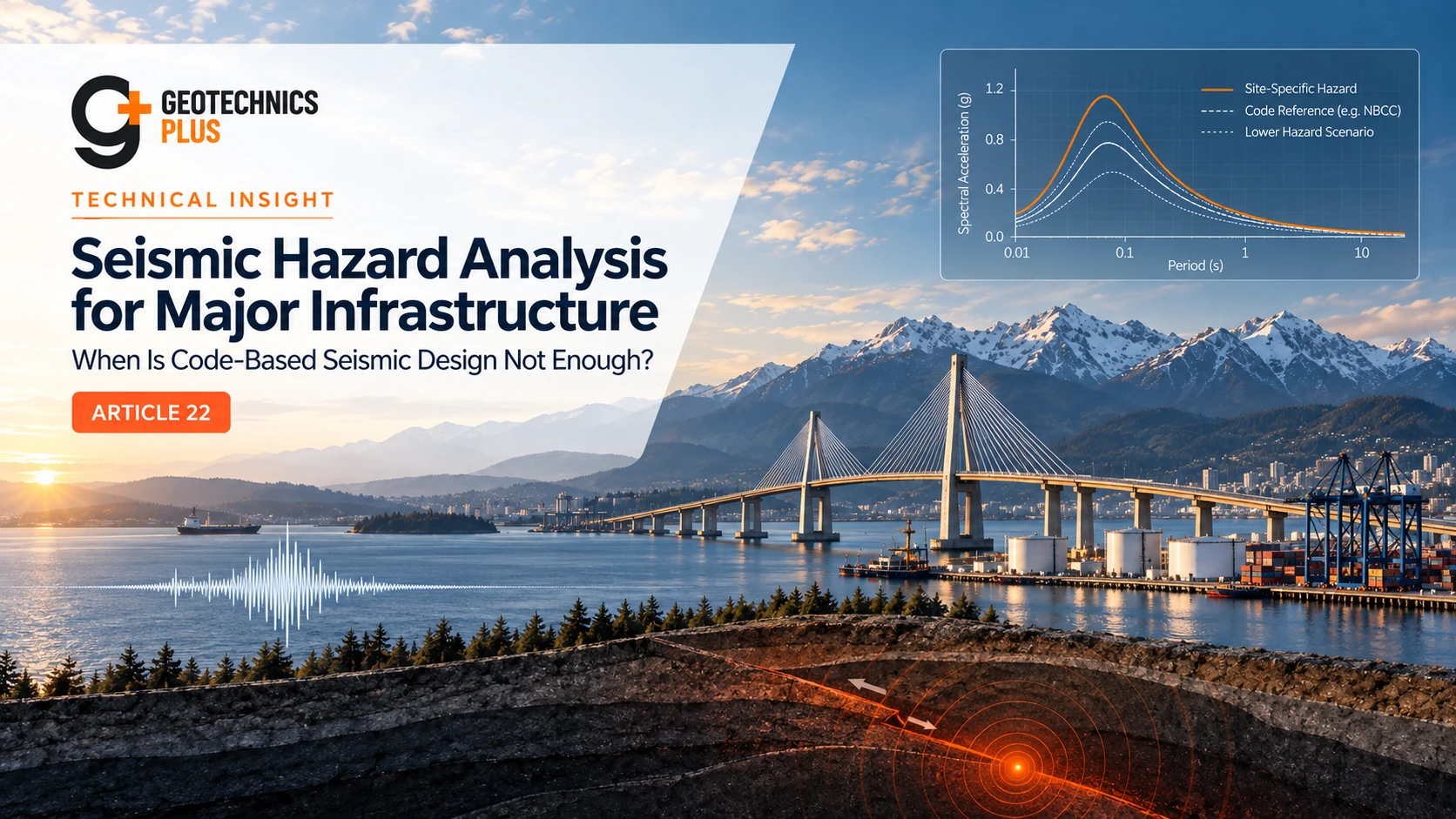
For many buildings and conventional facilities, seismic design begins with code-based hazard values and a prescribed design spectrum. That is entirely appropriate when the project falls within the assumptions and performance objectives of the governing code.
Major infrastructure is different. A port structure, mine facility, nuclear installation, large industrial plant, dam-related asset, critical bridge or other high-consequence facility may have a design life, consequence of failure, dynamic sensitivity or performance requirement that is not fully represented by a standard code spectrum. In those cases, the question is not simply what seismic coefficient does the code give? The more important question is what ground motions actually control the engineering performance of this site and this facility?
That is the role of seismic hazard analysis.
1. What does a code-based seismic spectrum represent?
Building codes provide standardized seismic hazard values so that routine design can be completed consistently and safely. In Canada, the National Building Code of Canada 2025 provides the current national model-code framework, while the legally applicable edition depends on the adopting province, territory or authority having jurisdiction. Natural Resources Canada provides the associated seismic hazard tools for the 2020 and 2025 editions.
These values are derived from national seismic hazard models that combine earthquake source characterization, recurrence relationships and ground-motion models. They are an efficient representation of regional hazard for code design. They are not, however, a substitute for every project-specific hazard question.
Three limitations are particularly important for complex projects:
- the code is developed around specified building performance objectives and probability levels;
- the national model necessarily simplifies regional source geometry and uncertainty; and
- a code spectrum does not by itself identify which earthquake scenarios dominate the hazard at a particular period or for a particular facility.
For conventional structures, these limitations are usually acceptable. For high-consequence facilities, they may become controlling design issues.
2. When should site-specific seismic hazard analysis be considered?
A site-specific assessment should be considered when the consequences of seismic under-design are high, when the required performance objective differs materially from normal building-code performance, or when the facility response is highly sensitive to the character of the ground motion.
Typical triggers include:
- critical infrastructure with stringent post-earthquake functionality requirements;
- nuclear, dam, tailings, marine or industrial facilities where lower-probability events may be relevant;
- long design lives or unusual target annual probabilities of exceedance;
- important nearby faults or complex tectonic settings;
- sites where deep soil, soft soil or basin effects may significantly alter the surface motion;
- dynamic soil-structure interaction or nonlinear soil response that depends strongly on spectral shape or duration;
- liquefaction, seismic slope stability or deformation analyses requiring appropriate earthquake magnitude and duration;
- projects that require time-history analysis rather than response-spectrum analysis alone; and
- cases where independent technical review identifies material uncertainty in the governing seismic demand.
Natural Resources Canada specifically notes that very low probability hazards, such as approximately 1-in-5,000- or 1-in-10,000-year levels, are normally associated with special facilities such as nuclear plants or dams and are beyond the normal scope of the National Building Code. At those probability levels, a site-specific assessment may be required rather than simple extrapolation of code values.
3. Probabilistic seismic hazard analysis: what does PSHA actually tell us?
Probabilistic Seismic Hazard Analysis, or PSHA, evaluates the annual frequency with which different levels of ground motion may be exceeded at a site. Rather than selecting one earthquake scenario, it integrates the potential contributions of many possible earthquakes.
A PSHA typically combines:
- the geometry and location of seismic sources;
- earthquake magnitude-frequency relationships;
- maximum magnitude assumptions;
- ground-motion models appropriate to the tectonic environment;
- source-to-site distance;
- site conditions; and
- epistemic and aleatory uncertainty.
The result is commonly expressed as a hazard curve: ground-motion intensity on one axis and annual frequency of exceedance on the other. Hazard curves can be developed for peak ground acceleration, peak ground velocity and spectral acceleration at selected periods.
This is more informative than a single design value because it shows how rapidly hazard changes as the target probability becomes more stringent. That matters when a project has multiple performance levels, for example an operational earthquake, a design-basis event and a very rare safety-related event.
4. Deterministic seismic hazard analysis still has an important role
Deterministic Seismic Hazard Analysis, or DSHA, evaluates the consequences of selected credible earthquake scenarios. A deterministic assessment may consider a specified magnitude on a particular fault or source, the corresponding source-to-site distance and an appropriate ground-motion model.
PSHA and DSHA should not be treated as competing methods. For complex facilities they often answer different questions.
PSHA asks: what level of shaking corresponds to a selected annual probability of exceedance?
DSHA asks: what would the site experience if a particular credible earthquake scenario occurred?
Deterministic scenarios are particularly useful for understanding near-fault effects, validating probabilistic results, selecting time histories, evaluating fault-specific sensitivity and communicating the physical meaning of the hazard to the broader design team.
5. Seismic sources and recurrence assumptions can control the answer
Every seismic hazard model begins with assumptions about where earthquakes can occur and how frequently earthquakes of different magnitudes occur.
Depending on the region, the model may include mapped active faults, distributed crustal seismicity, subduction-interface sources, in-slab earthquakes or broad background zones. The quality of the final hazard estimate therefore depends heavily on whether the source model represents the tectonic environment appropriately.
For routine code calculations this work is embedded within the national model. For a site-specific study, the source characterization may require review of earthquake catalogues, paleoseismic information, geological mapping, tectonic studies and recent scientific literature.
This becomes especially important at very low annual probabilities. Rare-event hazard is sensitive to assumptions regarding maximum magnitude, recurrence rate and the geometry of nearby sources. Those assumptions should be transparent and subjected to sensitivity analysis rather than hidden behind a single final spectrum.
6. Ground-motion models are not just an input table
Ground-motion models estimate shaking intensity as a function of earthquake magnitude, distance, site condition and other parameters. Modern seismic hazard analyses commonly use multiple models because no single equation perfectly represents future earthquake motion.
The selection and weighting of these models is a technical judgement. It should reflect the tectonic environment, magnitude and distance range, site conditions and the current state of practice.
For major projects, it is therefore useful to ask:
- Which ground-motion models were used?
- Why are they applicable to the site?
- How were their weights assigned?
- How sensitive is the resulting hazard to those choices?
- Are the selected models being extrapolated outside their intended range?
These questions can materially affect the design spectrum, particularly at long return periods or for sites close to significant seismic sources.
7. Deaggregation explains what is driving the hazard
A uniform-hazard spectrum tells us the ground-motion level associated with a target probability. It does not necessarily tell us what earthquake causes that motion.
Deaggregation separates the probabilistic hazard into contributions from earthquake magnitude, source-to-site distance and, where relevant, other parameters. It allows the engineer to identify the magnitude-distance combinations that dominate the hazard at a given spectral period.
This is critical because the controlling earthquake at short periods may not be the same as the controlling earthquake at long periods.
For example, a moderate nearby crustal earthquake may dominate short-period acceleration, while a larger and more distant event may contribute more strongly at long periods. In western Canada, interface and in-slab subduction events may also contribute differently across the spectrum.
Deaggregation therefore provides the bridge between the probabilistic hazard calculation and the engineering tasks that follow, including record selection, liquefaction assessment, cyclic degradation, seismic slope deformation and dynamic soil-structure interaction.
8. Site response can change the ground motion substantially
Regional hazard is not the same as ground motion at the foundation level of the structure.
Local soil conditions can amplify, de-amplify or redistribute shaking across the frequency range. Thick soft deposits, deep sedimentary basins, strong impedance contrasts and nonlinear soil behaviour can all change the surface motion.
A project-specific site response analysis may therefore be warranted where:
- the soil profile falls outside the assumptions of simplified code amplification procedures;
- soft or deep deposits are present;
- the structure is sensitive to long-period motion;
- nonlinear soil behaviour is expected at the design shaking level;
- foundation-level motion is required for soil-structure interaction analysis; or
- critical equipment has narrow-band dynamic sensitivity.
Site response may be evaluated using equivalent-linear or nonlinear methods, depending on the project, shaking level and soil conditions. The analysis should use defensible modulus-reduction and damping relationships, appropriate small-strain stiffness and uncertainty bounds that are meaningful to the engineering decision.
9. The design spectrum should reflect the performance objective
One of the most common mistakes in complex seismic design is to treat the response spectrum as an isolated deliverable.
The spectrum should instead be tied directly to the required performance objective.
A facility may need to:
- remain operational after a relatively frequent earthquake;
- limit damage under a design-level earthquake;
- prevent uncontrolled release, instability or collapse under a rare event; or
- demonstrate margin beyond the primary design-basis event.
Each objective may correspond to a different probability level and may require a different interpretation of allowable deformation, structural demand, foundation response and system functionality.
For critical assets, the seismic hazard analysis should therefore be developed together with the geotechnical, structural, mechanical and risk teams rather than produced independently and handed downstream.
10. Time-history selection should follow the hazard, not precede it
Nonlinear dynamic analysis requires acceleration time histories. The selection of those records should be informed by the hazard assessment.
Important considerations include:
- earthquake magnitude;
- source-to-site distance;
- tectonic mechanism;
- spectral shape;
- duration;
- site condition;
- near-fault effects where relevant; and
- the period range important to the structure-soil system.
Scaling or spectral matching can be useful, but it should not erase the physical characteristics that made a record appropriate in the first place. A set of motions that matches a target spectrum perfectly but poorly represents the controlling earthquake scenarios may give false confidence in a sophisticated analysis.
11. Seismic hazard affects more than structural base shear
For geotechnical design, seismic hazard characterization directly influences several different limit states.
Liquefaction: magnitude, shaking intensity and duration affect triggering and the expected severity of cyclic response.
Seismic slope stability: appropriate acceleration histories and frequency content influence deformation-based assessments.
Foundations: inertial demand, kinematic interaction and nonlinear soil behaviour depend on the input motion.
Retaining and marine structures: seismic earth pressures, permanent deformation and hydrodynamic interaction may be sensitive to both amplitude and duration.
Buried infrastructure: transient ground strain, differential movement and permanent ground deformation can become more important than conventional inertial loading.
Soil-structure interaction: foundation impedance, radiation damping and spatially variable motion can affect the dynamic response of heavy or sensitive structures.
For this reason, the hazard study should define the input motions needed by the downstream analyses rather than simply provide a single PGA value.
12. Nuclear and other high-consequence facilities require a different level of evidence
For nuclear facilities, seismic hazard is part of a broader site-evaluation and safety-analysis framework. Canadian Nuclear Safety Commission regulatory documents require site characteristics and external hazards to be addressed within the safety case, and the level of evidence is correspondingly higher than for normal commercial buildings.
The same principle applies more broadly to dams, tailings facilities and other assets where failure could have major off-site consequences: the acceptable level of uncertainty is lower, and independent review becomes more important.
A technically robust study should clearly document:
- the source model;
- recurrence assumptions;
- ground-motion model selection and weighting;
- treatment of epistemic and aleatory uncertainty;
- hazard curves and selected probability levels;
- deaggregation results;
- site-response assumptions;
- development of design spectra;
- record-selection methodology; and
- sensitivity of the engineering conclusions to key uncertainties.
13. When is independent seismic review valuable?
Independent review adds the most value when it tests the assumptions that control the final engineering decision rather than simply checking arithmetic.
For seismic hazard work, that means challenging the source characterization, probability level, model selection, site response, spectral development and compatibility with downstream analyses.
The key question is not whether every analyst would obtain exactly the same spectrum. The key question is whether the adopted hazard characterization is technically defensible, sufficiently conservative for the stated performance objective and internally consistent with the engineering analyses that depend on it.
14. A practical decision framework
A useful way to decide whether code-based values are sufficient is to work through five questions:
- What performance must the facility achieve after the earthquake?
- What probability level is appropriate for that performance objective?
- Are the regional code hazard values representative of the site and probability being considered?
- Could local soil response or source-specific effects materially change the motion?
- Do downstream analyses require information that a standard code spectrum cannot provide?
If the answer to the final three questions is yes, a site-specific seismic hazard assessment should be considered.
Conclusion
Code-based seismic design is an efficient and appropriate starting point for most projects. It should not automatically be treated as the final answer for critical infrastructure.
For high-consequence or dynamically sensitive facilities, seismic hazard analysis should identify not only how much shaking is expected, but also what earthquake scenarios control it, how local ground conditions modify it, how uncertain the result is and how that uncertainty affects engineering performance.
That shift—from a code coefficient to a defensible site-specific understanding of seismic demand—is what allows advanced geotechnical and structural analyses to become meaningful rather than simply more complicated.
References and further guidance
- National Research Council Canada. National Building Code of Canada 2025.
- Natural Resources Canada, Earthquakes Canada. Seismic Hazard Tools.
- Natural Resources Canada, Earthquakes Canada. Low Probability Hazard and the National Building Code of Canada.
- Natural Resources Canada. Sixth-generation seismic hazard model of Canada supporting the 2020/2025 NBCC hazard framework.
- Canadian Nuclear Safety Commission. REGDOC-1.1.1, Site Evaluation and Site Preparation for New Reactor Facilities, Version 1.3.
- Canadian Nuclear Safety Commission. REGDOC-2.5.2, Design of Reactor Facilities: Nuclear Power Plants, Version 2.1.