
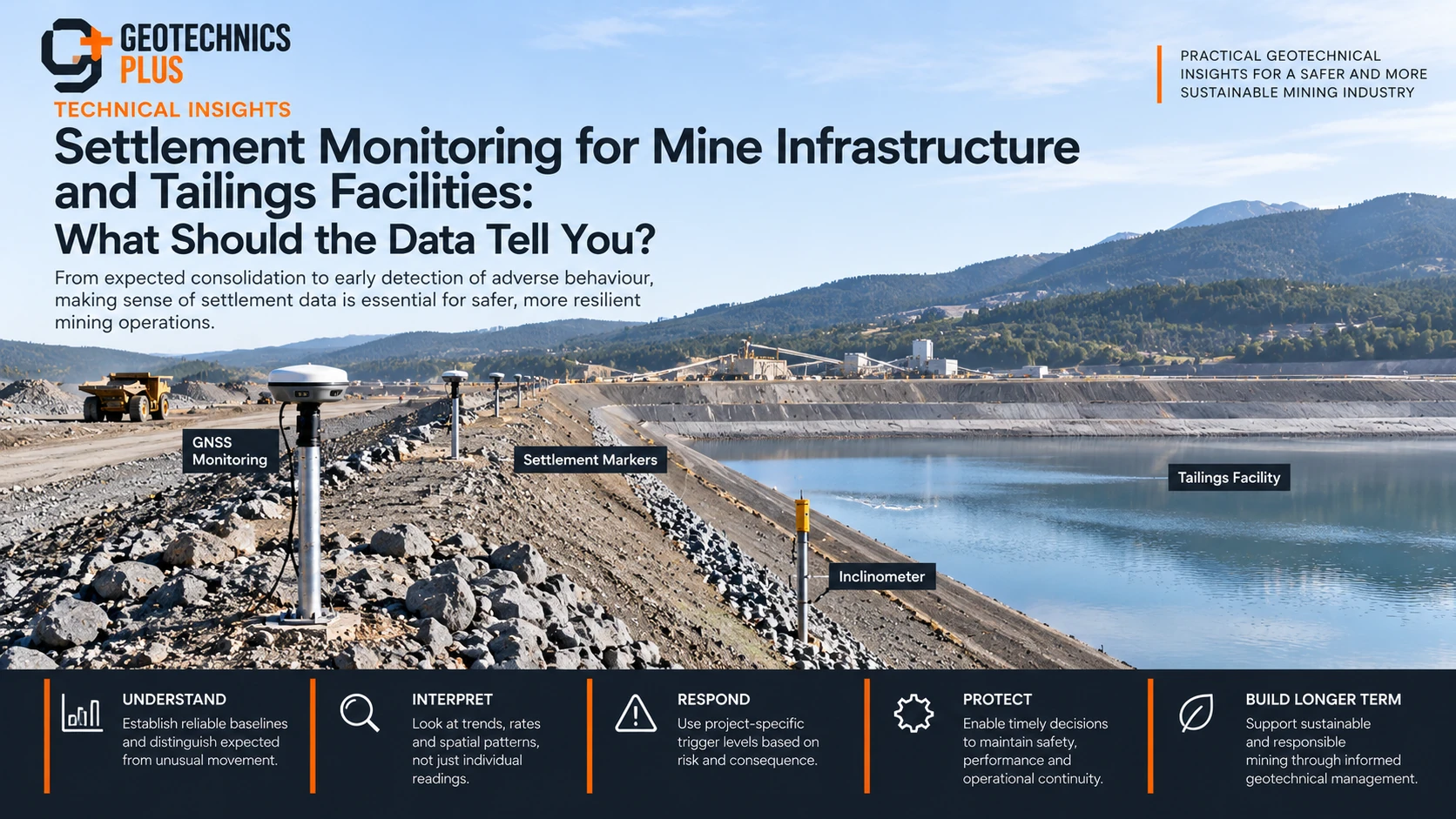
Settlement is expected in many mining and tailings systems.
Embankment raises add load. Tailings deposition changes stresses. Compressible foundation soils consolidate. Rockfill and mine fills can undergo construction-related compression. Process plants, conveyors, tanks and heavy mine infrastructure can also settle as loads are applied.
The existence of settlement is therefore not, by itself, evidence of poor performance.
The more useful engineering question is:
Is the observed movement consistent with the expected mechanism and design assumptions, or is the pattern, rate or location of movement telling us that the system is behaving differently?
That distinction is particularly important for tailings facilities because deformation data should not be interpreted in isolation. Settlement, lateral movement, pore pressure, construction sequence, deposition pattern and water management can all be parts of the same performance story.
1. Monitoring should test design assumptions
A monitoring system is most valuable when every instrument or survey point is connected to a specific engineering question.
For a tailings facility, those questions may include:
- Is the foundation consolidating at approximately the expected rate?
- Is an embankment raise producing the anticipated deformation response?
- Is lateral movement developing in addition to vertical settlement?
- Are pore pressures dissipating as assumed in the design?
- Is the tailings beach or pond position changing the loading or seepage condition?
- Is deformation localized or distributed across the structure?
- Is the facility approaching a trigger level linked to a potential failure mode?
The Global Industry Standard on Tailings Management (GISTM) requires an integrated engineering monitoring system appropriate for verifying design assumptions and monitoring potential failure modes. It also requires defined performance objectives, indicators and parameters, and prompt action when performance moves outside expected ranges.
The practical implication is simple: monitoring should be designed around the behaviour that matters, not around the instruments that happen to be available.
2. Expected consolidation is not the same as adverse movement
Some settlement may be entirely consistent with predicted behaviour.
For example, a new embankment raise placed over compressible foundation soils can generate additional consolidation. A rockfill platform may experience early construction compression. Tailings deposition can increase effective stress and induce gradual settlement in underlying materials.
The engineering task is to compare the observed response with the expected response.
Questions include:
- Is the magnitude within the predicted range?
- Is the rate increasing, decreasing or stabilizing as expected?
- Does the deformation occur where the model predicted it would?
- Does settlement correlate with a documented load increment, raise or deposition change?
- Are pore-pressure trends compatible with the deformation?
- Is there unexpected lateral displacement accompanying vertical movement?
A settlement value that is acceptable during one construction stage may be concerning during another. Context is therefore essential.
3. Establish a baseline before the next loading stage
For staged mine and tailings infrastructure, the most useful baseline is often not a single project-start reading.
Each major change in loading or geometry can create a new interpretation period.
Before an embankment raise, major surcharge, new process structure or significant change in deposition strategy, the project team should understand:
- the current deformation trend;
- the current pore-pressure condition;
- the stability of survey controls and monitoring points;
- the recent operating and deposition history;
- the previous loading sequence; and
- whether the facility has reached the degree of consolidation assumed before the next stage.
This allows the post-loading response to be distinguished from movement that was already occurring.
4. Look at rate and acceleration, not only cumulative settlement
Cumulative movement is important, but rate can be equally informative.
A gradually decreasing settlement rate following a load increment may be consistent with consolidation. A sustained increase in rate, an unexpected acceleration or a sudden change in slope can warrant investigation even before a numerical displacement threshold is reached.
Trend interpretation should therefore consider:
- incremental movement between readings;
- rate of movement;
- acceleration or deceleration;
- time since the most recent loading event;
- rainfall, snowmelt or water-level changes where relevant;
- construction and deposition activities; and
- correlation with other instrumentation.
The purpose is not to make every change in slope an alarm. It is to identify whether the evolving trend is consistent with the anticipated geotechnical mechanism.
5. Spatial patterns can be more important than a single point
One isolated settlement point should rarely be interpreted without its neighbours.
A coherent settlement bowl developing across a broad loaded area may reflect a different mechanism from a localized movement concentrated near an embankment transition, abutment, foundation change or drainage feature.
Spatial interpretation can help distinguish:
- broad foundation consolidation;
- differential settlement across changing ground conditions;
- local construction effects;
- movement associated with a weak zone;
- instrument disturbance; and
- potentially developing deformation mechanisms.
For large facilities, conventional survey data may be supplemented by GNSS, automated total stations, extensometers, inclinometers, remote sensing or other methods. The appropriate system depends on the question being answered, the required resolution and the consequence of missing a change in behaviour.
6. Settlement data should be interpreted together with pore pressure
For many tailings facilities, deformation and pore-pressure response are closely linked.
Settlement caused by consolidation is associated with changes in effective stress and drainage. A movement trend that appears reasonable geometrically may still require attention if pore pressures are not dissipating as expected.
Conversely, a pore-pressure increase may be much easier to interpret when considered alongside settlement, lateral displacement, water levels and recent construction activity.
This is why a performance review should integrate, where relevant:
- settlement or survey data;
- piezometric levels or pore pressures;
- inclinometer or lateral-displacement data;
- seepage observations and flows;
- pond level and location;
- tailings beach geometry;
- raise and deposition history; and
- visual observations.
No single dataset should be expected to explain the full behaviour of a complex tailings system.
7. Embankment raises create natural monitoring checkpoints
Each raise changes geometry, loading and potentially drainage conditions.
That makes the period before, during and after a raise an important performance-verification window.
A useful monitoring plan may increase reading frequency during critical stages such as:
- before a new raise begins;
- during rapid loading;
- immediately after completion of a raise;
- following unusual water-management conditions;
- after significant rainfall or seismic events where applicable; and
- when a trend approaches a predefined trigger level.
The appropriate frequency should be linked to how quickly the relevant failure mechanism could develop and how much time the project needs to respond.
8. Mine infrastructure needs the same performance-based thinking
Settlement monitoring is not limited to tailings embankments.
Mine sites often include crushers, process plants, tanks, conveyors, stockpiles, haul roads, portals, pipelines, water-management structures and heavy foundations constructed over variable ground or engineered fill.
For these assets, the governing concern may be:
- differential settlement affecting equipment alignment;
- movement at conveyor or pipeline interfaces;
- tank shell or bottom distortion;
- settlement of high fills or waste-rock platforms;
- foundation movement adjacent to excavations; or
- relative movement between structures founded on different systems.
The same principles apply: define the performance requirement, establish a reliable baseline, understand expected movement, monitor the relevant response and connect trigger levels to an engineering action.
9. Trigger levels should be linked to potential failure modes and actions
GISTM requires performance outside expected ranges to be addressed through Trigger Action Response Plans (TARPs) or critical controls.
A TARP should therefore do more than assign colours to displacement numbers.
Each trigger should be connected to:
- the behaviour being monitored;
- the relevant potential failure mode or performance concern;
- the reliability and uncertainty of the monitoring method;
- the expected trend at the current stage of the facility;
- the required review or escalation pathway; and
- the specific actions to be taken.
A simple conceptual structure may be:
Normal / Expected
Observed response remains consistent with design expectations. Continue monitoring and routine review.
Review / Alert
A threshold, unusual rate or unexpected spatial trend is observed. Validate the data, review construction and operating conditions, integrate other instrumentation and increase surveillance where appropriate.
Action
The predefined action criterion is reached or engineering review identifies unacceptable behaviour. Implement the agreed response, escalate to the responsible technical roles and modify operations or construction as required.
The numerical values should be site-specific and should not be copied from another facility without understanding the basis on which they were developed.
10. Validate unusual readings before drawing conclusions
An anomalous reading can represent real movement, but it can also reflect a monitoring problem.
Before attributing a sudden change to ground behaviour, check:
- instrument condition;
- survey control stability;
- datum or coordinate changes;
- recent maintenance or replacement;
- physical disturbance of the point;
- data-processing changes;
- weather or access effects; and
- correlation with adjacent instruments.
Validation should be prompt. The objective is not to dismiss an exceedance, but to determine quickly whether it represents a real change in performance and what that change means.
11. Monitoring should improve the model over time
A well-designed monitoring programme does more than confirm compliance with limits.
It can improve understanding of the facility.
Observed settlement and pore-pressure response can be compared with predicted behaviour and used to:
- refine material parameters;
- update consolidation estimates;
- calibrate numerical models;
- improve future raise design;
- adjust construction sequencing;
- optimize monitoring locations and frequency; and
- support decisions through the facility lifecycle.
This is consistent with the Observational Method: use measured performance to verify assumptions and adapt the design or operation where appropriate.
12. Closure does not end the need for interpretation
Some deformation mechanisms continue after active deposition or construction ends.
Consolidation, creep, seepage changes, water-level adjustments and long-term degradation can remain relevant during closure and post-closure.
The monitoring strategy should therefore evolve with the facility rather than simply stop when production stops.
GISTM explicitly applies monitoring across the facility lifecycle, including closure, and MAC’s tailings guidance similarly treats surveillance as part of ongoing tailings management.
A practical interpretation framework
| Observation | Possible interpretation | Engineering response |
|---|---|---|
| Gradual settlement after a documented raise with decreasing rate | Potentially consistent with expected consolidation | Compare with prediction and pore-pressure response; continue monitoring |
| Settlement rate increases without a corresponding loading event | Behaviour may differ from expectation | Validate data, review operating conditions and integrate other instrumentation |
| Localized movement at one point only | Possible local mechanism or measurement issue | Check point integrity and neighbouring data; inspect the area |
| Vertical settlement accompanied by unexpected lateral movement | Potentially different deformation mechanism | Escalate engineering review and assess relevant potential failure modes |
| Settlement broadly as expected but pore pressure remains elevated | Drainage or consolidation response may differ from design assumptions | Review piezometric response, loading rate and design assumptions |
| Trend approaches a TARP threshold | Reduced margin to predefined performance criterion | Apply the specified TARP response and increase review frequency as required |
The engineering decision
Settlement monitoring in mining should not be reduced to comparing survey readings with a single limit.
For tailings facilities and mine infrastructure, the useful interpretation comes from understanding:
what loading has occurred + what movement was expected + how fast movement is developing + where it is occurring + what pore pressures and other instruments are showing + what the consequences are if the trend continues.
The purpose of monitoring is therefore not simply to document movement.
It is to provide sufficiently reliable evidence to decide whether the facility is behaving as intended and to support timely engineering action when it is not.
References
- Global Industry Standard on Tailings Management (GISTM), particularly Principle 7 and Requirements 7.1–7.5 on integrated performance monitoring, verification of design assumptions and response to deviations from expected performance.
- The Mining Association of Canada — A Guide to the Management of Tailings Facilities, Version 3.2.
- The Mining Association of Canada — Developing an Operation, Maintenance and Surveillance Manual for Tailings and Water Management Facilities, Version 2.1.
- Canadian Dam Association — Dam Safety Guidelines and technical guidance for mining dams.