
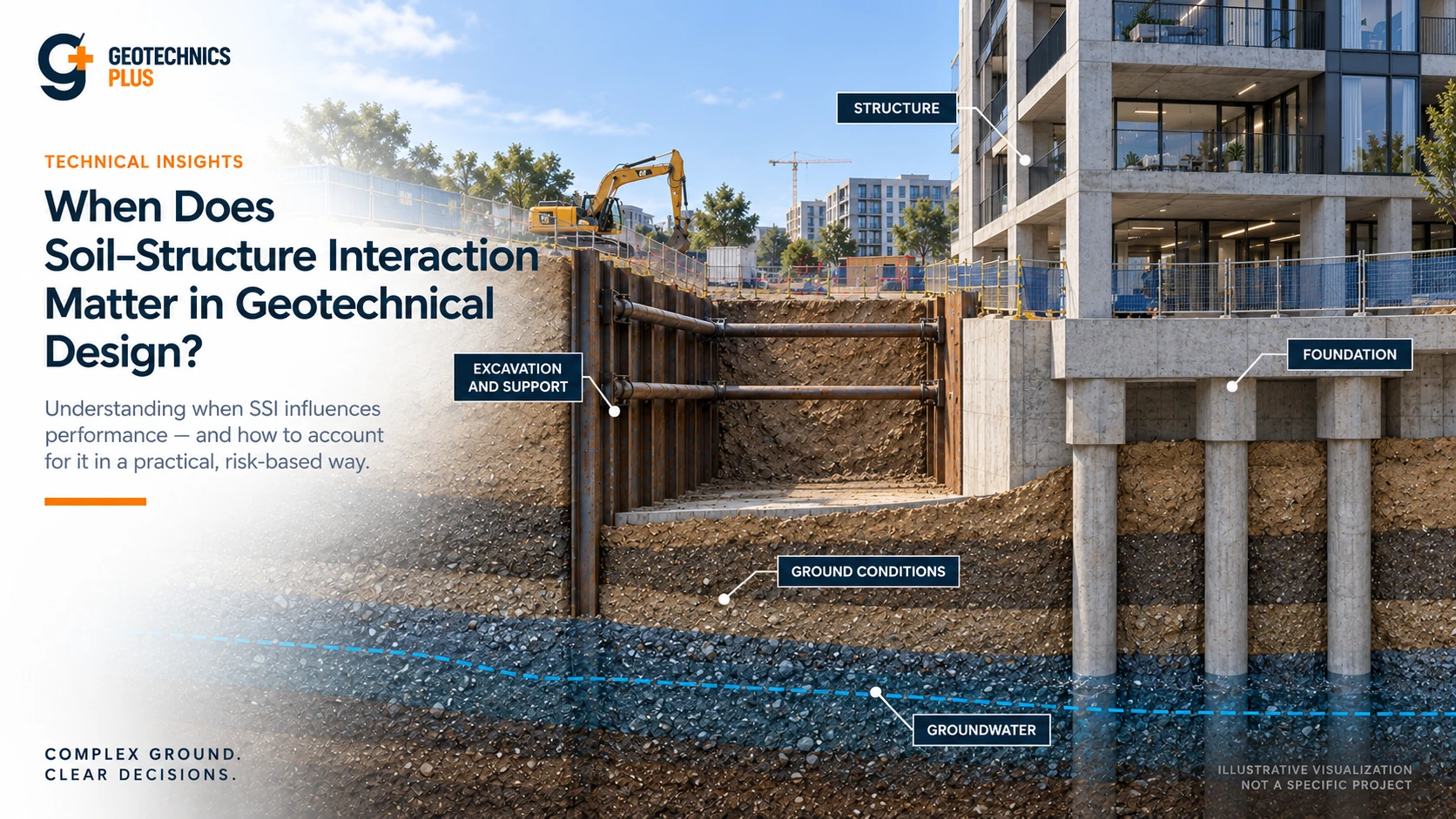
Some foundation problems are controlled less by ultimate capacity than by what happens after the ground and structure begin to deform together. Support flexibility changes reactions. Reactions change ground stress and settlement. The resulting movement then feeds back into the structure.
That feedback is soil–structure interaction (SSI).
For many routine structures, fixed supports or simplified springs are entirely appropriate. But when foundation movement can redistribute structural demand—or structural stiffness can materially change how load is transferred into the ground—treating the two systems separately can hide the behaviour that actually controls the design decision.
It is: “Would interaction materially change the engineering decision?”
Soil and structure are part of the same load-transfer system
A conventional workflow often separates structural and geotechnical analysis. The structural engineer determines foundation reactions. The geotechnical engineer checks bearing, settlement, lateral resistance or pile response. Foundation flexibility may then be represented by springs or another simplified support model.
That workflow is efficient and often appropriate. Its limitation is that the assumed foundation reactions may themselves depend on foundation movement.
Consider a large raft supporting columns with substantially different loads. If the raft and soil deform, column forces can redistribute. A stiffer part of the foundation may attract more load while another portion unloads. The final reaction pattern may therefore differ from the pattern used to calculate the initial settlement.
The same principle can occur in:
- piled rafts and large pile groups;
- bridge foundations and integral abutments;
- heavily loaded industrial foundations;
- deep basements and retaining systems;
- buried structures and tunnels;
- foundations subjected to large lateral or overturning demand; and
- structures where differential movement controls performance.
In these systems, load and deformation cannot always be treated as independent inputs and outputs.

Five situations where SSI deserves closer attention
1. Foundation stiffness affects load distribution
If several foundations support a continuous structural system, assuming each support is fixed produces one set of reactions. If those supports have different translational or rotational stiffnesses, the load path may change.
This becomes increasingly important when foundation sizes differ substantially, soil stiffness varies across the footprint, piles or pile groups have different stiffnesses, structural continuity is high, or rotational flexibility affects member forces.
The important parameter is often not simply the ultimate capacity of the soil. It is the stiffness of the complete foundation-ground system over the range of movement relevant to the structure.
2. Differential movement matters more than total settlement
Two structures can experience the same maximum settlement and have very different performance. A relatively uniform settlement may be tolerable, while a smaller differential movement may significantly affect cladding, equipment alignment, rails, piping, bridge bearings, utilities or structural framing.
When structural stiffness redistributes load in response to deformation, the settlement problem becomes interactive. The analysis must then consider not only how much the ground settles, but also how the structure reacts as settlement develops.
3. Lateral loading creates coupled translation and rotation
SSI can become important where foundations resist wind, seismic demand, earth pressure, braking forces, equipment loads, vessel actions or large overturning moments.
A foundation generally does not translate independently of rotation. Likewise, soil resistance does not develop as a perfectly linear spring extending indefinitely with displacement. Translation, rotation, embedment, geometry, soil nonlinearity and structural stiffness can influence displacement, bending moments, pile-group response and load distribution.
4. Construction sequence changes the system
SSI is not limited to the completed structure. Construction may temporarily create a very different load path. Examples include staged excavation beside existing foundations, temporary bracing in basements, sequential bridge construction, embankment loading beside piles, tunnelling near structures, and staged loading of large rafts or industrial facilities.
The structural stiffness present during an intermediate construction stage may be substantially different from the final stiffness. Soil response may also depend on stress history, consolidation, excavation unloading and sequence. A model of the completed geometry alone can therefore miss the stage where the critical interaction occurs.
5. Ground deformation is imposed on the structure
Not all SSI begins with a structural load. Sometimes the ground moves first.
Excavation, tunnelling, consolidation, embankment loading, slope movement, seismic ground deformation, liquefaction-related movement, mining subsidence or ground improvement can impose deformation on foundations and buried structures.
In those cases, the conventional logic of structure → foundation → soil has effectively reversed. The engineering problem becomes ground movement → foundation interaction → structural response.
A spring is a model — not a soil property
One of the most common SSI simplifications is to represent the foundation using springs. There is nothing inherently wrong with that. The problem arises when a spring stiffness is treated as though it were a unique material property of the soil.
Foundation stiffness depends on foundation dimensions and shape, embedment, soil layering, strain level, drainage condition, loading direction, load duration, pile-group interaction and whether translation, rotation or coupled movement is being considered.
A spring suitable for one footing size, loading mode or deformation range may therefore be inappropriate elsewhere on the same project. Where response is nonlinear, the stiffness used should also be consistent with the movement range and analysis objective rather than treated as a universal constant.
This is particularly important for the widely used modulus of subgrade reaction. Its numerical value depends on the loaded area and the behaviour being represented. It should not automatically be transferred from a plate test, handbook value or unrelated foundation geometry.
The appropriate simplification should reproduce the behaviour needed for the engineering decision, not merely provide a number that structural software accepts.
SSI does not automatically require a large finite-element model
Recognizing interaction does not mean every project needs a fully coupled three-dimensional nonlinear analysis. A useful hierarchy is:
- Fixed or idealized support — appropriate where foundation movements are small relative to structural sensitivity and interaction is unlikely to change the design decision.
- Equivalent foundation springs — translational and rotational stiffnesses capture meaningful flexibility where simplified relationships remain representative.
- Iterative geotechnical–structural analysis — separate geotechnical and structural models exchange reactions, movements or stiffnesses until a compatible solution is reached.
- Coupled numerical analysis — ground, foundation and relevant structural components are represented together where nonlinearity, staging, contact, three-dimensional geometry or complex interaction materially affects the result.
This is consistent with the broader principle discussed in our related Insight, When Does a Geotechnical Problem Need Advanced Numerical Modelling?: analytical sophistication should be proportional to the decision, uncertainty and consequence.
Soil stiffness deserves particular care
SSI predictions can be highly sensitive to soil stiffness. But “soil stiffness” is not one number.
The modulus mobilized at small strain can be substantially greater than the stiffness mobilized as strain increases. Different stress paths, drainage conditions and loading histories may also produce different responses.
This matters because many SSI problems are governed primarily by serviceability deformation, where the relevant strain range may be considerably smaller than the strain associated with failure.
A technically sophisticated model using poorly selected stiffness parameters can therefore be less reliable than a simpler model based on a well-developed ground model and calibrated deformation parameters.
Good SSI analysis starts with:
- the ground model;
- credible stiffness ranges;
- the expected strain level;
- appropriate drainage assumptions; and
- sensitivity to the parameters that actually control the decision.
The software comes later.
Interface behaviour can control the result
Another source of modelling error is assuming perfect compatibility between soil and structure. Real interfaces may slip, separate, mobilize friction progressively, transfer compression but not tension, or develop different behaviour during loading and unloading.
Examples include retaining walls, buried structures, pile–soil interfaces and foundations under significant rotation. Where interface behaviour controls load transfer, contact assumptions can be just as important as the soil constitutive model.
Static and seismic SSI are related — but not identical
Under earthquake loading, additional interaction mechanisms become important. Foundation flexibility can alter the dynamic characteristics of the structure, including effective period and damping. Foundation embedment and rigidity can also modify the motion transmitted from the free field to the foundation.
The literature commonly distinguishes:
- Inertial interaction — structural inertia causes foundation translation and rotation that interact with the supporting soil.
- Kinematic interaction — foundation dimensions, embedment and stiffness modify the motion that would otherwise occur in the free field.
FEMA P-2091 provides practical guidance on SSI, including foundation flexibility and damping effects. NIST GCR 12-917-21 provides a synthesis of SSI principles and modelling approaches for building structures.
For routine projects, simplified treatment may still be appropriate. For critical, unusual or highly deformation-sensitive facilities, the interaction deserves more explicit consideration.
A short illustrative example
Consider a continuous structural frame supported on a large raft where column loads vary substantially across the footprint. A fixed-base structural model produces a reaction pattern that is then used to calculate settlement. The settlement analysis shows that one portion of the raft is significantly more flexible because of a deeper compressible layer.
If those settlements are imposed back into the structural model, the frame redistributes force. Some columns unload while others attract additional reaction. The revised reaction pattern then changes the settlement prediction.
The important engineering question is not whether the first or second model is “more advanced.” It is whether this feedback changes:
- differential settlement;
- foundation reinforcement demand;
- column or wall forces;
- serviceability performance;
- required foundation dimensions; or
- the construction or monitoring strategy.
If the answer is no, a simpler representation may be adequate. If the answer is yes, the interaction is part of the design problem and should be represented explicitly enough to support the decision.
What should a project team ask before requesting an SSI analysis?
- What decision could change because of SSI?
- Which deformation or load-transfer mechanism matters?
- How sensitive is the structure to differential movement or rotation?
- How uncertain is foundation stiffness?
- Does structural flexibility materially change the foundation reaction pattern?
- Does construction sequence affect the governing condition?
- Is ground movement imposed independently of structural loading?
- Would a spring model or iterative analysis answer the question adequately?
- Which assumptions require sensitivity testing?
- What observations or monitoring could validate the predicted behaviour?
If the project cannot identify what decision the SSI model is intended to support, more modelling is unlikely to resolve the real uncertainty.
Better models begin with better questions
SSI is sometimes treated as a software problem. It is primarily an engineering problem.
A defensible assessment requires the geotechnical and structural teams to agree on the mechanism being investigated, the relevant ground behaviour, the structural response that matters, the acceptable level of simplification, the credible uncertainty range and the decision the analysis must support.
When those questions are clear, sophisticated modelling can be extremely valuable. When they are not, additional model complexity can simply create a more detailed representation of an uncertain assumption.
Geotechnics Plus supports project teams with soil–structure interaction assessment, foundation stiffness evaluation, staged-construction analysis and advanced numerical modelling for complex geotechnical and geo-structural systems.
References and further reading
- Federal Emergency Management Agency. FEMA P-2091 — A Practical Guide to Soil-Structure Interaction, 2020. FEMA publication.
- National Institute of Standards and Technology. Soil-Structure Interaction for Building Structures, NIST GCR 12-917-21, 2012. NIST publication.
- Federal Highway Administration. Geotechnical Engineering Circular No. 3 — Earthquake Engineering for Highways, Design Principles, 2011. FHWA publications library.