
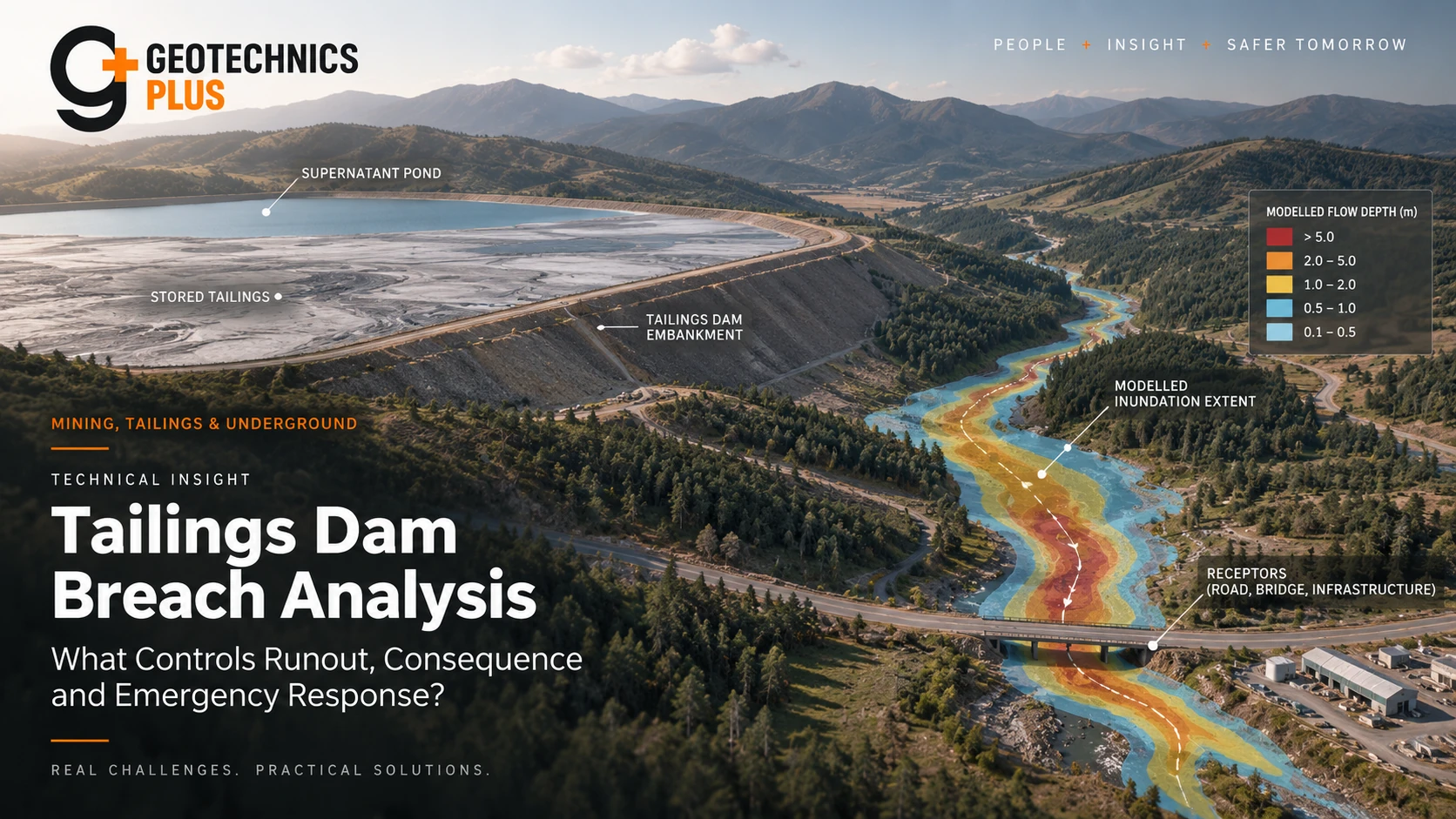
A tailings dam breach analysis is often presented as a modelling problem: define a breach, release the stored material, route it downstream and map the inundation area.
For tailings facilities, that sequence is incomplete.
The result can be controlled as much by the assumed failure mechanism and state of the stored tailings as by the numerical model itself. A liquefiable saturated tailings mass, a ponded-water release, a progressively eroding embankment and a non-erosional instability do not generate the same outflow. They should not be represented by the same simplified breach assumptions.
That is why a technically defensible Tailings Dam Breach Analysis, or TDBA, starts with the facility and its credible failure modes—not with the software.
The Global Industry Standard on Tailings Management requires breach analyses to consider credible failure modes, site conditions and slurry properties, and to estimate the area potentially affected by a failure. The Canadian Dam Association's 2021 Tailings Dam Breach Analysis Technical Bulletin similarly provides a framework specifically intended for the complexities of tailings outflow rather than conventional water-dam breach alone.
1. What is a tailings dam breach analysis actually intended to answer?
A breach analysis assumes a failure scenario and estimates its physical consequences. It is generally used to answer questions such as:
- What volume of water and tailings could be released?
- How quickly could the release develop?
- How far could the material travel?
- What areas could be inundated or covered by deposited tailings?
- What flow depths and velocities could occur?
- How much warning time could downstream receptors have?
- Which people, infrastructure, waterways and environmental receptors could be affected?
These outputs support consequence classification, emergency preparedness and response planning, risk assessments, closure planning and, in some cases, the selection of design criteria.
One distinction is critical: a breach analysis is not a probability-of-failure calculation. The Global Industry Standard on Tailings Management explicitly separates the physical consequences of credible failure scenarios from the probability that those scenarios will occur.
That distinction matters. A severe breach scenario does not mean the facility is unsafe, and a low-probability failure mode should not be ignored simply because its consequence is difficult to model. Breach analysis asks what could happen if a credible flow failure occurred. Risk assessment then combines consequence with likelihood and controls.
2. Tailings dams do not breach like conventional water-retaining dams
A conventional reservoir breach is primarily a hydraulic problem involving water release, embankment erosion and downstream flood routing.
A tailings facility can involve several interacting materials and mechanisms:
- free water or reclaim pond water;
- saturated or partially saturated tailings;
- contractive tailings susceptible to static or seismic liquefaction;
- coarser beach deposits;
- dam fill with different erosion characteristics;
- foundation soils that may participate in the instability; and
- deposited material whose strength and rheology change as it travels.
The released mass may behave as water, slurry, debris-like flow, liquefied soil or a combination that evolves during the event.
Using a water-dam breach model without demonstrating that its assumptions represent the expected tailings behaviour can therefore produce a visually precise result that is physically weak.
3. The analysis should begin with credible failure modes
The first technical question is not what breach width should be entered? It is what failure mechanisms are technically credible for this facility at this stage of its lifecycle?
Credible failure modes may include:
- overtopping and erosion;
- internal erosion or piping;
- static instability of the embankment or foundation;
- seismic instability;
- liquefaction or flow failure of retained tailings;
- foundation failure;
- rapid drawdown or unusual pore-pressure conditions;
- erosion associated with extreme inflow or surface-water management failure;
- failure associated with appurtenant structures; and
- combinations of initiating events and progressive mechanisms.
Different failure modes can produce fundamentally different breach geometries, release rates and mobilized volumes.
A breach scenario should therefore be traceable to a failure-mode assessment, design basis, dam safety review, operational condition or other defensible technical basis. Arbitrary 'sunny-day' and 'flood-day' scenarios alone may not capture the governing consequence.
4. Erosional and non-erosional breach mechanisms should be distinguished
The Canadian Dam Association distinguishes broadly between erosional and non-erosional tailings breach processes.
An erosional breach may develop through overtopping, piping or progressive removal of embankment and retained material. Breach formation time, erodibility, hydraulic head and available water can strongly influence the release hydrograph.
A non-erosional breach may be associated with instability, liquefaction or rapid movement of the dam and retained tailings. In this case, the failure may not develop through the gradual hydraulic enlargement assumed by traditional water-dam equations.
This is one of the most important areas of uncertainty in current practice. CDA technical workshops continue to identify non-erosional breach modelling, including instability and liquefaction-driven mechanisms, as an evolving area because the geomechanical response, runout and deposition cannot always be represented by conventional erosion-based tools.
For a major facility, the analysis should explain why the adopted breach mechanism is representative rather than simply reporting the parameter values selected.
5. Mobilized volume is usually more important than total stored volume
A common simplifying assumption is that the entire stored tailings volume is released. That can be conservative in some settings, but it is not automatically technically meaningful.
The quantity that matters is the volume that can become mobile under the assumed failure mechanism.
That depends on:
- pond and supernatant-water volume;
- tailings saturation;
- contractive or dilative behaviour;
- undrained strength;
- geometry of the impoundment;
- beach slope and depositional history;
- location of the breach relative to the pond;
- potential retrogression into the stored tailings; and
- whether liquefaction or strain softening allows progressive mobilization.
For some scenarios, free water may dominate the initial release and entrain tailings as the breach develops. For others, a large mass of flowable tailings may control the event even where the pond is relatively small.
Mobilized volume should therefore be treated as a scenario-dependent engineering parameter, not a fixed percentage selected without reference to the material state and failure mechanism.
6. Tailings rheology and flowability can control runout
Once released, tailings may not behave as a Newtonian fluid. Yield stress, viscosity, solids concentration, grain-size distribution and degree of liquefaction can all influence mobility.
The most important question is not which rheological model is most sophisticated. It is whether the assumed rheology reasonably represents the material that would actually be released.
Key inputs may include:
- solids concentration;
- water content;
- undrained residual or remoulded strength;
- yield stress;
- viscosity or equivalent resistance parameters;
- segregation potential; and
- how those parameters change with strain, dilution and deposition.
Laboratory testing can help, but tailings behaviour during a large release may fall outside normal laboratory strain paths. Sensitivity analysis is therefore often more informative than presenting a single deterministic rheological value to several decimal places.
7. Breach geometry and formation time should not be hidden calibration parameters
Breach width, final invert elevation, side slopes and formation time can materially change peak discharge and downstream arrival time.
Empirical water-dam breach equations are sometimes used as a starting point, but their applicability to a tailings facility should be examined carefully. A liquefaction-driven flow failure, for example, may not have a physically meaningful 'breach formation time' in the same sense as an overtopping erosion event.
For defensible modelling, breach parameters should be linked to:
- the assumed failure mechanism;
- dam geometry and construction materials;
- available hydraulic head;
- expected erosion or instability process;
- case-history evidence where applicable; and
- sensitivity ranges that show how much the outputs depend on uncertain inputs.
8. The downstream model is only as good as the terrain and resistance assumptions
After release, topography controls routing, but topography alone is not enough.
Runout may be affected by:
- valley confinement;
- channel slope and geometry;
- surface roughness;
- buildings and infrastructure;
- vegetation;
- tributaries and water bodies;
- erosion and entrainment of downstream material;
- deposition and flow bifurcation; and
- changes in rheology as the released material dilutes or segregates.
Digital terrain models should be sufficiently current and detailed for the decision being made. For downstream communities or critical infrastructure, outdated terrain can be more consequential than a small refinement in the numerical solver.
9. One breach scenario is rarely enough
Because the important inputs are uncertain, a single deterministic scenario can create false precision.
A stronger assessment considers a set of technically meaningful scenarios, for example:
- a water-dominated erosional breach;
- a flowable-tailings scenario;
- a non-erosional instability or liquefaction scenario;
- different pond conditions;
- different mobilized tailings volumes;
- different breach locations; and
- reasonable upper and lower bounds on key rheological or resistance parameters.
The objective is not to generate dozens of maps. It is to identify which assumptions control consequence and whether the emergency planning envelope remains robust when those assumptions vary.
10. What outputs matter most?
An inundation boundary is only one output.
For emergency preparedness and consequence assessment, the analysis should generally consider:
- maximum flow depth;
- maximum velocity;
- depth-velocity combinations;
- arrival time;
- duration of hazardous conditions;
- extent and depth of tailings deposition;
- potential blockage of rivers, roads or evacuation routes;
- effects on bridges and critical infrastructure;
- potential environmental receptors; and
- areas where uncertainty in the inundation boundary is material to decisions.
The Global Industry Standard on Tailings Management specifically identifies impacted area, flow arrival times, depths, velocities and material deposition as key outputs for higher-consequence facilities with flowable materials.
11. Breach analysis should inform consequence classification—not be reverse-engineered to it
Consequence classification affects design, governance and review requirements. That creates a risk that breach assumptions become unconsciously selected to support an expected classification.
The correct sequence is the opposite:
credible failure scenario → defensible breach/runout analysis → exposed receptors and consequences → consequence classification.
The breach model should not be tuned to produce the classification assumed at the beginning of the study.
Where the classification changes depending on uncertain modelling assumptions, that sensitivity should be made explicit because it may affect design criteria and the level of independent review.
12. Emergency preparedness depends on more than the maximum inundation map
A useful Emergency Preparedness and Response Plan needs actionable information.
For downstream communities and site personnel, an envelope showing the furthest possible runout is important, but so are:
- how quickly hazardous flow may arrive;
- which evacuation routes remain available;
- which bridges or roads could be lost;
- where warning systems are needed;
- what monitoring observations could precede the failure mode;
- which external agencies must be coordinated; and
- how conditions change between initial release and later deposition.
Under GISTM, emergency preparedness is explicitly linked to credible flow-failure scenarios from the breach analysis and requires coordination with affected communities and external responders.
13. The most important uncertainty should be visible to decision-makers
Tailings breach modelling contains substantial uncertainty. That is not a reason to avoid the analysis; it is a reason to communicate the uncertainty properly.
A good technical report should identify which outputs are sensitive to:
- failure mode;
- mobilized volume;
- water inventory;
- tailings rheology or residual strength;
- breach geometry and development;
- downstream resistance and entrainment;
- terrain resolution; and
- model formulation.
Where an uncertainty does not materially affect the emergency planning envelope, it may not warrant elaborate refinement. Where a modest change moves a community, road or critical asset into or out of the affected area, it deserves much more attention.
The level of analysis should be driven by the decision consequence—not simply by the availability of a more complex model.
14. What are common weaknesses in tailings breach assessments?
Recurring weaknesses include:
- treating tailings as water without justification;
- using one breach scenario for all credible failure mechanisms;
- assuming the entire impoundment mobilizes without a physical basis;
- using empirical breach equations outside their applicable range without sensitivity checks;
- selecting rheology without linking it to laboratory data or plausible material states;
- using obsolete topography;
- reporting only the maximum inundation footprint;
- not testing how assumptions affect downstream arrival time or consequence classification; and
- presenting model precision without communicating physical uncertainty.
A sophisticated software package does not correct a weak failure scenario.
15. Independent review is most valuable at the assumptions stage
Independent review should not wait until the final inundation maps are produced.
The highest-value review questions usually occur earlier:
- Are the failure modes complete and credible?
- Is the assumed material state consistent with the facility's actual deposition and pore-pressure conditions?
- Is the mobilized volume physically defensible?
- Does the selected breach mechanism match the failure mode?
- Is the rheology appropriate?
- Are the controlling uncertainties being tested?
- Are the outputs sufficient for consequence classification and emergency planning?
Reviewing these questions after a large modelling program has been completed is inefficient. For high-consequence facilities, early technical challenge can materially improve both the analysis and the decisions that follow from it.
16. A practical breach-analysis framework
A robust TDBA can be organized around seven questions:
- What credible failure modes could produce a flow release?
- What water and tailings could become mobile under each scenario?
- How would the breach or instability physically develop?
- How should the released material be represented during runout?
- Which assumptions most strongly control depth, velocity, arrival time and deposition?
- Which people, infrastructure and environmental receptors are exposed?
- What information is needed for consequence classification, emergency planning and risk reduction?
If these questions are answered transparently, the numerical model becomes a tool for engineering judgement rather than the source of it.
Conclusion
A tailings dam breach analysis should not be judged by the complexity of its software or the visual quality of its inundation maps.
Its value depends on whether the analysis represents credible failure mechanisms, plausible mobilized volumes, appropriate tailings behaviour and the downstream conditions that control consequence.
For high-consequence facilities, the most defensible approach is therefore scenario-based and uncertainty-aware: connect the breach model to the failure-mode assessment, test the assumptions that matter, and translate the outputs into consequence classification, emergency preparedness and risk-reduction decisions.
The objective is not to predict an unknowable failure with false precision. It is to understand the range of credible consequences well enough to design, operate, monitor and prepare responsibly.
References and further guidance
- Global Tailings Review. Global Industry Standard on Tailings Management, 2020, including Requirement 2.3 on breach analysis.
- Canadian Dam Association. Tailings Dam Breach Analysis Technical Bulletin, 2021.
- Canadian Dam Association. Dam Safety Guidelines and Mining Dam Technical Bulletins.
- The Mining Association of Canada. A Guide to the Management of Tailings Facilities, Version 3.2, 2021.
- The Mining Association of Canada. Towards Sustainable Mining Tailings Management Protocol. The 2023 protocol is the reporting version used for 2026 and 2027.