
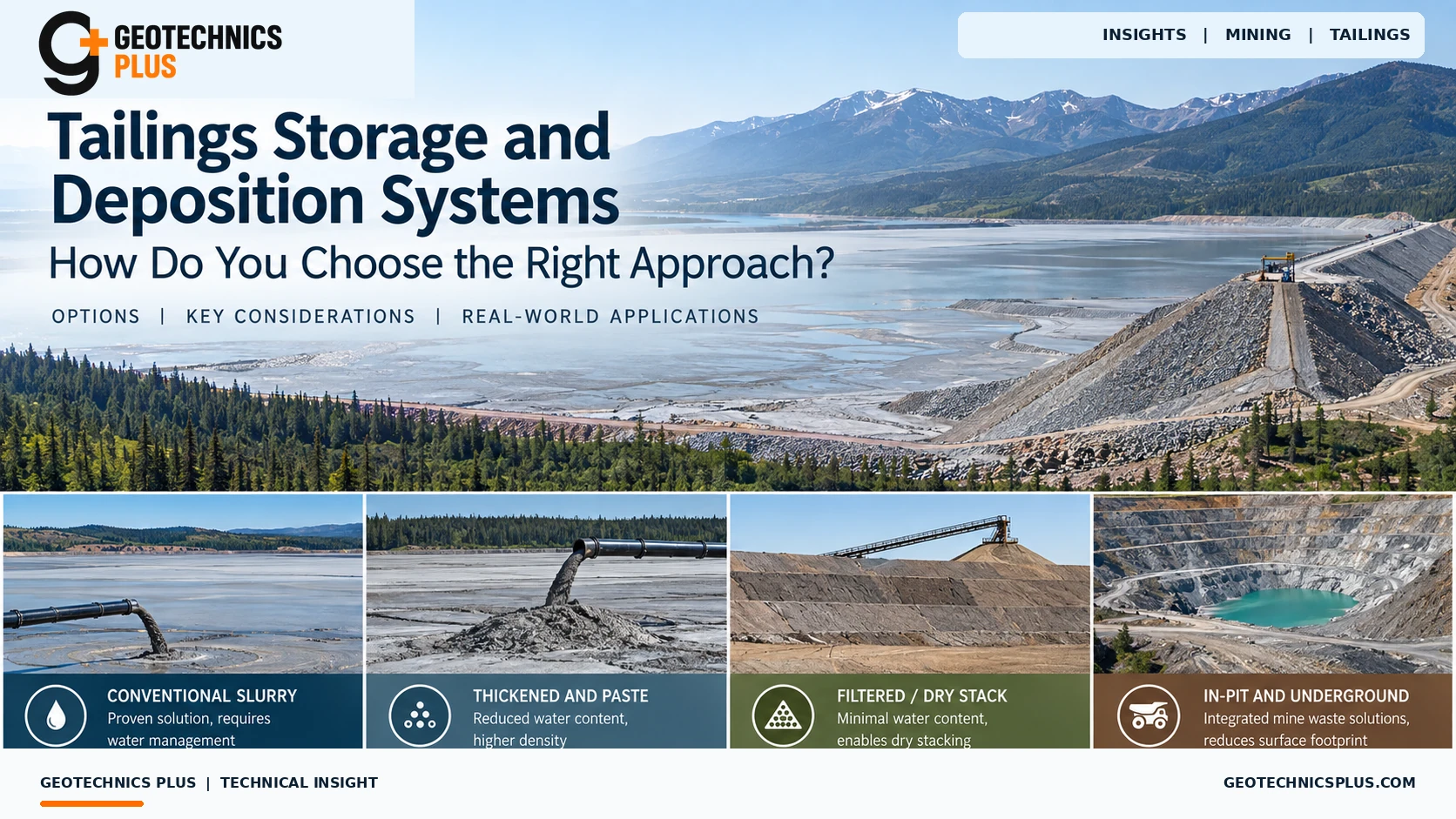
There is no single ‘best’ tailings storage system.
The right approach depends on the tailings themselves, the site, climate, water balance, foundation conditions, seismic setting, mine plan, consequence profile, operating capability and closure strategy. A conventional slurry impoundment may be appropriate at one site. A thickened or paste system may better suit another. Filtered tailings can reduce the quantity of free water stored with the tailings, but they introduce different requirements for filtration, haulage or conveying, compaction, dust control and water management.
Tailings technology should be selected as a complete system—not as a single product such as “dry stack” or “paste.” Dewatering, transport, deposition, containment, water management, embankment construction, monitoring and closure all have to work together.
This article compares the principal tailings storage and deposition approaches and explains the engineering questions that should drive selection.
First separate three different decisions
Tailings discussions often mix three different concepts together:
- How much water remains in the tailings? Conventional slurry, thickened tailings, paste tailings or filtered tailings.
- Where and how are the tailings stored? Surface impoundment, stack, mined-out pit, underground backfill or an integrated/co-disposal system.
- If an embankment is used, how is it raised? Upstream, centreline, downstream or single-stage construction.
These are related, but they are not the same decision. For example, thickened tailings can still be deposited within an impoundment, and an embankment around that impoundment can still be raised by different methods. Similarly, filtered tailings may avoid a conventional ponded impoundment but still require containment, drainage, erosion control and long-term slope design.
1. Conventional slurry tailings in an impoundment
Conventional slurry tailings are transported hydraulically at relatively high water content and deposited into a tailings storage facility where solids settle and water is recovered, decanted or managed within the facility.
Best suited when: hydraulic transport is efficient, adequate storage geometry is available, water can be safely managed and the site supports an engineered containment system.
Advantages:
- well-established transport and deposition technology;
- continuous pipeline transport can be operationally efficient;
- tailings beaches can be developed through controlled deposition;
- can accommodate very large mine throughputs.
Watch for: pond size and location, seepage, phreatic conditions, dam-raise sequencing, beach geometry, liquefaction susceptibility, water balance, storm storage, decant reliability and closure water management.
A slurry impoundment should never be viewed as only a dam problem. The water-management system, deposition plan and evolving tailings beach are part of the geotechnical system.
2. Thickened tailings
Thickened tailings are dewatered more than conventional slurry before transport, increasing solids concentration and reducing the volume of process water carried to the storage area.
Best suited when: reducing water inventory or improving water recovery has value, the rheology remains compatible with pumping, and the site can benefit from steeper deposited beach slopes or a smaller pond.
Advantages:
- improved process-water recovery compared with conventional slurry;
- potential reduction in ponded water;
- potential for different beach geometry and storage efficiency;
- can reduce total water-management demand in water-limited settings.
Watch for: pumping energy, pipeline restart behaviour, rheology variability, beach-slope assumptions, segregation, deposition control and sensitivity to changes in grind or mineralogy.
The term ‘thickened’ does not define one fixed solids content or one fixed geotechnical behaviour. Performance remains highly site- and material-specific.
3. Paste tailings
Paste tailings are dewatered further so that they behave as a high-solids, non-segregating or low-segregation material with significant yield stress. They may be deposited at surface or used in underground mine backfill, depending on the project.
Best suited when: high water recovery is important, the material can be reliably pumped or placed, and the deposition strategy can use the material’s rheological behaviour to control beach development.
Advantages:
- high water recovery compared with conventional slurry;
- reduced segregation in suitable materials;
- potential for steeper deposition slopes;
- can integrate with paste-backfill systems in underground operations.
Watch for: thickener performance, pumpability, yield stress, pipeline pressure, deposition consistency, sensitivity to process variability and whether the deposited material develops the assumed density and drainage behaviour.
Important distinction: paste tailings do not automatically mean “no dam.” Surface paste disposal can still require perimeter containment, drainage works, water-management structures and geotechnical slope design.
4. Filtered tailings / dry-stack systems
Filtered tailings are mechanically dewatered—commonly using pressure or vacuum filtration—to produce an unsaturated or partially saturated cake that can be transported by conveyor, truck or other mechanical means and placed in a compacted stack.
Best suited when: water recovery is highly valuable, filtration can reliably match plant throughput, the climate and operating model support mechanical placement, and a compacted stack offers clear risk or closure advantages.
Advantages:
- substantial reduction in water stored with the tailings;
- high process-water recovery;
- potential for progressive compaction and reclamation;
- no requirement for a large conventional supernatant pond in normal operation.
Watch for: filter-plant reliability, moisture variability, weather sensitivity, trafficability, compaction quality, lift control, dust, erosion, runoff, drainage, stack stability and the consequences of production continuing when filtration capacity is constrained.
Filtered tailings should not be treated as inherently risk-free. They replace some risks with others and require a high level of operational discipline to achieve the design density, moisture and geometry consistently.
5. In-pit tailings placement
Where a suitable mined-out pit is available, tailings may be placed below the surrounding ground surface rather than in a purpose-built surface impoundment or stack.
Best suited when: mine sequencing makes pit capacity available, hydrogeology and geochemistry are compatible with long-term storage, and placing tailings in the pit does not compromise future resource recovery or water-management objectives.
Advantages:
- can reduce the need for large external embankments;
- may reduce the above-ground footprint;
- can integrate tailings management with closure planning.
Watch for: pit-wall stability, groundwater interaction, water quality, pit-lake development, tailings consolidation, decanting, long-term seepage and mine-plan conflicts.
6. Underground backfill and integrated mine-waste systems
Some tailings can be returned underground as hydraulic fill, paste fill or cemented paste backfill. Other projects may co-manage tailings with waste rock or use integrated mine-waste landforms.
Best suited when: underground mining requires backfill or where coordinated management of tailings and waste rock provides a clear geotechnical, operational or closure advantage.
Advantages:
- can reduce surface tailings volume;
- may improve underground ground control where backfill is required;
- can integrate mine-waste and closure strategies.
Watch for: binder demand, backfill strength, underground reticulation, drainage, geochemistry, production matching and the fact that only part of the tailings stream may be suitable or required underground.
Embankment raise methods are a separate choice
Where tailings are stored behind raised embankments, the wall geometry is commonly described as upstream, centreline or downstream. A single-stage embankment can also be built to full height without subsequent raises.
Upstream construction
With upstream construction, successive raises move the crest toward the stored tailings, and part of the raised embankment may be supported on previously deposited tailings.
This approach can reduce external borrow requirements, but its performance depends strongly on tailings density, drainage, pore pressure, rate of rise, seismic demand and resistance to static or dynamic liquefaction.
Centreline construction
With centreline construction, the crest remains approximately in the same plan position as the facility is raised. The method combines aspects of upstream and downstream construction and can allow engineered drainage and structural zones to be carried upward as the dam rises.
Downstream construction
With downstream construction, successive raises move away from the stored tailings. This generally places each raise on engineered fill rather than directly on previously deposited tailings, but it requires a larger downstream footprint and significantly more construction material as height increases.
Single-stage construction
A single-stage embankment is built to the required height in one principal construction stage. It can simplify some raise-related risks but requires greater upfront capital and confidence in the final required geometry.
Do not rank embankment methods by name alone. The ICMM Good Practice Guide notes that failures have occurred across different embankment geometries and emphasizes site-specific design criteria, geotechnical characterization, operational controls and effective tailings-management systems.
What should actually drive technology selection?
The strongest projects compare complete tailings-management alternatives early, before the mill layout, pipeline route, dam concept or filtration strategy becomes difficult to change.
1. Tailings mineralogy and particle-size distribution
Grain size, clay content, mineralogy, density, compressibility, permeability and segregation potential strongly influence beach formation, dewatering, filtration, liquefaction resistance and closure behaviour.
2. Rheology and transport
Conventional slurry, thickened and paste systems impose very different pump, pipeline, energy and restart requirements. Filtered tailings shift the problem toward mechanical transport, trafficability and placement logistics.
3. Water balance and climate
Water-scarce mines may value aggressive water recovery, while wet climates may place greater emphasis on storm storage, diversion, erosion control and limiting ponded water. Cold regions add freeze-thaw, ice-lens and winter-operability considerations.
4. Topography and storage geometry
Valley, side-hill, ring-dyke, stack and in-pit concepts interact very differently with topography. Storage efficiency, dam height, catchment area, foundation footprint and closure landform should be compared together.
5. Foundation conditions
Soft foundations, sensitive soils, permafrost, deep alluvium or variable bedrock can dominate facility performance regardless of tailings technology. Foundation preparation, drainage and staged construction may control the feasible alternatives.
6. Seismicity and liquefaction
Both the embankment and stored tailings should be assessed for static and dynamic liquefaction where relevant. The credible deformation mechanism matters more than simply applying a generic seismic coefficient.
7. Consequence classification and downstream setting
The potential consequences of loss of containment should influence the level of conservatism, redundancy, monitoring, freeboard, water management and closure design—not only the choice of embankment geometry.
8. Operational robustness
The system must work every day. Thickening, filtration, pumping, conveying, compaction and water recovery all have equipment limits. A concept that performs well in analysis but is difficult to operate consistently may create greater real-world risk.
9. Closure and post-closure
The final landform, cover system, drainage, erosion resistance, geochemistry, residual water inventory and long-term maintenance requirements should be evaluated during selection—not after the facility is largely built.
10. Whole-life environmental, technical and economic trade-offs
Capital cost alone is not a sufficient decision metric. The Mining Association of Canada recommends a rigorous selection of tailings technology and location early in the facility life cycle, and Environment and Climate Change Canada’s alternatives-assessment guidance likewise calls for transparent comparison of technical, environmental, socio-economic and economic factors across the full project life cycle.
A practical comparison of the main tailings technologies
| Approach | Typical strength | Primary issue to test early |
|---|---|---|
| Conventional slurry impoundment | Proven at very large throughput | Water inventory, seepage, dam and beach management |
| Thickened tailings | Improved water recovery with hydraulic transport | Rheology, pumping and deposited beach behaviour |
| Paste tailings | High water recovery and reduced segregation potential | Process reliability, pumpability and deposition consistency |
| Filtered tailings / dry stack | Low free-water inventory and progressive compaction | Filtration capacity, moisture control, compaction and weather |
| In-pit placement | Reduced external storage footprint | Hydrogeology, pit stability and mine-sequence compatibility |
| Underground backfill / integrated disposal | Can reduce surface volume and support mining | Production matching, binder/strength and system integration |
Common misconceptions to avoid
- “Filtered means dry.” Filter cake still contains moisture and its geotechnical behaviour depends on achieved moisture, density and placement quality.
- “Paste means no containment.” Surface paste systems can still need perimeter embankments, drainage and storm-water management.
- “Downstream means safe.” Geometry alone does not eliminate foundation, seepage, seismic, overtopping or construction risks.
- “Upstream means automatically unacceptable.” Suitability depends on jurisdiction, site conditions, material behaviour, design criteria and the ability to construct, operate and monitor the facility safely.
- “Dry stack eliminates water management.” Runoff, infiltration, erosion, underdrainage and closure water management remain fundamental.
Do not choose the tailings technology before defining the life-cycle problem
A stronger selection process is:
- characterize the tailings and mine-water balance;
- define credible storage locations and geometries;
- screen slurry, thickened, paste, filtered, in-pit and integrated alternatives where technically realistic;
- evaluate embankment concepts separately where containment is required;
- compare seismic, seepage, liquefaction and closure mechanisms;
- test operational reliability and upset conditions;
- compare whole-life environmental, technical and economic consequences;
- then optimize the preferred system.
Key takeaway: Tailings selection is a systems decision. The right solution is not the technology with the least water or the strongest embankment in isolation; it is the option that can be designed, constructed, operated, monitored and closed safely for the specific mine and site.
Where independent technical review adds value
Independent review is particularly valuable during alternatives assessment and concept selection, when the project can still challenge assumptions about water content, deposition, embankment geometry, site selection, foundation conditions, liquefaction, closure and operating reliability before they become embedded in the mine plan.
Geotechnics Plus supports mining and tailings teams with specialist geotechnical review, tailings-facility design assurance, advanced numerical modelling, seismic and liquefaction assessment, settlement and deformation analysis, soil–structure interaction and construction-stage problem solving.
Selected references
- Global Industry Standard on Tailings Management (GISTM).
- ICMM — Tailings Management: Good Practice Guide.
- Mining Association of Canada — A Guide to the Management of Tailings Facilities, Version 3.2.
- Global Tailings Review — About Tailings.
- Environment and Climate Change Canada — Guidelines for the Assessment of Alternatives for Mine Waste Disposal.