
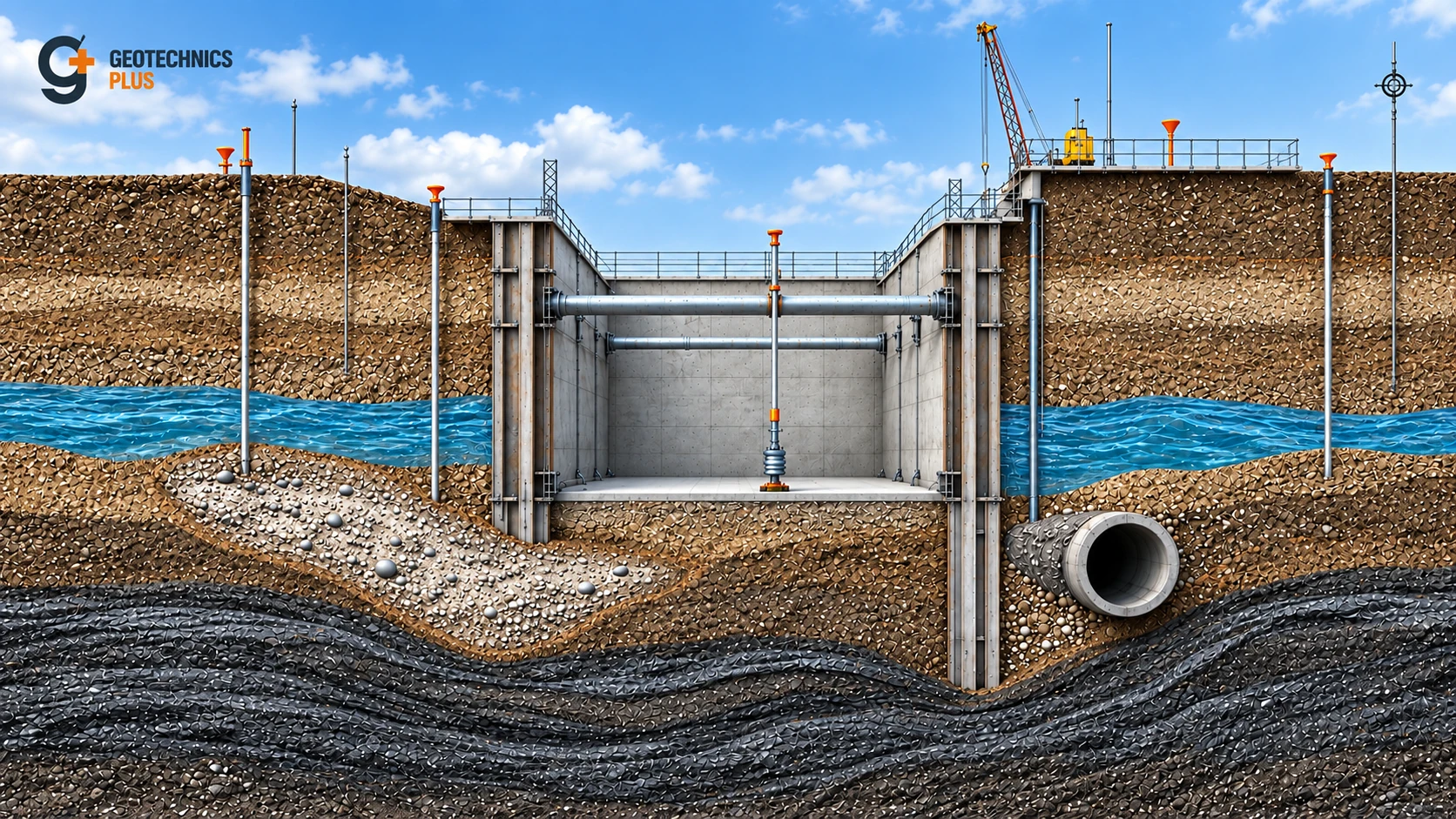
Unexpected ground conditions do not become important simply because they differ from a borehole log or design assumption. They become important when the difference changes the mechanism that controls safety, serviceability, constructability, cost or schedule.
That distinction is critical during construction. A field observation can trigger one of two unhelpful reactions: either the team treats every variation as a major design failure, or it dismisses a material change as “normal variability.” A better response is structured, evidence-based and proportionate to the consequence.
This article presents a practical geotechnical framework for responding when construction encounters conditions that differ from expectation. It focuses on the technical decision: What has changed, does it matter, what evidence is needed, and what should happen next?
Different does not automatically mean unacceptable
Ground conditions are inherently variable. Even a well-planned investigation samples only a small fraction of the ground that construction will eventually expose or influence. The fact that the field condition differs from an interpreted profile is therefore not, by itself, evidence that the design is inadequate.
The more useful question is whether the difference changes a governing engineering mechanism. Examples include:
- a weaker or more compressible layer occurring within a foundation influence zone;
- groundwater appearing at a level or rate that changes effective stress, stability or dewatering demand;
- a stronger layer causing pile refusal or changing the installation method;
- unexpected fill, obstruction or boulders affecting excavation or trenchless work;
- ground movements exceeding the range assumed for adjacent structures or utilities; or
- construction sequencing creating a temporary condition that was not represented in the design.
The response should therefore be driven by engineering significance, not simply by geological difference.

Step 1 — Preserve the facts before interpreting them
Construction decisions are often made under time pressure. That makes factual documentation unusually valuable. Before the discussion becomes dominated by interpretations, claims or solutions, the team should establish what was actually observed.
Depending on the issue, useful records may include:
- location, elevation, dimensions and construction stage;
- photographs and sketches tied to a clear reference point;
- field descriptions, samples or targeted testing;
- groundwater levels, inflow rates or piezometric response;
- equipment response, refusal records, installation logs or production rates;
- instrumentation trends and baseline comparisons;
- temporary works configuration and sequence at the time of observation; and
- the relevant design assumption, drawing, specification or geotechnical model.
The objective is not to create paperwork for its own sake. It is to prevent the technical assessment from being built on incomplete or changing recollections.
Step 2 — Compare the observation with the ground model, not one borehole
A borehole log is a point observation. A geotechnical design should be based on an interpreted ground model that considers stratigraphy, variability, groundwater, engineering properties and the mechanism being assessed.
When a field condition differs from expectation, the comparison should therefore be made against the design ground model and the range of conditions it was intended to represent.
For example, a soft seam located between boreholes may be entirely consistent with the interpreted variability. But if that seam is continuous beneath a footing, slope or excavation support system and materially changes deformation or stability, its engineering significance can be much greater than its thickness suggests.
Similarly, the presence of water is not automatically problematic. The key questions are whether the water level, pressure or flow path differs from the design basis and whether that difference changes effective stress, uplift, erosion, piping, basal stability, support loads or construction method.
Step 3 — Ask four questions before deciding how much response is justified
1. Does the condition change the governing mechanism?
The first technical question is whether the observed condition affects the mechanism that controls the design. A change that has no meaningful influence on stability, deformation, load transfer, drainage or constructability may require little more than documentation. A subtle change that alters the governing mechanism may require much more.
2. What is the consequence if the interpretation is wrong?
The same uncertainty should be treated differently depending on what is at stake. A localized variation beneath a lightly loaded temporary platform is not equivalent to uncertainty affecting a deep excavation beside an operating railway, a high-consequence industrial facility or a heavily loaded foundation.
3. How much uncertainty remains?
Sometimes a short targeted investigation resolves the issue: expose more of the surface, obtain a sample, run a probe, measure water pressure or review adjacent instrumentation. In other cases, the extent of the condition remains uncertain and the analysis must explicitly consider credible ranges.
4. Is there enough time to observe and react?
Monitoring is valuable only if the project can detect an adverse trend, understand it and implement a response before an unacceptable condition develops. Where behaviour can change rapidly or the consequence of delay is high, relying on monitoring alone may not provide sufficient control.
Step 4 — Choose the minimum response that is technically sufficient
The correct response is not automatically “redesign.” It should be the minimum level of intervention that produces a defensible decision.
A practical response ladder is:
- Document and proceed — the observed condition is within the design envelope and does not materially change the governing mechanism.
- Field adaptation within the design intent — a pre-agreed detail, construction tolerance or approved method can address the condition without changing the design basis.
- Targeted engineering check — a simplified calculation, sensitivity check or short technical assessment confirms whether the original conclusion remains valid.
- Focused investigation or monitoring — additional evidence is needed to reduce uncertainty before the decision can be made.
- Detailed re-analysis or redesign — the condition materially changes the mechanism, demand, resistance, deformation or construction sequence.
- Defined hold point — work affecting the condition does not proceed until the responsible parties have sufficient evidence and an approved response.
This hierarchy avoids two common extremes: stopping significant work for immaterial variations, or continuing through a material change because the schedule is under pressure.
Monitoring should answer a decision question
Instrumentation is most useful when the project knows what the measurements are intended to decide. FHWA guidance describes monitoring as a way to manage geotechnical risk and verify performance during construction, while the observational method formalizes a managed cycle of prediction, measurement, review and predefined modification.
That does not mean that any project with instruments is using the Observational Method. A robust observational approach requires defined performance predictions, monitoring, trigger criteria, responsibilities and feasible actions before unacceptable behaviour occurs.
Useful monitoring questions include:
- Is the measured movement consistent with the predicted mechanism?
- Is the rate of movement accelerating, stable or reducing?
- Do pore pressures respond as expected to excavation, loading or dewatering?
- Is there enough remaining margin before the next construction stage?
- What specific action is triggered by a threshold or trend?
FHWA construction-support guidance also emphasizes instrumentation, documentation and field communication when conditions evolve during execution.
When advanced numerical modelling is justified
Advanced modelling can be valuable when the changed condition affects soil–structure interaction, staged construction, nonlinear behaviour, consolidation, seepage or three-dimensional geometry. It is particularly useful when the project needs to understand how much the response changes, not merely whether an assumption changed.
But the model should not become a substitute for field evidence. If the uncertainty is primarily the extent of a soft layer or the groundwater regime, improving the ground model may be more valuable than increasing analytical complexity.
Our related Insight, When Does a Geotechnical Problem Need Advanced Numerical Modelling?, discusses how model complexity should be selected around the decision rather than the available software.
Keep the technical and contractual tracks separate
Unexpected ground conditions can have contractual implications, but the engineering assessment and the question of contractual entitlement are not the same decision.
- Verify the observed condition.
- Assess mechanism and consequence.
- Define investigation, analysis or monitoring.
- Develop technically acceptable response.
- Record assumptions, limits and closure.
- Preserve contemporaneous factual records.
- Follow applicable notice requirements.
- Track time, quantities and impacts.
- Maintain role and responsibility clarity.
- Address entitlement under the contract.
This separation improves decision quality. The engineer can focus on what the ground is doing and what is technically required, while the commercial team preserves notices, records and contract rights without forcing the technical assessment toward a predetermined claims position.
A short illustrative example
Consider a braced excavation where groundwater inflow and wall movement increase after excavation reaches a particular stratum. The temptation may be to treat the issue as simply “higher groundwater than expected.”
A disciplined response would ask:
- Was the measured piezometric level actually outside the design range?
- Did the excavation expose a more permeable layer or a hydraulic connection not represented in the ground model?
- Did the support installation sequence or excavation depth differ from the analyzed stage?
- Is wall movement increasing because of hydraulic effects, soil stiffness, support response or a combination?
- Do the current trends remain within a range where monitoring and staged action are feasible?
Those questions may lead to targeted pumping tests, piezometer review, a sensitivity analysis, revised sequencing or additional support. The key is that the response follows the mechanism rather than jumping directly from observation to remedy.
Common failure modes during construction-stage geotechnical decisions
Treating the nearest borehole as the design ground model
Point data are valuable, but the engineering interpretation should consider spatial variability and the mechanism controlling performance.
Waiting for a threshold without reviewing the trend
A single trigger value can be misleading if rate, direction and construction stage are ignored. Trends and context matter.
Collecting monitoring data with no predefined action
More data do not automatically reduce risk. Monitoring should connect to decisions, responsibilities and response actions.
Changing the design basis informally in the field
Field adaptation is sometimes necessary, but material design changes should remain traceable to the responsible engineer and appropriate approval process.
Allowing the claims discussion to drive the technical conclusion
The technical record is strongest when observations, interpretation, analysis and recommendations remain factual and defensible.
Escalating too late
Senior geotechnical input is most valuable while options remain open. Once a critical construction stage is complete, both the technical and commercial choices may be much narrower.
Questions to answer before the next construction stage
Before proceeding through a material change in ground conditions, the project team should be able to answer:
- What exactly has been observed, and how reliable is the evidence?
- Is the condition within the interpreted ground model or outside it?
- Does it change a governing mechanism or design assumption?
- What is the credible consequence if the current interpretation is wrong?
- What uncertainty remains, and can it be reduced quickly?
- Is monitoring capable of providing warning early enough to act?
- What response is technically sufficient and proportionate?
- Who is responsible for approving the next step?
- What should be documented for technical closure and contractual records?
The objective is controlled adaptation, not perfect prediction
No geotechnical investigation can remove all uncertainty before construction. The better project strategy is to understand the important uncertainties, recognize when field evidence changes the decision, and have a disciplined process for adapting without losing control of safety, performance, responsibility or documentation.
That is where construction-stage geotechnical support adds value: not by promising that the ground will behave exactly as predicted, but by helping the team distinguish normal variability from material change and respond at the right level of intensity.
Geotechnics Plus supports owners, contractors and engineering teams with construction-stage geotechnical advisory, ground-risk assessment, monitoring review and targeted technical analysis for complex or changing ground conditions.
References and further reading
- Federal Highway Administration. Geotechnical Technical Guidance Manual. FHWA Federal Lands Highway, 2007. Guidance includes construction support, documentation, instrumentation and monitoring of geotechnical performance. FHWA publication.
- Federal Highway Administration. Ground Modification Methods Reference Manual, Volume I, FHWA-NHI-16-027. Discusses construction control and instrumentation monitoring as tools for managing geotechnical risk. FHWA publication.
- Federal Highway Administration. Geotechnical Site Characterization, GEC 5, FHWA-NHI-16-072, 2016. Notes that planned investigations commonly require adaptation when field conditions differ from expectation and emphasizes communication with designers during execution. FHWA publication.
- Nicholson, D., Tse, C.-M. and Penny, C. The Observational Method in Ground Engineering: Principles and Applications, CIRIA R185, 1999. CIRIA record.
- International Organization for Standardization. ISO 31000:2018 — Risk Management — Guidelines. A general framework for identifying, analyzing, treating, monitoring and communicating risk. ISO record.