
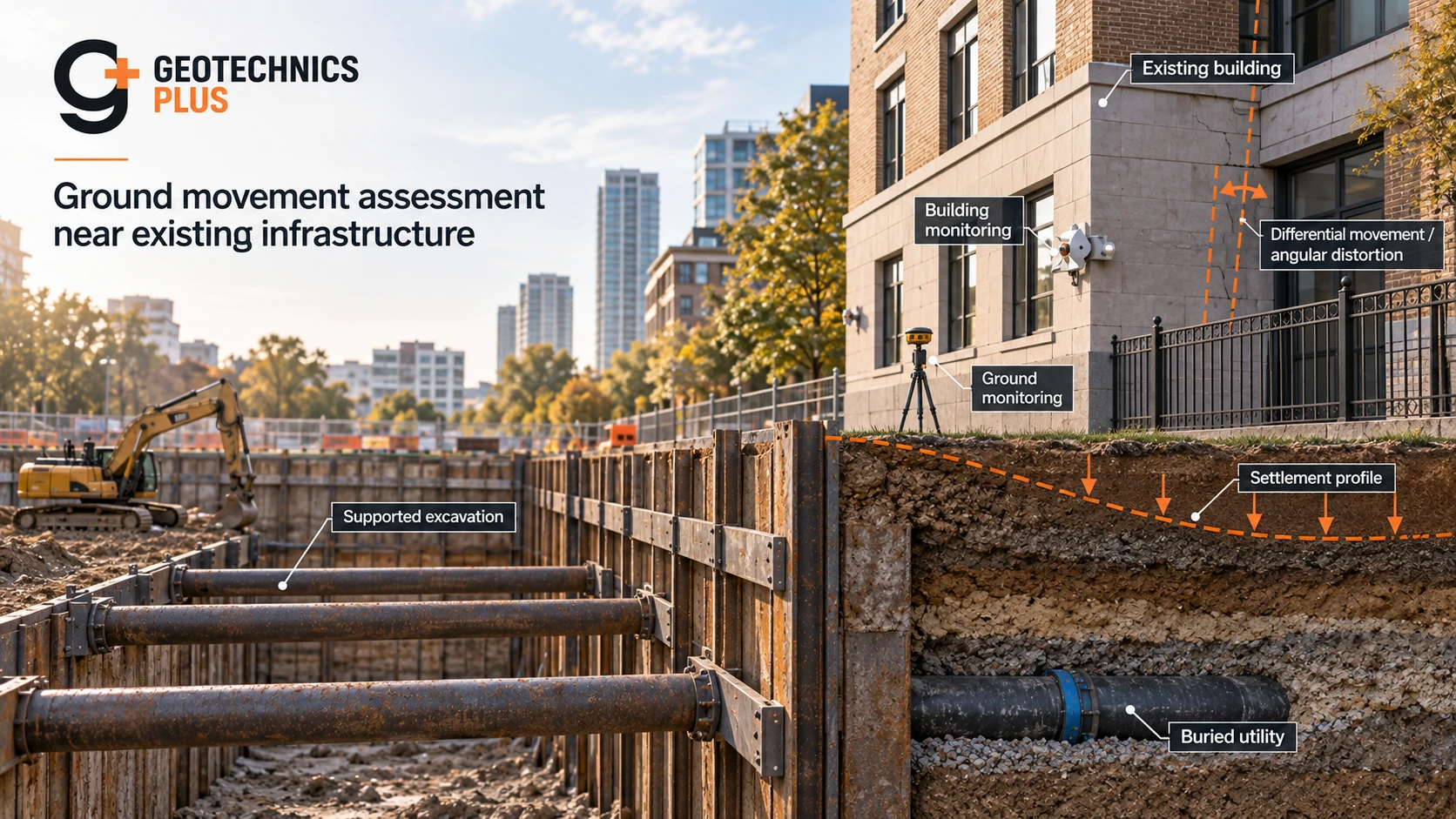
Ground movement is unavoidable on many infrastructure projects. Excavations unload the ground. Tunnelling causes volume loss. Dewatering can induce consolidation. New foundations redistribute stress. Temporary works deflect. Ground improvement and staged construction change the stiffness and drainage response of the soil mass.
The engineering challenge is therefore rarely to achieve zero movement. The real challenge is to determine how much movement can be tolerated by the specific assets that may be affected, how confidently that movement can be predicted, and what should happen if measured response begins to depart from expectations.
An allowable movement is not a soil parameter. It is a project-specific performance limit derived from the asset being protected, its condition, structural system, service function, sensitivity, consequence of damage and the uncertainty in the predicted ground response.
This distinction matters. A settlement value that is insignificant for one structure may be unacceptable for an adjacent utility, track system, brittle façade, sensitive equipment foundation or aging masonry building.
Start with the asset, not with a generic settlement number
Project teams sometimes begin by asking for a single allowable settlement—10 mm, 20 mm, 25 mm or another familiar value. That can be useful as an initial screening number, but it should not become the engineering basis without understanding what the protected asset can actually tolerate.
The same vertical movement can produce very different consequences depending on how it occurs. Uniform settlement of a flexible structure may be largely benign. A smaller amount of differential settlement over a short distance may generate damaging distortion. A buried pipe may tolerate gradual settlement but be vulnerable to joint rotation. A track slab may remain structurally sound while exceeding operational geometry tolerances. A façade may crack at strains that are insignificant to the main frame.
The practical starting point is therefore:
- What asset is being protected?
- What failure or serviceability mechanism matters?
- What movement measure best represents that mechanism?
- What consequence follows if the limit is exceeded?
Settlement alone is rarely enough
Absolute vertical settlement is only one descriptor of movement. Depending on the asset, more meaningful parameters may include:
- differential settlement between supports or points along the asset;
- angular distortion or rotation;
- horizontal strain across a structure or utility;
- lateral displacement toward an excavation or tunnel;
- curvature over a building footprint;
- joint movement in segmented pipelines or buried services;
- tilt of a tower, pier, equipment foundation or retaining element; and
- rate of movement, which can be as important as cumulative magnitude.
For buildings, construction-induced movement assessment often focuses on the combination of deflection, horizontal strain and structural response rather than on a single settlement value. CIRIA C796, for example, provides a framework for evaluating construction-induced ground movement effects on framed buildings and emphasizes assessment of the building response rather than reliance on a universal settlement threshold.
Greenfield movement is not the same as asset response
Predicted ground movement is often first calculated as if no structure were present. This greenfield movement profile is valuable because it describes the ground response to tunnelling, excavation, dewatering or other construction activity.
But an existing structure interacts with that movement field.
A stiff building may bridge across part of a settlement trough and redistribute load. A flexible utility may follow the ground more closely. Piled foundations may transfer loads to deeper strata while still experiencing lateral ground movement or drag effects. A basement or retaining wall may alter local stiffness and change the deformation pattern.
That is where soil–structure interaction becomes important. The question is not only how much the ground moves, but how the asset modifies and responds to that movement.
Asset condition can control the allowable movement
Two nominally similar buildings may have very different tolerances if one is new and robust while the other has pre-existing cracking, past settlement, altered load paths, weak connections or brittle finishes.
Likewise, an older utility may have undocumented repairs, corroded joints or limited redundancy. A bridge bearing may have restricted movement capacity. A tunnel lining may already carry locked-in distortion. Sensitive industrial or rail systems may have operational tolerances well below the structural damage threshold.
For this reason, pre-construction condition surveys, records review and asset-owner criteria are not administrative exercises. They form part of the geotechnical performance definition.
A practical hierarchy for establishing movement criteria
A defensible movement criterion should be developed from several layers of evidence rather than selected from one table.
1. Asset-specific requirements
Start with owner standards, operating tolerances, equipment requirements, structural design criteria and any contractual protection requirements. These may govern before conventional geotechnical damage criteria become relevant.
2. Structural and serviceability assessment
Identify what type of movement would affect the asset and estimate the corresponding structural or functional response. For buildings, this may involve distortion, strain, cracking or load redistribution. For utilities, it may involve joint rotation, bending strain, leakage risk or loss of grade.
3. Existing condition and vulnerability
Account for pre-existing distress, prior movement, age, material brittleness, undocumented alterations and limited redundancy.
4. Predicted movement and uncertainty
Compare the asset tolerance with the predicted construction-induced movement, including a realistic range rather than a single deterministic value. The closer the prediction is to the tolerance, the more important uncertainty becomes.
5. Monitoring and intervention capability
A project may tolerate a narrower margin when reliable monitoring, rapid interpretation and practical mitigation measures are available. Where intervention is difficult or the consequence is high, larger margins may be justified.
Trigger levels are not the same as failure limits
Monitoring plans often use green, amber and red trigger levels. These should not be interpreted as three versions of an allowable settlement value.
A useful trigger framework normally separates:
- expected response — movement within the anticipated range;
- early warning — movement or rate indicating that performance is trending away from expectation;
- action level — a threshold requiring engineering review, construction adjustment or mitigation; and
- asset protection limit — the level associated with unacceptable serviceability, damage or safety consequence.
The action level should generally occur before the asset reaches its unacceptable condition. Otherwise, the monitoring system only documents a problem after the opportunity to manage it has passed.
This approach is consistent with the observational method: predicted behaviour, defined monitoring, pre-agreed response measures and active comparison between observed and expected performance.
Rate of movement can be more important than the total
A project may record 8 mm of settlement over several months with no meaningful concern, while 4 mm occurring over a few hours could indicate a developing problem.
Movement interpretation should therefore consider:
- cumulative displacement;
- incremental displacement between readings;
- rate and acceleration;
- correlation with construction activities;
- spatial consistency across neighbouring instruments; and
- whether the observed mechanism matches the design model.
Instrumentation should answer a decision question. ISO 18674-1 sets out general rules for performance monitoring of the ground and structures interacting with the ground, including monitoring before, during and after construction. ISO 18674-2 addresses displacement measurements using extensometers and their use in checking design assumptions and evaluating stability.
Baseline movement matters
Existing infrastructure often moves before the new project begins. Seasonal temperature changes, groundwater fluctuations, traffic loading, adjacent construction and long-term consolidation can all produce measurable displacement.
Without an adequate baseline, normal background movement can be incorrectly attributed to construction—or genuine construction effects can be obscured by existing trends.
A useful baseline should establish:
- instrument stability and repeatability;
- normal variation with temperature, groundwater and operations;
- pre-existing movement trends; and
- enough history to distinguish a construction-related change in behaviour.
Example: deep excavation beside a building and buried utility
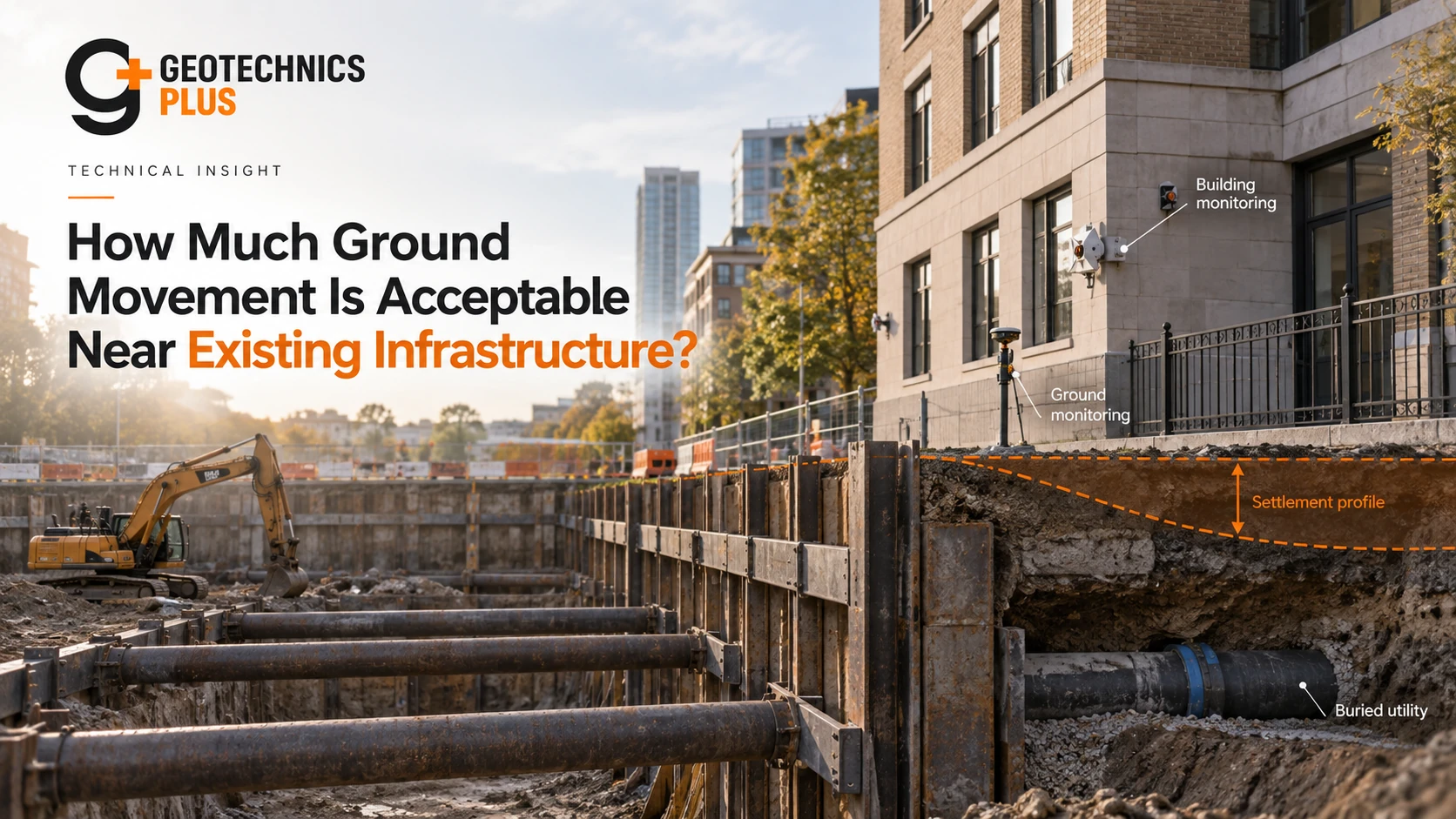
Consider a supported excavation beside an existing reinforced-concrete building and a buried utility running within the same influence zone.
The geotechnical model predicts a modest settlement trough and lateral wall movement. If the building is relatively stiff, part of the free-field settlement may be bridged by the foundation system. The building assessment may therefore focus on differential movement, rotation and frame distortion.
The buried utility may behave differently. It may follow the ground more closely, making local curvature or joint rotation the controlling mechanism. The same ground movement profile can therefore produce two different allowable criteria:
- one based on building distortion and structural response; and
- another based on utility strain, joint movement or serviceability.
A single project-wide settlement limit would miss that distinction.
When should more advanced analysis be used?
Simplified empirical methods are often sufficient when predicted movement is small relative to asset tolerance and the mechanism is well understood.
More advanced analysis becomes valuable when:
- the predicted movement approaches the acceptance threshold;
- the asset is particularly sensitive or high consequence;
- soil–structure interaction materially changes the expected response;
- construction sequence, dewatering or staged support governs deformation;
- multiple adjacent assets respond differently to the same movement field; or
- field performance begins to diverge from the original prediction.
In those cases, a calibrated numerical model can help distinguish between the ground movement mechanism and the actual asset response. The objective should still be to improve the engineering decision—not to create complexity for its own sake. See also When Does a Geotechnical Problem Need Advanced Numerical Modelling?
Monitoring should connect directly to construction decisions
A good instrumentation and monitoring plan should define more than instrument type and reading frequency.
It should identify:
- the mechanism being monitored;
- the expected response range;
- the asset-specific criteria;
- trigger levels and escalation rules;
- who reviews the data and how quickly;
- what construction activities are restricted at each trigger; and
- what mitigation measures are available.
Monitoring without a response plan is measurement, not risk management.
What should the project team be able to answer?
Before major excavation, tunnelling, dewatering or other ground-disturbing work begins near existing infrastructure, the project team should be able to answer:
- Which assets are within the credible zone of influence?
- What movement mechanism could affect each asset?
- What measure—settlement, rotation, strain, tilt, lateral displacement or another parameter—best represents that risk?
- What is the asset's current condition?
- What movement is predicted, and what is the uncertainty?
- How does soil–structure interaction change the response?
- What monitoring is required to verify performance?
- What are the early-warning, action and protection thresholds?
- Who has authority to change or stop the work if performance departs from expectation?
- What mitigation can realistically be implemented before unacceptable movement occurs?
Key takeaway: Acceptable ground movement should be defined by the performance of the infrastructure being protected—not by a generic settlement number. The strongest approach links asset vulnerability, predicted ground response, uncertainty, monitoring and construction actions into one performance framework.
Resolve movement criteria before construction makes the decision for you
Ground movement criteria are most valuable when they are developed early enough to influence excavation support, tunnelling method, dewatering strategy, foundation design, instrumentation and contingency planning.
Once construction is underway, unclear acceptance criteria can create unnecessary stoppages, delayed decisions, disputes over responsibility and reactive mitigation.
Geotechnics Plus supports infrastructure teams with specialist geotechnical review, movement and settlement assessment, soil–structure interaction, advanced numerical modelling, monitoring interpretation and construction-stage decision support for ground-sensitive projects.
Selected references
- CIRIA C796 — Assessing the impacts of construction-induced ground movement on framed buildings.
- ISO 18674-1:2015 — Geotechnical monitoring by field instrumentation — General rules.
- ISO 18674-2:2016 — Measurement of displacements along a line: Extensometers.
- AFTES GT16R1 — Settlements induced by tunnelling.