
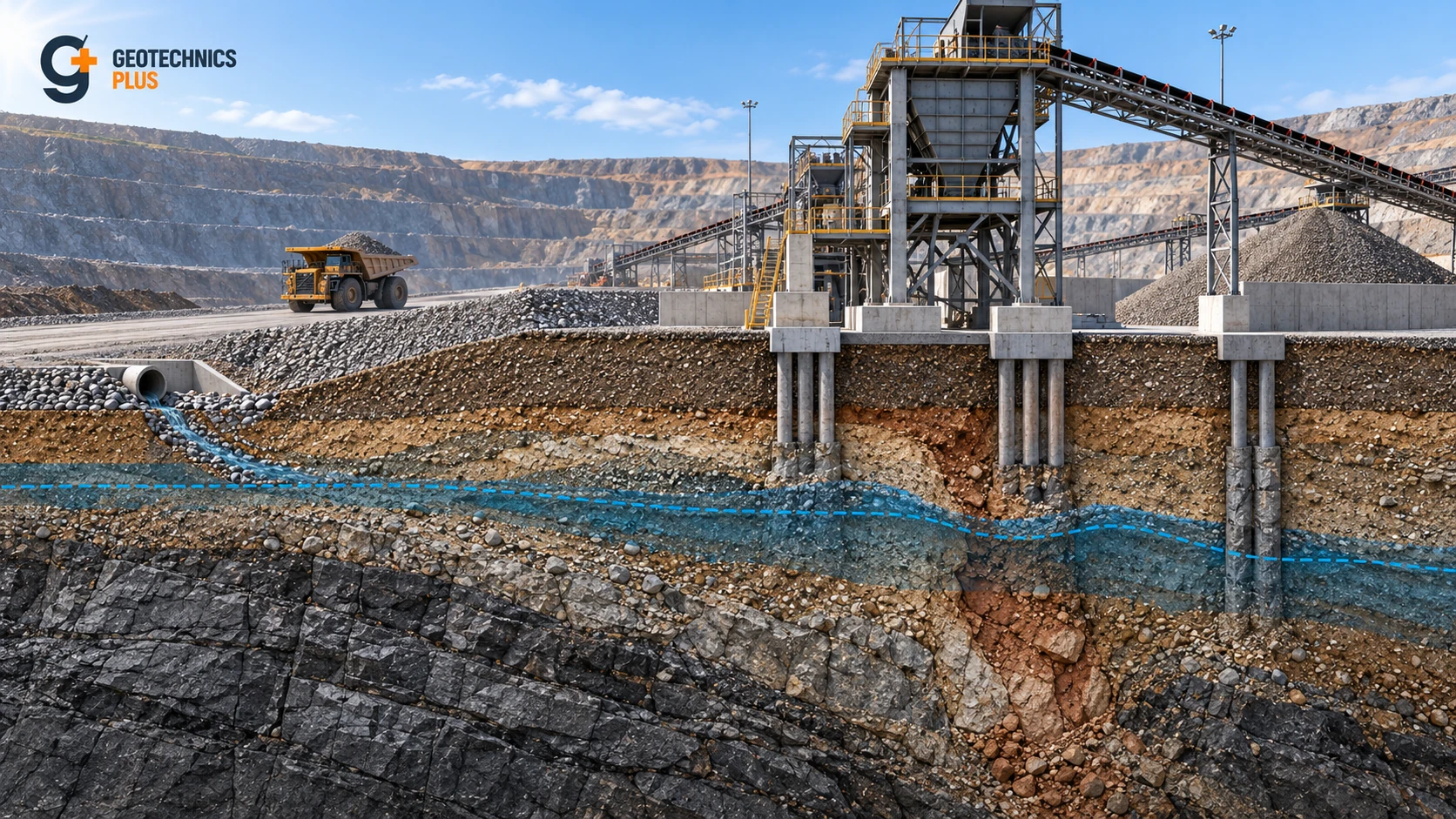
Mine development compresses a large number of geotechnical decisions into a relatively short design and construction window. Open pits or underground workings, process plants, crushers, conveyors, stockpiles, haul roads, heavy foundations, retaining structures, water-management systems, waste rock facilities and tailings infrastructure may all be advancing at the same time.
The challenge is not simply that the ground is variable. It is that different facilities are sensitive to different parts of that variability.
A weathered rock profile that is acceptable beneath a haul road may be critical beneath a crusher foundation. A groundwater condition that is manageable during routine excavation may become controlling for a deep plant basement. A compressible layer that has little effect on bearing capacity may still govern differential settlement across a conveyor transfer structure.
It is: "Do we understand the ground well enough to make the decisions that could materially affect safety, performance, cost and schedule?"
A mine is not one geotechnical problem
One of the most common weaknesses in mine development is treating the site as though a single ground model can answer every design question. In practice, the relevant geotechnical model depends on the asset and the mechanism being assessed.
For example, slope design may be controlled by structural geology and groundwater. A process-plant foundation may be controlled by stiffness and differential settlement. A stockpile pad may be governed by consolidation and staged loading. A retaining system may be controlled by temporary construction sequence. Tailings and waste rock facilities introduce their own lifecycle, seepage, stability and governance requirements.
The objective before construction is therefore to connect ground uncertainty to facility-specific consequence.
Eight issues that should be resolved before construction
1. Is the ground model adequate for each critical facility?
Investigation quantity alone is a poor measure of readiness. The important question is whether the investigation resolves the uncertainties that matter to the proposed facility.
A process plant, crusher or mill foundation may require a much better definition of near-surface weathering, stiffness contrasts and rockhead variability than a broad site-wide investigation provides. Conversely, a large embankment or stockpile may be more sensitive to the continuity of compressible strata and groundwater than to small-scale rock variability.
Before construction, the team should be able to identify the critical geotechnical domains, the uncertainty remaining in each domain, and the design consequence if the interpretation is wrong.
2. Where does deformation govern instead of ultimate capacity?
Mining infrastructure is often heavy, highly connected and sensitive to alignment. Crushers, mills, conveyors, transfer towers, tanks, pipe racks and equipment foundations can tolerate substantial load yet remain sensitive to differential movement.
That means a foundation can satisfy conventional bearing-capacity checks while still creating a performance problem through settlement, rotation or distortion.
Where multiple foundations support a continuous structural or mechanical system, the stiffness of the ground-foundation system may also redistribute reactions. This is where soil–structure interaction becomes relevant. Our related Insight, When Does Soil–Structure Interaction Matter in Geotechnical Design?, discusses that decision in more detail.
3. Is groundwater understood as a design input—not merely a construction nuisance?
Groundwater can affect effective stress, slope stability, excavation support loads, basal stability, uplift, erosion, seepage, foundation construction, access and long-term performance.
Mine sites also evolve. Dewatering, pit development, water storage, seasonal recharge and new drainage paths can change the groundwater regime after the original investigation.
A defensible pre-construction design therefore needs more than a single measured water level. It needs an interpretation of likely groundwater conditions, credible variation, construction-stage effects and the consequences if inflow or pore pressure differs from expectation.
4. Are earthworks and engineered fills treated as geotechnical assets?
Mine development can involve very large volumes of cut, fill and processed material. Yet earthworks specifications sometimes remain generic even when later facilities depend directly on the fill performance.
Important issues include source variability, particle size, moisture conditioning, compaction method, lift thickness, oversize content, proof-rolling response, drainage and verification testing. For large fills, the team may also need to consider self-weight settlement, collapse on wetting, creep or construction-induced variability.
If a heavy facility is planned over engineered fill, the earthworks acceptance criteria should be tied to the performance required by that facility—not just to a standard compaction percentage.
5. Have mine excavation and infrastructure interfaces been checked?
Some of the highest-risk conditions occur at interfaces: a conveyor near a pit crest, infrastructure over historical workings, a plant excavation beside a haul road, a pipeline crossing variable fill, or a foundation affected by future mine expansion.
These interfaces can be missed when different design packages are developed by separate teams. The ground may satisfy each package in isolation but create a problem when excavation sequence, blast effects, groundwater drawdown, slope deformation or future mine geometry are considered together.
6. Are cyclic, dynamic and seismic demands being treated appropriately?
Mining facilities can impose substantial cyclic or dynamic demand from rotating equipment, crushers, screens, conveyors and repeated heavy traffic. Depending on the site, seismic loading may also affect slopes, foundations, retaining structures, saturated fills and mine-waste facilities.
Not every project needs advanced dynamic numerical analysis. But where stiffness degradation, cyclic pore-pressure generation, vibration sensitivity, liquefaction, large soil–structure interaction effects or complex geometry may change the design decision, simplified static checks may no longer be sufficient.
The appropriate level of analysis should be driven by the decision and consequence. See also When Does a Geotechnical Problem Need Advanced Numerical Modelling?.
7. Is construction sequence part of the geotechnical design?
The completed facility is not always the critical condition. Temporary excavations, partial fills, staged foundation loading, dewatering, blasting, temporary access and incomplete drainage can create short-term conditions that govern stability or movement.
This is especially important where construction is advancing quickly and several contractors or design packages interact. The design should identify the stages that materially change ground response and define the controls needed before the next stage proceeds.
8. Are tailings and mine-waste facilities being treated with the required lifecycle discipline?
Tailings, waste rock and associated water-management facilities require dedicated governance and should not be reduced to ordinary earthworks. Industry guidance emphasizes lifecycle management, risk-informed design, site-specific operating controls, monitoring and clear accountability.
For projects involving tailings facilities, the applicable owner requirements, regulatory framework and recognized guidance should be established early. The Mining Association of Canada Tailings Guide and the Global Industry Standard on Tailings Management are examples of frameworks that emphasize design, construction, operation, surveillance and change management across the facility lifecycle.
A practical example: a crusher and conveyor founded across variable ground
Consider a crusher structure and transfer conveyor spanning an area where shallow competent rock transitions into deeper weathered material and engineered fill.
A conventional approach might size foundations independently using allowable bearing pressures. But the more important project risk may be differential movement between the crusher, transfer tower and conveyor supports.
Before construction, the team should ask whether the rockhead profile is sufficiently defined, whether fill stiffness is consistent, whether dynamic loads matter, whether foundation flexibility will redistribute reactions, and whether a shallow-foundation solution can meet alignment tolerances.
If those questions remain unresolved, the right response may be targeted drilling or geophysics, better stiffness characterization, a settlement sensitivity study, foundation optimization, ground improvement, deep foundations—or a combination. The key is to resolve the decision-controlling uncertainty before concrete and steel lock the layout into place.
What should a senior technical review challenge?
A useful specialist review before mine construction should not simply repeat calculations. It should challenge the assumptions connecting the ground model to the project decision.
- Which geotechnical uncertainties can materially change the design?
- Are critical facilities supported by enough site-specific data?
- Are design parameters representative of the relevant strain and stress range?
- Is settlement or deformation more important than ultimate capacity?
- Have groundwater and construction-stage conditions been bounded?
- Are earthworks criteria linked to facility performance?
- Have interfaces between mine planning and infrastructure design been checked?
- Do dynamic, seismic or cyclic mechanisms require additional assessment?
- Are monitoring thresholds tied to defined actions?
- What information could still be obtained now at relatively low cost but become expensive to obtain after construction starts?
Resolve uncertainty while it is still inexpensive to act
Once excavation, foundations, structural steel and process equipment are underway, options narrow quickly. A geotechnical issue that might have been resolved through one targeted investigation program or a short design review can become a construction delay, redesign or operational constraint.
The highest-value geotechnical input during mine development is therefore often not another calculation. It is identifying the small number of ground-related uncertainties capable of changing the project outcome—and resolving them before construction commits the project to a difficult path.
Geotechnics Plus supports mine owners, contractors and project teams with specialist geotechnical review, advanced numerical modelling, foundation and earthworks assessment, construction-stage problem solving and design assurance for complex ground conditions.
Selected references
- International Finance Corporation — Environmental, Health, and Safety Guidelines for Mining.
- WorkSafe Western Australia — Ground Control for Western Australian Mining Operations: Code of Practice.
- Mining Association of Canada — A Guide to the Management of Tailings Facilities.
- Global Industry Standard on Tailings Management.