
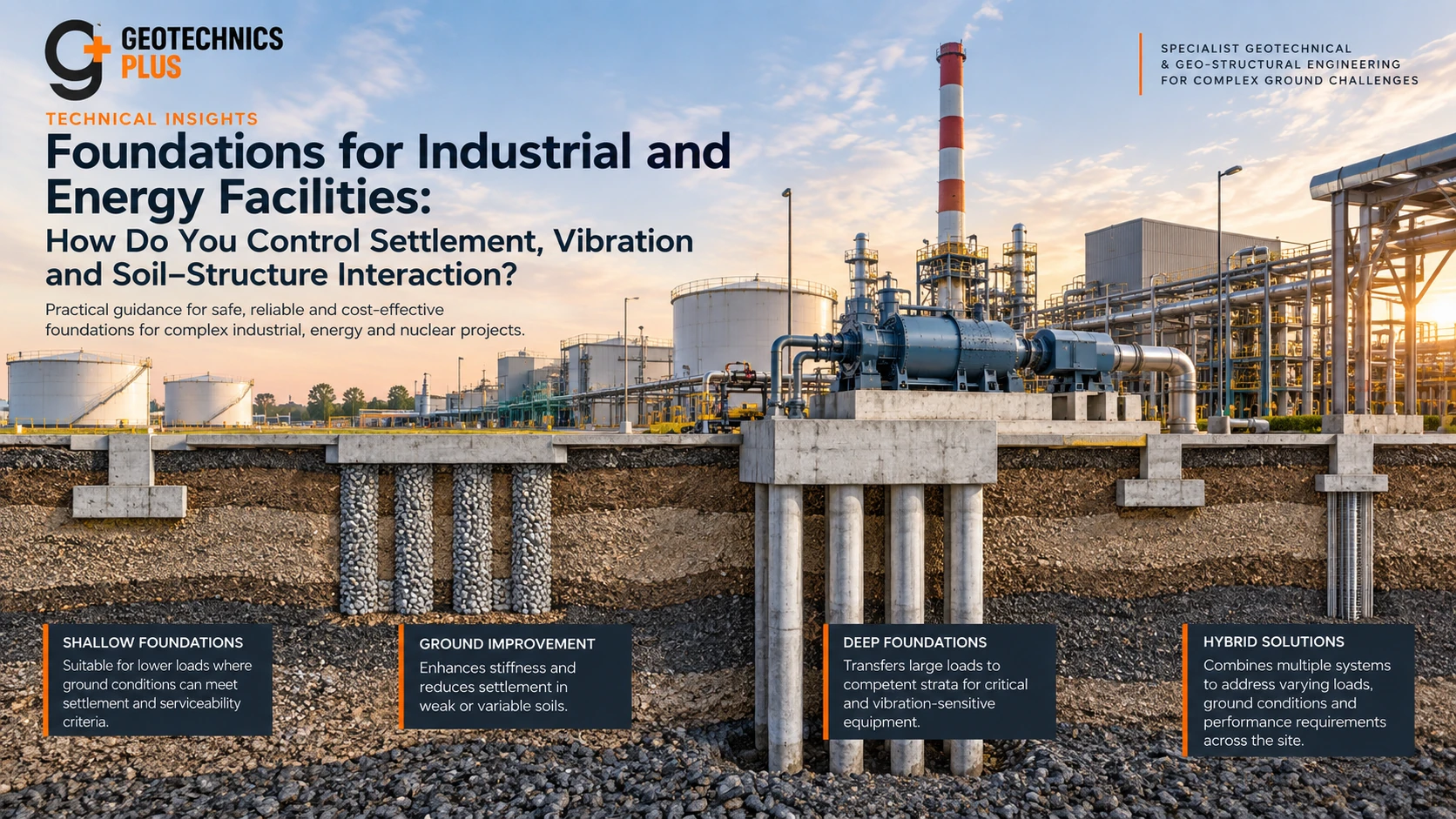
Industrial and energy facilities place unusually diverse demands on the ground.
A single site may include turbine-generators, compressors, pumps, transformers, tanks, pipe racks, process buildings, cooling systems, electrical infrastructure and large equipment foundations. Some components are governed primarily by static load. Others may be much more sensitive to vibration, differential movement or alignment.
The geotechnical challenge is therefore rarely “Can the soil carry the load?”
A more useful question is:
Can the ground–foundation–structure system maintain the required deformation, vibration and operational performance throughout construction and service?
That distinction changes how the site should be investigated, how foundation alternatives should be assessed and when more advanced soil–structure or dynamic analysis is justified.
1. Start with performance requirements, not foundation type
It is tempting to begin with a conventional choice between shallow foundations and piles. That decision is often premature.
Different systems within the same industrial facility may have very different tolerances. A warehouse-type structure may tolerate movement that would be unacceptable for rotating equipment. A pipe rack may be structurally capable of accommodating settlement but remain sensitive at connections. A turbine-generator foundation may have both deformation and vibration criteria.
The project team should therefore define, before selecting foundations, the required total settlement, differential movement and angular distortion, equipment alignment tolerance, vibration criteria, construction-stage movement limits, operational loading ranges and future expansion requirements.
Foundation selection then becomes a response to those requirements rather than a standalone geotechnical exercise.
2. The ground model should reflect the equipment layout
An industrial site can cover a large area while concentrating its most sensitive foundations within relatively small zones. A site-wide average soil profile may therefore be misleading.
The investigation should resolve the geological conditions beneath the systems for which uncertainty matters most. Important transitions can include fill to native soil, loose to dense granular material, soft to stiff cohesive deposits, weathered to competent rock, abrupt rockhead variation, former excavations or buried structures, variable groundwater and localized weak or compressible layers.
The objective is not simply to generate more boreholes. It is to understand whether differences in ground stiffness or compressibility can produce materially different foundation performance across connected structures and equipment.
3. Bearing capacity is rarely the complete design check
Large equipment foundations may have ample bearing resistance while still experiencing unacceptable settlement. That is particularly important where the loads are high but the equipment tolerances are small.
The assessment may need to distinguish immediate settlement, consolidation settlement, long-term creep, differential settlement, foundation rotation and relative movement between equipment, structures and connecting systems.
A foundation that performs adequately in isolation can still create an operational problem when connected to another structure behaving differently. The design question therefore needs to extend beyond absolute settlement to relative movement across the facility.
4. Dynamic equipment changes the problem
Rotating and reciprocating equipment introduces demands that cannot always be represented adequately by static equivalent loads.
For geotechnical design, relevant considerations can include operating frequencies, transient conditions, unbalanced forces, soil stiffness and damping, foundation mass and geometry, natural frequencies, frequency separation, vibration amplitudes and transmission of vibration to nearby equipment or structures.
Not every machine foundation requires an elaborate three-dimensional dynamic model. But treating a genuinely dynamic problem as a purely static one can miss the mechanism that controls performance.
5. Soil–structure interaction may control foundation behaviour
The foundation does not act independently of the structure above it or the soil beneath it. For large mat foundations, heavily loaded equipment blocks or structures with significant stiffness, load redistribution can depend strongly on the interaction between foundation and ground.
A rigid-base assumption may overpredict some forces and underpredict others. Likewise, assuming uniform soil springs without considering how stiffness changes with loading, depth or geometry can create a false sense of precision.
Explicit soil–structure interaction becomes more valuable where foundation stiffness materially affects load distribution, adjacent foundations interact, settlement compatibility is important, seismic response depends on foundation flexibility, uplift or partial contact is possible, staged construction influences stress history, or structural and geotechnical decisions are strongly coupled.
Related insight: When Does Soil–Structure Interaction Matter in Geotechnical Design?
6. Ground improvement can be part of the foundation system
Where weak or variable soils are relatively shallow, ground improvement may allow the project to retain a shallow-foundation strategy.
Potential techniques can include densification, rigid inclusions, stone columns, soil mixing, grouting, replacement, preload or surcharge, and combinations of methods.
The important question is not simply whether a technique can increase bearing capacity. The treatment needs to deliver the required stiffness and deformation performance.
Design should therefore define measurable performance criteria such as target settlement reduction, post-treatment stiffness, allowable variability, treatment depth, verification testing and transition requirements at the edge of treated zones.
7. Deep foundations may solve one problem and create another
Piles or drilled foundations may be justified where compressible deposits extend to depth, concentrated loads are high or sensitive equipment requires particularly predictable movement behaviour.
But deep foundations should not automatically be assumed to eliminate geotechnical risk. Important issues can include group settlement, downdrag, installation effects, variable founding strata, pile-cap stiffness, rock socket variability, lateral response, dynamic stiffness and construction tolerances.
There is also a broader system issue. A piled turbine building may experience very little settlement while surrounding slabs, pipe racks, utilities or auxiliary structures remain shallow-founded. The differential movement may therefore migrate to the interfaces.
8. Mixed foundation systems require deliberate transition design
Large industrial sites often use several support strategies at once. That can be technically and commercially appropriate.
One facility may include deep foundations for critical equipment, shallow foundations for support buildings, ground-improved foundations for process structures, slab-on-grade for operating floors and independent equipment blocks for vibration-sensitive machinery.
The transition between these systems should be treated as part of the design. Potential issues include differential settlement at structural joints, utility penetrations, pipe connections, cable trenches and equipment interfaces.
A useful design review asks: Where do two systems with materially different stiffness or settlement behaviour connect?
9. Groundwater can influence both construction and long-term performance
Groundwater can affect industrial foundation design through temporary dewatering, changes in effective stress, uplift, durability and long-term drainage effects.
For major facilities, construction dewatering should not be considered independently from permanent geotechnical behaviour. Lowering groundwater during construction can create settlement outside the excavation, while permanent drainage systems may continue changing subsurface conditions long after commissioning.
10. Seismic design should consider ground deformation as well as structural forces
For industrial and energy facilities in seismic regions, the geotechnical assessment may need to address site response, liquefaction, cyclic softening, seismic settlement, lateral spreading, slope instability, foundation flexibility and dynamic soil–structure interaction.
The level of analysis should be proportionate to the consequence and sensitivity of the facility.
11. Nuclear facilities require a higher level of traceability
Nuclear projects deserve a distinction from conventional industrial development. The underlying soil mechanics are not fundamentally different, but expectations around characterization, uncertainty, traceability, verification and lifecycle performance are considerably higher.
For high-consequence facilities, a technically plausible model is not enough. The project needs a defensible chain from site investigation → parameters → analysis → design assumptions → construction verification → performance monitoring.
12. Construction verification protects the design assumptions
Many foundation problems develop not because the original engineering concept was unreasonable, but because the conditions achieved during construction differ from those assumed in design.
Potential examples include softened founding surfaces, inadequate fill compaction, variable ground-improvement performance, unexpected groundwater, over-excavation, disturbance of sensitive soil, changes to equipment locations or loads, and utility trenches crossing critical foundation zones.
The key question is:
Does the ground and foundation system constructed in the field still represent the system that was analysed?
13. Monitoring should be linked to decisions
Monitoring can be valuable for major industrial and energy projects, but only when it answers a defined engineering question.
Potential measurements include foundation settlement, differential movement, vibration, groundwater levels, ground-improvement performance, structural level surveys and construction-induced movement.
Before instrumentation is installed, the project should establish what is being measured, why it matters, what range is expected, what threshold triggers review, who evaluates the data and what happens if the threshold is exceeded.
A practical foundation-selection framework
| Project condition | Governing question | Potential response |
|---|---|---|
| Uniform competent ground, moderate loads | Can settlement tolerances be satisfied? | Shallow foundations |
| Weak or variable shallow deposits | Can treatment create sufficiently uniform performance? | Ground improvement + shallow foundations |
| Deep compressible strata / high concentrated loads | Is deeper support more predictable and economical? | Deep foundations |
| Dynamic machinery | Could soil-foundation response amplify vibration? | Dynamic foundation assessment |
| Large mats or interacting structures | Does foundation flexibility alter structural response? | Soil–structure interaction analysis |
| Mixed support systems | Where can relative movement develop? | Transition/interface design |
| High seismic consequence | Could ground deformation control facility performance? | Site response, liquefaction and seismic SSI assessment |
| Nuclear / high-consequence facility | Is the characterization and analysis defensible through the lifecycle? | Graded, traceable site and foundation evaluation |
When is advanced numerical modelling justified?
Advanced modelling becomes valuable when simplified methods cannot adequately represent the mechanism controlling the decision. Examples may include interacting foundations, complex construction staging, nonlinear soil response, dynamic soil–foundation interaction, large mats, combined static and seismic loading, groundwater coupling or significant three-dimensional effects.
The objective should not be to produce a more sophisticated model. It should be to resolve an uncertainty that matters to design or operation.
Related insight: When Does a Geotechnical Problem Need Advanced Numerical Modelling?
The engineering decision
There is no universally preferred foundation system for industrial and energy facilities.
A technically successful solution may involve shallow foundations, ground improvement, deep foundations or a combination.
The better solution is the one that controls the behaviour that actually matters: settlement, relative movement, vibration, seismic response and long-term operational compatibility.
For complex facilities, the ground, foundations, structures, equipment and construction sequence should therefore be treated as one interacting performance system, rather than a collection of independent design packages.
References
- ACI 351.3R-18 — Foundations for Dynamic Equipment.
- IAEA SSG-93 — Geotechnical Aspects in the Siting and Design of Nuclear Installations.
- IAEA SSR-1 — Site Evaluation for Nuclear Installations.
- CNSC REGDOC-1.1.1 — Site Evaluation and Site Preparation for New Reactor Facilities.
- Canadian Foundation Engineering Manual.