
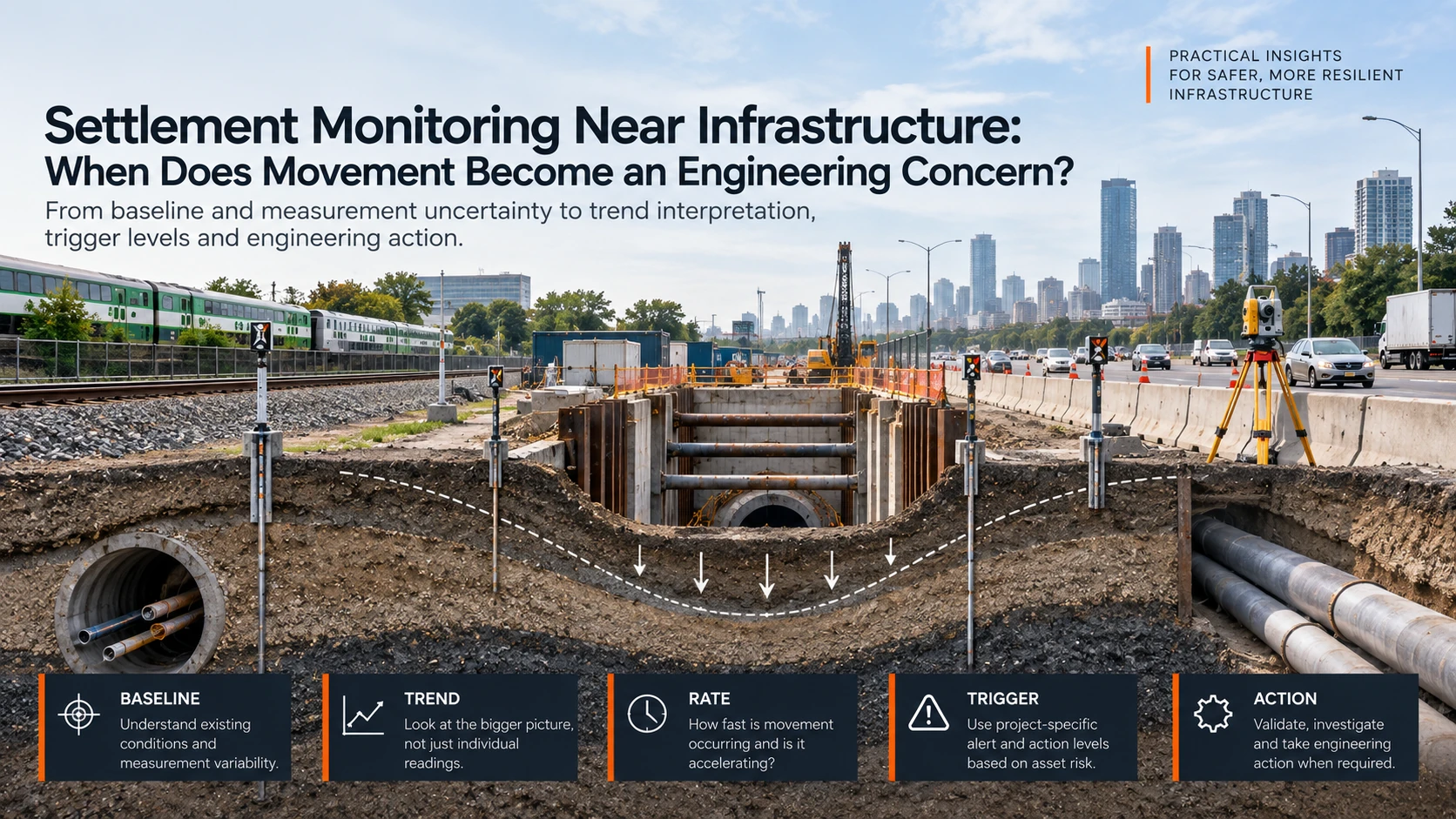
Settlement monitoring is often presented as a simple process:
install points → take readings → compare the numbers with a limit.
That sequence is incomplete.
A movement reading has little engineering meaning unless it is interpreted in the context of the asset being protected, the expected ground response, measurement uncertainty, the rate and pattern of movement, and the consequences if performance deteriorates.
The more useful question is therefore not:
How many millimetres of settlement have been measured?
It is:
Is the observed movement credible, is it consistent with the expected mechanism, and does it require an engineering response?
This distinction is particularly important near railways, roads, bridges, utilities, buildings, retaining structures, deep excavations and tunnelling works, where a monitoring system may be part of the project’s risk-control strategy rather than simply a record of construction performance.
1. Monitoring data are not the engineering decision
Instrumentation produces measurements. Engineering judgement converts those measurements into decisions.
A single settlement value does not, by itself, establish whether an asset is safe or whether construction should continue. The significance of the reading depends on questions such as:
- What asset is being protected?
- What type of movement can that asset tolerate?
- Was the point stable before construction?
- What is the repeatability and uncertainty of the measurement system?
- Is the movement total, differential, rotational or localized?
- How quickly is it developing?
- Do neighbouring points show a compatible trend?
- Is the movement consistent with the construction stage and predicted ground response?
- Has the asset itself shown any sign of distress?
ISO 18674-1 provides general rules for geotechnical monitoring of the ground, structures interacting with the ground, fills and geotechnical works. It explicitly includes monitoring before, during and after construction, data verification and use of monitoring in observational-design procedures.
The important principle is that monitoring should be designed around an engineering question.
2. Start with the asset and the failure or serviceability mechanism
Different infrastructure can respond very differently to the same magnitude of ground movement.
A buried gravity sewer may be sensitive to changes in grade. A rail track may be sensitive to differential vertical movement and twist. A bridge bearing or expansion joint may be sensitive to relative movement between supports. A brittle utility connection may tolerate less distortion than a flexible pipeline. A building may be governed by angular distortion rather than total settlement.
Before selecting monitoring points or trigger levels, the project team should identify:
- the assets at risk;
- the plausible ground-movement mechanisms;
- the response parameter that best represents asset performance;
- the predicted magnitude and spatial extent of movement;
- the consequence of exceeding acceptable performance; and
- the construction activities capable of producing that movement.
This creates a direct connection between the geotechnical model and the monitoring plan.
For a broader discussion of movement criteria, see How Much Ground Movement Is Acceptable Near Existing Infrastructure?
3. A useful baseline is more than the first reading
The baseline is the reference against which construction-related movement will be judged.
If that baseline is weak, every later interpretation becomes more difficult.
A robust baseline should establish:
- the initial geometry or elevation of the monitored point;
- the repeatability of the measurement method;
- whether the point was already moving before construction;
- natural or environmental variability where relevant;
- the stability of the reference benchmarks or control network; and
- the condition of the protected asset before the works begin.
There is no universal number of baseline readings that is correct for every project. The number and duration should be sufficient to distinguish normal measurement variability and pre-existing behaviour from movement associated with the works.
Where the consequences are significant, the baseline period should begin early enough to identify trends before the zone of construction influence reaches the asset.
4. The reference network must also be stable
A settlement point is only as reliable as the reference system used to measure it.
One of the most important quality checks is therefore whether benchmarks, prisms, survey stations or GNSS reference points are themselves located outside the expected influence zone and remain stable.
A common failure mode in monitoring programmes is apparent movement caused by movement of the reference, disturbance of a point, damage, a changed datum or a survey-control problem.
Good practice includes:
- independent checks on reference benchmarks;
- redundant control where project risk warrants it;
- documented survey procedures;
- consistent equipment and processing methods where practical;
- tracking changes in equipment, datum or methodology; and
- retaining raw measurements as well as processed displacement values.
The monitoring programme should make it possible to distinguish ground movement from measurement-system movement.
5. Total settlement is only one part of the interpretation
Infrastructure performance may be governed by several different movement measures.
Total movement
Total settlement is important where absolute levels or clearances matter.
Differential movement
Two nearby points may settle by similar amounts with limited impact, while a much smaller difference over a short distance can create damaging distortion.
Rotation or angular distortion
Buildings, structures and equipment can be sensitive to relative movement between supports even where absolute settlement remains modest.
Rate of movement
The rate can be as important as the accumulated magnitude.
A gradual trend developing over months may reflect expected consolidation or stress redistribution. The same total movement developing over a few hours may indicate a different mechanism and justify a more urgent review.
Spatial pattern
Movement should be interpreted across the monitoring network. A coherent trough or deformation pattern that correlates with the works is fundamentally different from a single isolated point showing an anomalous jump.
FHWA guidance for tunnelling and instrumentation specifically recommends considering the rate of change as well as absolute magnitude when developing action-triggering levels.
6. Measurement uncertainty has to be smaller than the decision being made
A monitoring programme cannot reliably trigger action at a movement smaller than the system can consistently resolve.
This sounds obvious, but it is a frequent source of false alarms.
The FHWA Road Tunnel Manual highlights the risk of setting action levels too close to the probable surveying accuracy. If the difference between normal, review and action thresholds is comparable to survey noise, project teams can spend significant time responding to apparent exceedances that are not real ground movement.
The monitoring specification should therefore define:
- required measurement accuracy and precision;
- expected repeatability;
- instrument range and resolution;
- quality-control requirements;
- the method used to validate anomalous readings; and
- how uncertainty is considered when comparing readings with trigger levels.
Trigger values should be compatible with what the monitoring system can actually detect.
7. Trigger levels should be project-specific
Generic settlement limits can be attractive because they are simple.
But the same numerical threshold should not automatically be applied to a railway, utility, bridge, building and roadway.
Project-specific trigger levels should be informed by:
- the performance tolerance of the protected asset;
- predicted ground movement;
- structural or geotechnical analysis;
- baseline variability;
- instrument accuracy;
- movement rate;
- spatial trends;
- construction stage; and
- the consequences of an adverse response.
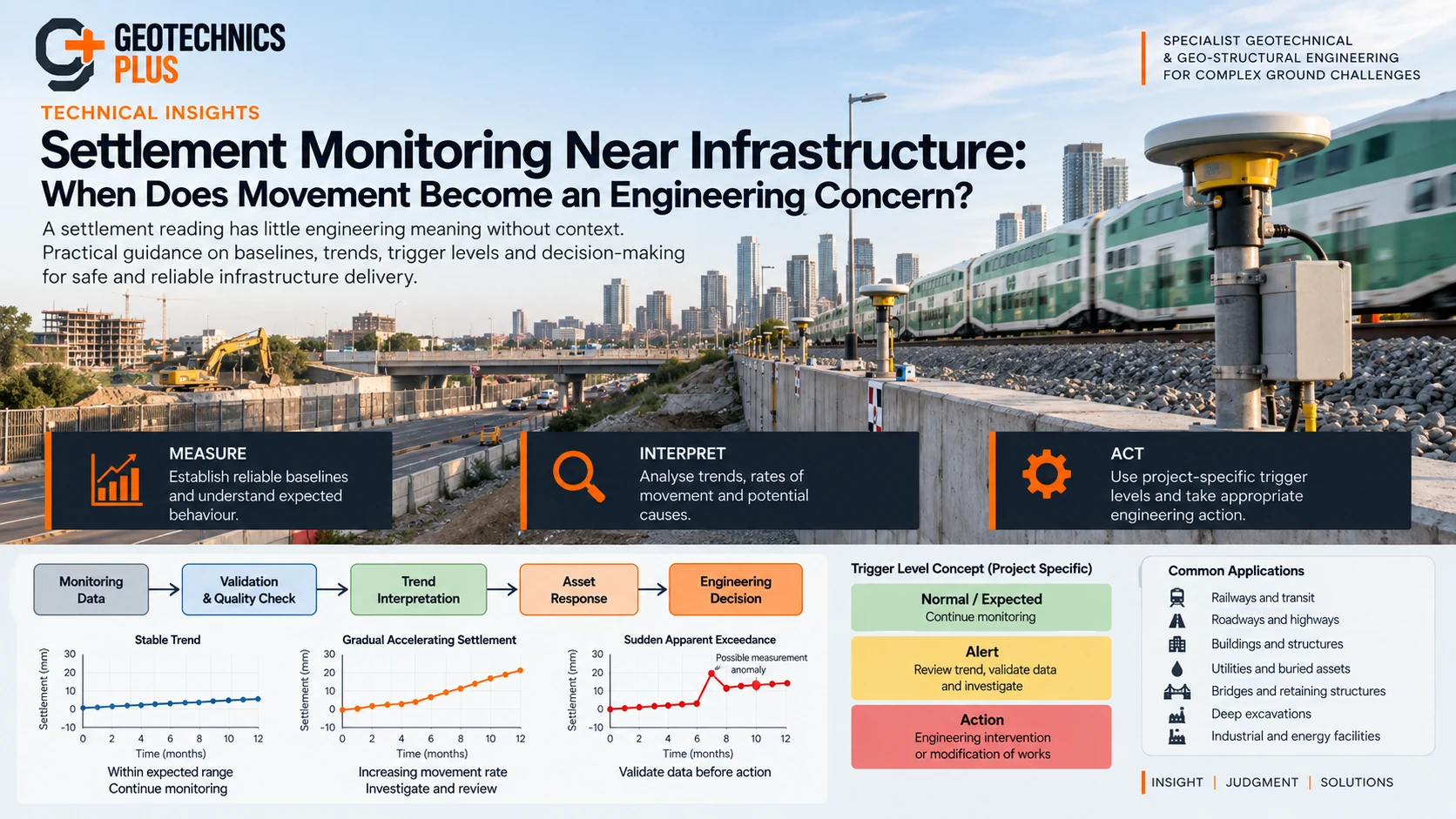
A practical framework often uses several response levels, for example:
Normal / Expected
Movement remains consistent with the anticipated response. Continue monitoring at the planned frequency.
Alert / Review
A predefined threshold or adverse trend is reached. Validate the data, review the trend and construction activities, inspect the asset where appropriate and consider increasing monitoring frequency.
Action
The predefined action criterion is reached or the engineering review identifies unacceptable behaviour. Implement the agreed response, which may include modifying or suspending specific works, stabilizing the ground or structure, or applying another contingency measure.
The names and number of levels can vary. What matters is that the response to each level is defined before the project reaches it.
8. A trigger-action-response plan is more valuable than a number alone
A threshold without a response plan transfers the real decision to the moment of exceedance, when time pressure is greatest.
A useful trigger-action-response plan should define:
- who receives the monitoring data;
- who validates an apparent exceedance;
- who has authority to change construction activities;
- the required response time;
- what additional checks or inspections are required;
- when monitoring frequency should increase;
- what contingency measures are available; and
- how work can resume after an action-level event.
CIRIA’s Observational Method guidance treats monitoring, review and predefined design modification as part of one managed process rather than as separate activities.
Not every monitoring programme is a formal Observational Method design, but the same discipline is valuable: define the decision logic before the data arrive.
9. What should happen when a threshold is exceeded?
An exceedance should be taken seriously, but the first step is normally to establish whether the reading is credible and what it means.
A structured review can include:
- Validate the reading. Repeat the measurement where appropriate and check survey closure, benchmarks, instrument health and data processing.
- Compare neighbouring instruments. Determine whether the movement forms a physically plausible spatial pattern.
- Review rate and history. Establish whether the movement is gradual, accelerating, sudden or isolated.
- Correlate with construction. Review excavation, tunnelling, dewatering, loading, vibration, ground treatment or other relevant activities.
- Inspect the protected asset. Look for physical evidence consistent with the measured movement.
- Compare with predictions. Assess whether the observed behaviour remains compatible with the geotechnical model and design assumptions.
- Apply the predefined response. Increase monitoring, modify the works, implement mitigation or suspend the relevant activity when required by the trigger-action-response plan.
For safety-critical conditions, the action plan may require immediate work restrictions before all diagnostic steps are complete. That decision should be established in the project-specific plan rather than improvised during an event.
10. An apparent exceedance is not always a geotechnical event
Before attributing a sudden change to ground movement, engineers should consider alternative explanations.
Potential causes of an anomalous reading include:
- disturbance or damage to the monitoring point;
- movement of the benchmark or survey station;
- temperature or environmental effects;
- instrument malfunction;
- a changed datum or coordinate system;
- data-processing or transcription errors;
- loss of line of sight;
- construction equipment obstructing or disturbing the point; and
- normal measurement scatter.
That does not mean anomalous data should be dismissed. It means the monitoring system should contain a defined process for verification before interpretation.
11. Monitoring frequency should change with risk
A fixed weekly or monthly frequency may be appropriate during stable periods but inadequate when the works approach a sensitive asset.
Monitoring frequency should reflect:
- distance between the active works and the asset;
- construction stage;
- predicted rate of response;
- previous monitoring trends;
- asset sensitivity;
- instrument type; and
- the time available to intervene before unacceptable performance develops.
ITAtech guidance for urban tunnelling similarly links monitoring frequency to construction progress, risk and the need to respond to evolving conditions.
The most useful monitoring plan is therefore adaptive rather than purely calendar-driven.
12. Instrument selection should follow the mechanism
Settlement survey points are only one part of a monitoring system.
Depending on the predicted mechanism, a project may use:
- precise levelling points or automated total-station prisms for surface or structural movement;
- GNSS monitoring where the required accuracy and site geometry are appropriate;
- inclinometers for lateral ground or wall movement;
- extensometers for deformation at depth;
- piezometers where groundwater or pore-pressure response influences movement;
- track-geometry monitoring;
- crack gauges or structural instrumentation; and
- condition surveys to relate measured movement to physical asset response.
The objective is not to install the largest number of instruments.
It is to create enough independent information to determine whether the predicted mechanism is occurring and whether intervention is required.
13. Monitoring is most powerful when compared with prediction
Monitoring becomes significantly more useful when measured behaviour is compared with an expected response.
The expected response may come from empirical settlement estimates, conventional analysis, staged numerical modelling or previous project experience.
Comparison between prediction and monitoring can answer questions such as:
- Is the magnitude within the expected range?
- Is movement occurring in the expected location?
- Is the rate faster than predicted?
- Is the influence zone wider than expected?
- Has movement continued after the relevant construction activity passed?
- Do the observations suggest that model assumptions should be revised?
Where behaviour differs materially from prediction, the appropriate response may be a model update, additional investigation, revised construction controls or a change to the design.
14. When can monitoring stop?
Monitoring should not automatically end when construction equipment leaves the area.
Some mechanisms, including consolidation, groundwater recovery and time-dependent structural response, may continue after the main construction activity has finished.
Closure criteria should be established based on:
- the expected mechanism and duration of movement;
- whether the observed trend has stabilized relative to measurement capability;
- completion of the construction activities influencing the asset;
- asset condition; and
- any long-term owner or regulatory requirements.
A statement that movement has “stopped” should always be understood in relation to the resolution, frequency and duration of the monitoring programme.
A practical monitoring-to-decision workflow
Define the asset and credible movement mechanism
↓
Establish predictions and performance criteria
↓
Design the monitoring network and stable reference system
↓
Collect and validate baseline data
↓
Monitor during the relevant construction stages
↓
Interpret magnitude + differential movement + rate + spatial trend
↓
Compare with prediction and project-specific trigger levels
↓
Validate apparent exceedances
↓
Apply the predefined engineering response
↓
Continue until project-specific stabilization / closure criteria are satisfied
The engineering decision
A settlement plot is not the final product of a monitoring programme.
The final product is a defensible engineering decision.
That requires a reliable baseline, stable control, measurements capable of resolving the required movement, project-specific triggers, interpretation of rate and spatial trends, and a predefined response when behaviour departs from expectations.
The most valuable monitoring programmes therefore connect:
measurement → validation → interpretation → asset performance → engineering action.
That framework is applicable across infrastructure, mining, marine, industrial, data-centre and building projects, even though the assets, movement mechanisms and trigger criteria differ.
References
- ISO 18674-1:2015 — Geotechnical investigation and testing — Geotechnical monitoring by field instrumentation — Part 1: General rules.
- FHWA-NHI-09-010 — Technical Manual for Design and Construction of Road Tunnels, Chapter 15: Instrumentation.
- FHWA Project Development and Design Manual, Chapter 6 — Geotechnical.
- CIRIA R185 — The Observational Method in Ground Engineering: Principles and Applications.
- ITAtech — Guidelines on Monitoring Frequencies in Urban Tunnelling.