
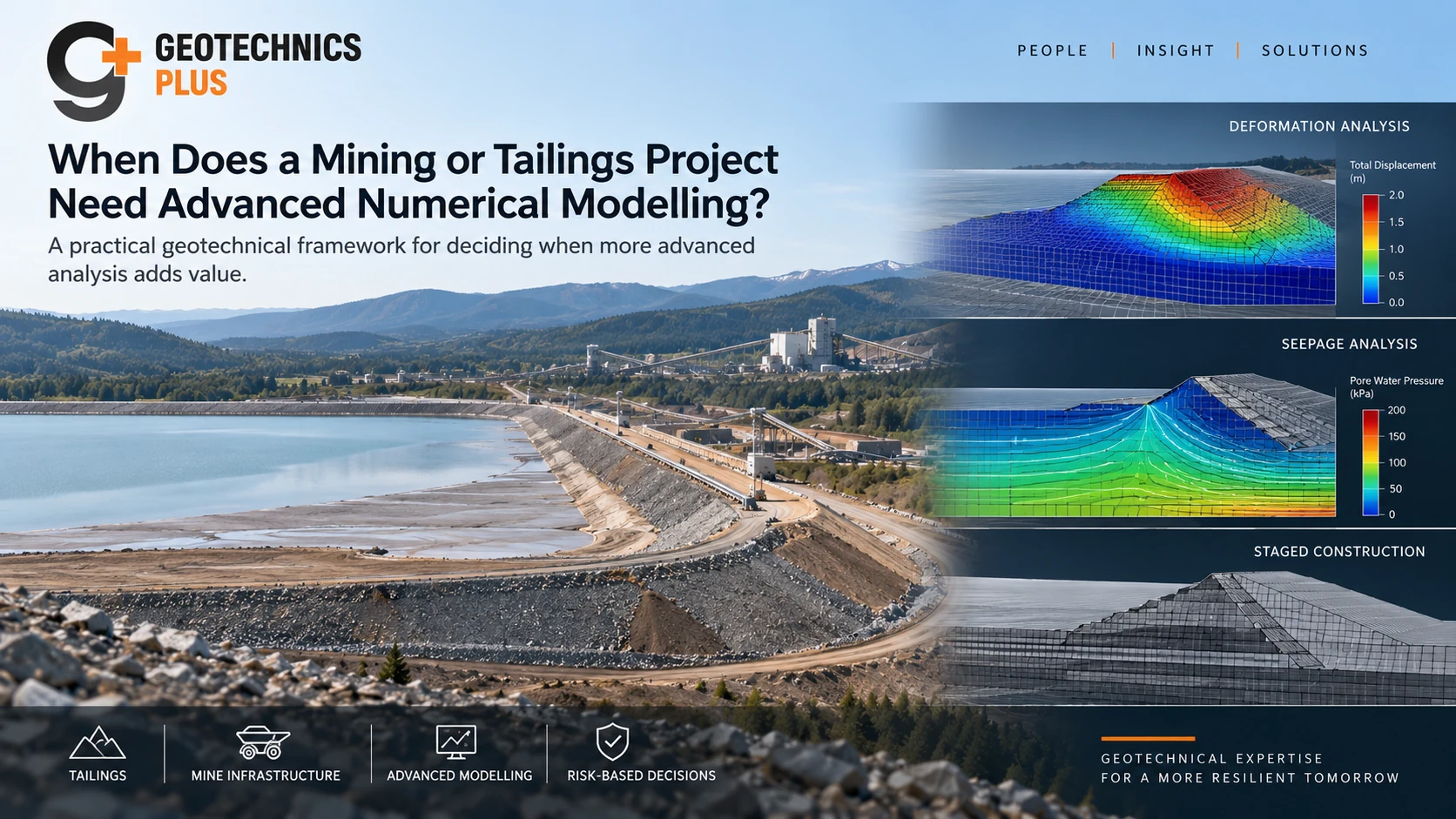
Mining and tailings projects can create a strong temptation to respond to uncertainty with a more complex model. That can be the wrong sequence.
If the main uncertainty is the location of a weak layer, the in-situ state of deposited tailings, the permeability of a foundation unit or the actual stiffness of an engineered fill, a larger finite-element model does not remove that uncertainty. It may only represent an uncertain interpretation in greater detail.
Advanced numerical modelling becomes valuable when the ground model is sufficiently credible and the engineering decision depends on behaviour that simpler methods cannot represent adequately.
The question is not: “Can this problem be modelled numerically?”
It is: “Would a more advanced model materially improve the decision, reduce a critical uncertainty, or change how the project is designed, constructed, monitored or operated?”
Model complexity should follow the decision—not the software
Mining and tailings projects involve mechanisms that can be difficult to represent using a single simplified calculation: staged embankment raises, evolving pore pressures, stress-history effects, nonlinear deformation, cyclic loading, soil–structure interaction, excavation sequence and changes in material behaviour with strain.
But complexity is only useful if it is tied to a defined decision. The first step is therefore to state what the model must help the project team decide.
Examples include whether a proposed tailings raise is likely to remain within deformation limits, whether a crusher foundation requires ground improvement or deep foundations, whether a staged excavation can proceed without unacceptable movement, whether seepage controls are sufficient, or whether seismic deformation could affect containment or critical infrastructure.
Seven situations where advanced modelling can add real value
1. Staged tailings raises and evolving stress history
A tailings storage facility does not experience its final loading condition instantaneously. It is built and operated through stages, and each stage changes the stress state, pore pressures, deformation and sometimes the material state of both tailings and foundation soils.
Where the sequence of loading matters, a single end-state stability check may not capture the governing condition. Numerical analysis can help represent construction history, consolidation, deformation accumulation and stress redistribution between raises.
This is especially useful when a future raise depends on the response of previously deposited tailings or soft foundation layers, or when observed performance needs to be reconciled with the design model before the next stage proceeds. See our related Insight, Tailings Storage Facilities: What Should Be Verified Before an Expansion or Raise?.
2. Coupled seepage and deformation
In many mine-waste and tailings problems, hydraulic and mechanical behaviour cannot be separated cleanly. Construction raises stresses, changes pore pressures and alters drainage gradients. Consolidation changes void ratio and permeability. Drainage conditions influence effective stress and therefore strength and deformation.
Where pore-pressure evolution controls performance, coupled seepage–deformation analysis may provide more useful information than applying a prescribed phreatic surface to a mechanical model.
The key is calibration. A sophisticated seepage model should be checked against piezometric response, drain flows, water levels and operating history wherever those data are available.
3. Strain softening, static liquefaction and progressive deformation
Some tailings and loose contractive materials may exhibit behaviour that cannot be represented adequately by a simple constant-strength model. Where static liquefaction, strain softening or progressive deformation is a credible mechanism, the analysis must distinguish between triggering, post-trigger behaviour and the consequences of strength loss.
Advanced constitutive models can be valuable, but they also demand a stronger parameter basis and experienced interpretation. Their output should not be treated as a direct prediction of reality simply because the contours are detailed.
The purpose is to explore credible mechanisms and sensitivity to material state—not to create false precision around uncertain parameters.
4. Seismic deformation and cyclic response
Seismic assessment of mine infrastructure and tailings facilities may require more than a pseudo-static stability calculation when performance depends on permanent deformation, cyclic pore-pressure generation, liquefaction, nonlinear stiffness degradation or interaction between soil and structure.
Dynamic analysis can provide insight into acceleration amplification, deformation patterns, cyclic demand and potential strain concentration. However, it requires defensible input motions, damping assumptions, constitutive behaviour and calibration of cyclic response.
Where the project decision depends on displacement rather than a single factor of safety, advanced analysis can be particularly valuable.
5. Heavy process infrastructure and soil–structure interaction
Crushers, mills, tanks, conveyor transfer towers and other heavy mine facilities can be sensitive to differential settlement, rotation, vibration and load redistribution.
Independent footing checks may be insufficient when the structure, foundations and ground form one interacting system. A coupled model can help determine whether foundation flexibility materially changes structural reactions or whether variable ground stiffness creates unacceptable distortion.
Our broader Insight, When Does Soil–Structure Interaction Matter in Geotechnical Design?, discusses how to decide when that coupling is worth modelling explicitly.
6. Complex excavations, retaining systems and mine–infrastructure interfaces
Mine projects often contain deep excavations, retaining structures, steep fills, foundations close to slopes, or infrastructure that interacts with current or future mine geometry.
Where construction sequence, excavation-induced unloading, support installation, groundwater drawdown or nearby loading materially affects response, staged numerical modelling can help identify the governing construction condition rather than only the final configuration.
Three-dimensional analysis becomes worthwhile only where out-of-plane geometry or load transfer is important enough to change the result. It should not be used merely because 3D software is available.
7. Ground improvement and foundation optimization
Advanced modelling can also support optimization rather than only risk assessment. For heavy infrastructure on soft, compressible or variable ground, numerical analysis can compare how shallow foundations, ground improvement, rigid inclusions, piles or hybrid solutions distribute load and control settlement.
The value is highest when different solutions have materially different cost, schedule or constructability implications and the model can reduce uncertainty in that decision.
When better data matters more than a better model
A technically advanced model cannot compensate for an unreliable ground model. If the controlling uncertainty is geological, hydrogeological or related to material state, targeted investigation may create more value than additional analytical sophistication.
Examples of high-value additional information may include targeted drilling across a suspected weak layer, CPT or in-situ testing to define material state, laboratory testing at the relevant stress path, permeability testing, geophysics to improve geometry, or instrumentation data that show how the facility is actually responding.
One of the most important senior technical decisions is therefore knowing when to stop refining the model and spend the next dollar on better evidence.
The constitutive model is not just a software setting
Choosing a constitutive model is an engineering decision. Different models represent stiffness, stress dependency, yielding, dilation, contractive behaviour, hardening, softening and cyclic response differently.
The model selected should be capable of representing the mechanism being assessed, but it should also be supported by the available data. A constitutive model with many parameters is not necessarily more reliable if several of those parameters are weakly constrained.
Good practice includes documenting why the selected model is appropriate, how parameters were derived, which parameters are most influential, and how uncertainty in those parameters affects the engineering conclusion.
Calibration and back-analysis can be more valuable than prediction alone
Mining and tailings projects often generate substantial performance data through settlement monitoring, inclinometers, piezometers, prisms, survey, vibration monitoring and operating records.
Where an existing facility or earlier construction stage has already been loaded, those data provide an opportunity to test the numerical model against observed behaviour.
A model that reproduces the right answer for the wrong reason is still unreliable, so calibration should consider multiple response quantities where practical—such as displacement pattern, pore-pressure response and load history—not only one matching data point.
What should an independent review challenge?
A specialist review of an advanced numerical model should go beyond checking whether the software converged. It should challenge the entire chain between the engineering question and the conclusion.
- Is the model answering a defined project decision?
- Is the geometry consistent with the current ground model and as-built information?
- Are construction stages represented where sequence affects response?
- Are boundary conditions far enough away and physically appropriate?
- Is mesh density adequate around important gradients and interfaces?
- Are groundwater and drainage assumptions consistent with observed conditions?
- Is the constitutive model appropriate for the mechanism being assessed?
- Are parameters supported by laboratory, field or back-analysis evidence?
- Have uncertainty and sensitivity been examined rather than hidden behind a single deterministic run?
- Has numerical performance been checked for mesh dependence, localization or non-physical behaviour?
- Where monitoring exists, does the model reproduce the observed pattern and trend?
- Does the final conclusion depend on model precision that the available data cannot support?
What recognized tailings frameworks imply for modelling practice
The Global Industry Standard on Tailings Management requires robust design based on an integrated knowledge base and calls for monitoring that verifies design assumptions and potential failure modes throughout the facility lifecycle. It also requires deviations from expected performance to be identified and addressed.
That has an important implication for numerical modelling: the model should not be treated as a one-time design product. Where material new information or monitoring data become available, the analytical basis should be revisited if those observations challenge the assumptions supporting the design.
The Mining Association of Canada Tailings Guide similarly emphasizes lifecycle management, site-specific systems, performance evaluation and continual improvement. For expansions and mine-life extensions, it recommends a rigorous approach to technology and facility decisions early in the planning process.
Key takeaway: advanced numerical modelling adds value when it represents a mechanism that matters to the decision, is supported by a credible ground and material model, and can be tested against evidence. Complexity without those three conditions creates detail—not necessarily confidence.
Use advanced modelling where it can change the project outcome
The best numerical model is not the largest or most visually impressive one. It is the model that helps the project team make a better decision with the available evidence.
For mining and tailings projects, that may mean evaluating staged loading, coupled seepage–deformation behaviour, seismic response, soil–structure interaction, settlement, progressive deformation or complex construction sequence. In other cases, the better engineering decision is to perform additional investigation, improve monitoring or use a simpler calculation with transparent sensitivity bounds.
Geotechnics Plus supports mining project teams with advanced numerical modelling, specialist geotechnical review, soil–structure interaction assessment, seepage and deformation analysis, design assurance and construction-stage technical support for complex ground and tailings-related decisions.
For the broader decision framework, see Geotechnical Risk in Mine Development: What Should Be Resolved Before Construction Starts?.