
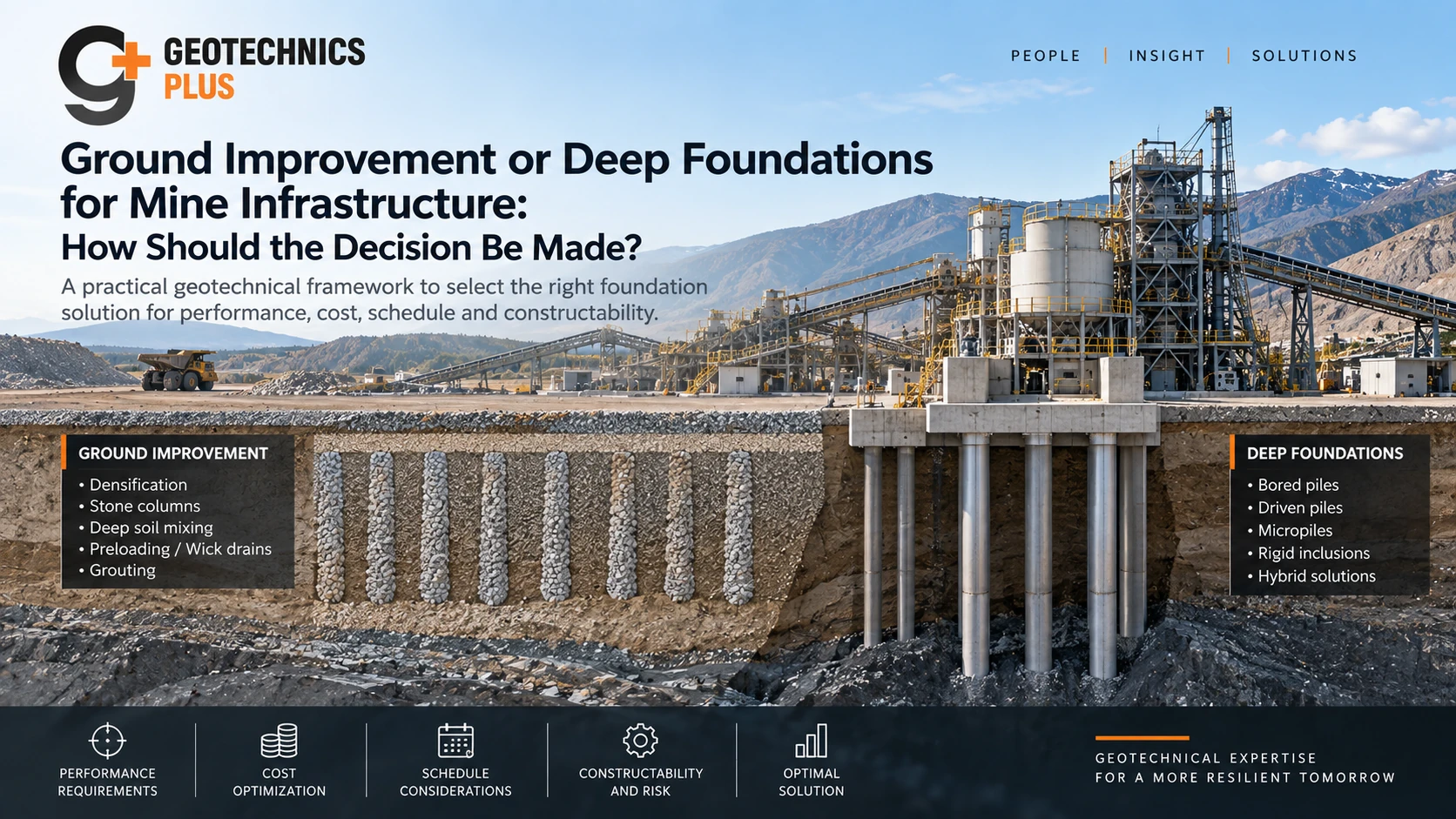
Mine infrastructure often places large, concentrated and sometimes dynamic loads onto ground that is anything but uniform. Process plants, crushers, mills, tanks, conveyor transfer towers, stockpile structures and heavy industrial slabs may be founded across engineered fill, weathered rock, soft alluvium, loose granular deposits or variable rockhead.
The first instinct is often to ask whether piles are required. That is usually too narrow a question.
The better question is: can the ground be modified sufficiently to meet the project’s settlement, deformation, bearing, dynamic and construction requirements more efficiently than transferring the load to deeper competent material?
The foundation decision should be based on performance—not foundation type
Deep foundations and ground improvement solve different problems in different ways. Piles or drilled shafts transfer load to deeper strata and can bypass weak or highly compressible materials. Ground improvement changes the behaviour of the existing ground by densifying it, reinforcing it, accelerating drainage, replacing weak material, increasing stiffness or reducing compressibility.
Neither approach is automatically superior. The correct solution depends on the mechanism controlling performance and the level of uncertainty the project can tolerate.
For mine infrastructure, that mechanism is frequently settlement or differential movement rather than ultimate bearing capacity. A foundation may have adequate capacity and still be unacceptable if movement affects equipment alignment, conveyor geometry, piping, vibration performance or structural reactions.
Seven questions that should drive the decision
1. What performance criterion actually governs?
The starting point should be explicit performance limits. For a crusher or mill foundation, alignment, rotation and vibration may be more important than bearing pressure. For a conveyor transfer tower, differential settlement between adjacent supports may govern. For a large process building, global settlement may be acceptable while local distortion is not.
If the allowable movement is very small, the project may need a solution that reduces not only average settlement but also spatial variability in stiffness.
2. How deep and how variable is the weak ground?
Ground improvement becomes more attractive when the problematic zone is within a practical treatment depth and can be treated consistently. Deep foundations become more attractive when weak or highly compressible soils extend to significant depth, when treatment would be difficult to verify, or when competent bearing strata are available at a predictable elevation.
Variable rockhead deserves particular attention. Piles founded partly on rock and partly in soil can create stiffness contrasts. Ground improvement beneath shallow foundations may sometimes create a more uniform support condition, but only if the weaker zones can be identified and treated reliably.
3. Is settlement caused by low stiffness, consolidation, loose structure or something else?
Different mechanisms require different solutions. Loose granular soils may respond well to densification. Soft saturated soils may require drainage, preload, reinforcement or load transfer. Highly organic or uncontrolled fills may be unsuitable for certain methods altogether.
This is why ground improvement should not be selected by method name first. The team should identify the mechanism, then choose a treatment capable of changing that mechanism.
4. How important are groundwater and drainage conditions?
Groundwater can strongly influence both the feasibility and the performance of improvement methods. Vibro techniques, deep soil mixing, grouting, preload, wick drains and rigid inclusions all interact differently with groundwater, permeability and pore-pressure response.
The construction-stage effect also matters. Some methods generate excess pore pressures or temporary ground movement; others may create spoil, slurry or dewatering requirements. The design should consider not only the final improved condition but also how the treatment will affect adjacent facilities and construction activities.
5. Do dynamic or seismic loads materially change the decision?
Heavy mine infrastructure can be sensitive to cyclic and dynamic loading, while loose saturated soils may also be susceptible to seismic densification or liquefaction.
Ground improvement may be selected specifically to increase density, reduce pore-pressure generation or improve stiffness. Deep foundations may bypass weak near-surface layers but still require consideration of kinematic loading, downdrag, lateral ground deformation or liquefaction-induced effects.
The preferred solution should therefore be checked against the actual dynamic mechanism—not simply treated as a static foundation problem with an added seismic load case.
6. Can the solution be verified during construction?
A design is only as reliable as the evidence that the installed ground condition meets the assumptions used in analysis.
Ground improvement requires a verification strategy appropriate to the method. That may include CPT, SPT, plate load testing, modulus testing, core recovery, strength testing, installation records, settlement monitoring or performance trials. Deep foundations similarly require installation records, integrity testing, load testing or other acceptance criteria.
The level of verification should reflect consequence and variability. A method that performs well in idealized analysis but cannot be verified practically in the field may not be the best project solution.
7. What does the project schedule value most?
Foundation selection is often a commercial decision as much as a geotechnical one. Piling may be technically straightforward but require specialized equipment, long procurement lead times or large quantities of concrete and steel. Ground improvement may reduce foundation quantities but require treatment trials, sequencing or waiting periods.
The best option is the one that meets performance requirements with a construction process the project can execute reliably.
Ground improvement should be selected by mechanism
There is no single “ground improvement solution.” Different methods change the ground in different ways.
Densification methods can be effective for loose granular deposits where increasing relative density and stiffness is the primary objective. Stone columns or vibro replacement may add reinforcement, drainage and stiffness in suitable soils. Rigid inclusions can transfer load through compressible layers while allowing a shallow foundation or load-transfer platform above. Deep soil mixing can create a stronger and stiffer composite ground mass where soft soils need substantial modification. Preload, surcharge and vertical drains can accelerate consolidation where time and footprint permit. Grouting may target local voids, improve contact conditions or reduce permeability in specific settings.
The project should avoid comparing methods only by unit rate. Each method should first be screened against soil type, treatment depth, groundwater, required stiffness, construction access, environmental constraints, variability and verification requirements.
When deep foundations are usually the stronger choice
Deep foundations become more compelling when the load must bypass a thick or highly variable weak zone, when settlement tolerances are exceptionally tight, when treatment depth is impractical, when the near-surface ground cannot be improved consistently, or when a competent founding layer exists at a reasonably predictable depth.
They may also be preferable where the structural layout produces highly concentrated loads or where lateral and overturning demands are significant.
However, deep foundations do not automatically eliminate geotechnical uncertainty. Downdrag, lateral soil movement, variable rock socket conditions, group interaction, construction-induced vibration and pile-to-pile variability still require careful evaluation.
Hybrid solutions are often overlooked
The strongest project solution is not always either ground improvement or piles. Hybrid systems can combine advantages from both.
Examples include ground improvement beneath lightly loaded structures with piles beneath critical equipment, rigid inclusions below a raft, localized deep foundations at transfer towers combined with improved ground along conveyor supports, or ground improvement that reduces pile lengths and quantities.
This is where soil–structure interaction and project-wide settlement compatibility become important. Optimizing individual foundations independently can create differential movement between connected structures.
See our related Insight, When Does Soil–Structure Interaction Matter in Geotechnical Design?.
A practical example: process plant foundations over variable fill and soft alluvium
Consider a process-plant area where engineered fill overlies a variable thickness of soft alluvium, with competent dense soil or weathered rock at depth. Several structures are connected by piping and conveyors, while one crusher foundation carries large dynamic loads.
A pile-only concept may appear conservative, but it may also create very stiff support beneath some structures while adjacent shallow foundations continue to settle. A ground-improvement-only concept may reduce settlement across the site but still be inadequate beneath the crusher.
A better project-level solution might use ground improvement to create a more uniform support condition beneath the general plant area and deep foundations or rigid inclusions beneath the most settlement-sensitive or dynamically loaded equipment.
The key engineering task is to evaluate the whole settlement and load-transfer system rather than optimize each foundation independently.
When advanced numerical modelling adds value
Advanced modelling can be useful where the decision depends on interaction between improved ground, untreated soil, inclusions, raft foundations, piles or connected structures.
It can also help assess differential settlement across variable treatment zones, stress transfer into rigid inclusions, group interaction, staged construction or the effect of different stiffness assumptions on structural reactions.
But the same rule applies as in all numerical work: the model should not be more sophisticated than the data supporting it. If the controlling uncertainty is the thickness of soft soil or the stiffness of existing fill, targeted investigation may create more value than a more complex model.
See When Does a Mining or Tailings Project Need Advanced Numerical Modelling?.
What should an independent review challenge?
A focused technical review should challenge whether the selected foundation concept actually addresses the controlling project mechanism.
- Are movement criteria defined for the structure and connected equipment?
- Is the ground profile sufficiently characterized over the full foundation footprint?
- Has variability in rockhead, fill quality or soft-soil thickness been considered?
- Does the selected ground-improvement method match the soil mechanism?
- Are groundwater and construction-stage pore pressures relevant?
- Is dynamic or seismic performance controlling?
- Are treatment depth, spacing and area sufficient to address differential movement?
- Can the installed condition be verified with practical acceptance criteria?
- Have interfaces between improved ground, untreated ground and deep foundations been assessed?
- Does the design optimize the whole facility rather than individual footings in isolation?
Key takeaway: the decision between ground improvement and deep foundations should be made by identifying the controlling performance mechanism, understanding the depth and variability of the weak ground, and selecting the solution that can be constructed and verified with the greatest confidence. In many mine projects, the best answer is neither purely shallow nor purely deep—it is a project-specific combination that controls movement across the whole infrastructure system.
Optimize before the foundation concept becomes fixed
The greatest opportunity to reduce foundation cost and geotechnical risk usually exists before structural layouts, equipment loads and construction packages are fully locked in.
At that stage, targeted investigation, settlement sensitivity studies, ground-improvement trials, soil–structure interaction assessment and independent technical review can materially change the preferred foundation strategy.
Geotechnics Plus supports mining and industrial project teams with foundation optimization, ground-improvement assessment, advanced numerical modelling, soil–structure interaction analysis, design assurance and construction-stage technical support for complex ground conditions.