
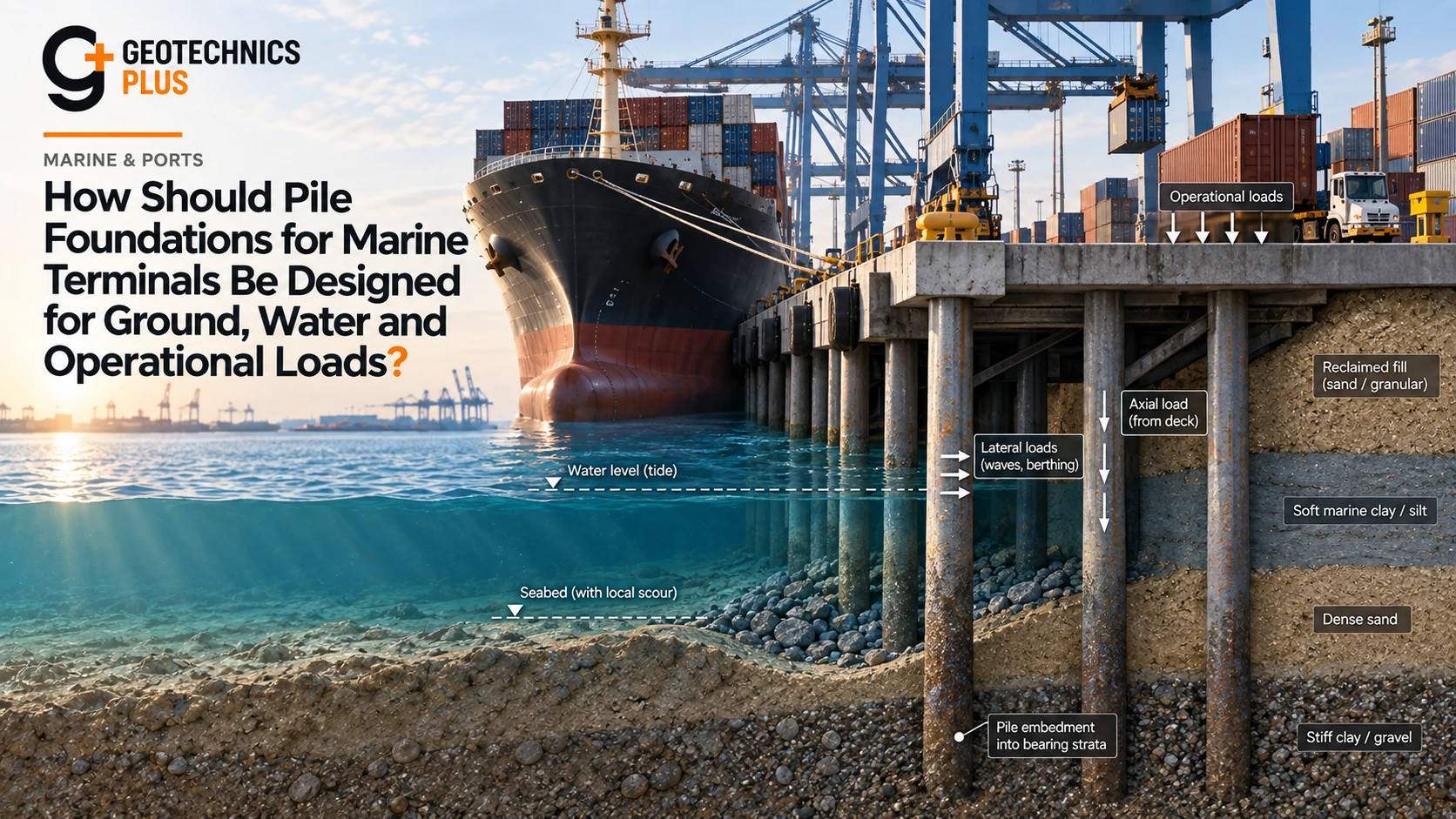
Pile-supported marine terminals operate in an unusually demanding environment. The same foundation system may have to carry heavy vertical deck loads, resist berthing and mooring forces, accommodate waves and currents, remain stable as the seabed changes, tolerate cyclic loading and continue performing through dredging, scour, settlement and seismic events.
That combination means pile design for a marine terminal is rarely an axial-capacity problem alone. A pile may have adequate compression resistance and still be unsuitable because lateral deformation, bending demand, group interaction, downdrag, unsupported length or kinematic ground movement controls performance.
A marine pile is part of a coupled ground–structure–water system. The key design question is not simply whether the pile can carry load, but whether the complete pile–deck–soil system can satisfy strength, deformation and operational requirements across the credible life-cycle conditions.
Axial capacity is only part of the problem
Axial geotechnical resistance remains fundamental, but marine terminal piles are also exposed to lateral demand, bending, cyclic degradation, settlement compatibility and changes in effective embedment. The foundation system must therefore be checked as a combined system rather than as independent piles carrying independent loads.
Depending on the terminal, the governing design issue may be:
- compression or uplift resistance;
- lateral pile-head displacement;
- pile bending moment and curvature;
- pile-group interaction;
- downdrag from settling reclaimed ground;
- loss of lateral support due to scour or dredging;
- liquefaction or lateral spreading;
- berthing, mooring or accidental lateral loading;
- cyclic degradation of soil resistance; or
- construction-induced damage or installation effects.
The design should identify these mechanisms early enough that pile type, spacing, batter, stiffness, penetration and installation method can be selected around the governing response.
Lateral pile response can govern marine structures
Marine terminals often carry substantial horizontal loads from vessel berthing, mooring, cranes, wind, current, waves and seismic action. These loads are transferred through the deck into the pile group, where lateral resistance is mobilised progressively with pile movement.
The relevant performance measure may therefore be displacement rather than nominal capacity. Excessive pile-head movement can affect crane rails, deck joints, utilities, fender systems, mooring equipment and operational tolerances long before the pile reaches its ultimate geotechnical resistance.
Lateral pile response depends strongly on:
- soil stiffness and strength with depth;
- pile diameter, wall thickness and flexural stiffness;
- pile-head fixity;
- water depth and unsupported length;
- pile spacing and group effects;
- cyclic loading history;
- seabed elevation and scour; and
- whether the surrounding ground itself is expected to move.
For this reason, a single lateral capacity value is rarely enough to describe foundation performance.
Scour is not only a hydraulic problem
Scour around marine foundations changes the geotechnical boundary condition. When seabed material is removed, the pile loses lateral confinement and its effective unsupported length increases. That can reduce stiffness, increase bending demand and move the critical section deeper into the pile.
Local scour can also affect piles differently across a group. Waterside piles may lose more support than landward piles, creating changes in load distribution that are not captured if a uniform seabed level is assumed.
Key point: scour depth should be carried directly into the pile analysis. It is not enough to confirm that the pile remains embedded; the changed stiffness, bending demand and group response must also be assessed.
The same principle applies where propeller wash, thruster jets, currents or maintenance dredging can progressively lower the seabed during operation.
Dredging can materially change foundation performance
Berth deepening is often treated as an operational or navigation upgrade, but it can significantly affect pile behaviour. Lowering the seabed can reduce passive support, increase free length, alter pile-head stiffness and increase lateral deflection under the same applied load.
Dredging may also change the response of nearby retaining walls or slopes, which can impose additional lateral ground movement on the piles.
For existing terminals, proposed berth deepening should therefore trigger a foundation reassessment that considers:
- new seabed elevation and dredging tolerances;
- combined dredging and scour conditions;
- remaining pile penetration;
- lateral stiffness and bending demand;
- global stability of the berth slope or retained ground; and
- whether operational loads have also increased since the original design.
This directly complements the quay-wall issues discussed in What Controls the Performance of Quay Walls and Marine Structures?
Downdrag can develop behind marine terminals
Marine terminals are frequently constructed over reclaimed fill or compressible marine deposits. If the surrounding ground continues to settle after pile installation, downward shear may develop along the pile shaft.
That negative skin friction adds load to the pile and can increase settlement or structural demand. More importantly, the pile and surrounding ground may not settle by the same amount, so compatibility between the deck, approach structures, utilities and ground-supported pavement becomes important.
Downdrag assessment should consider:
- the depth of compressible soil;
- magnitude and rate of ground settlement;
- neutral plane location;
- long-term effective stress changes;
- pile group effects; and
- whether reclamation, surcharge or groundwater changes may continue after terminal opening.
A structurally adequate pile can still create an operational problem if the surrounding apron settles significantly relative to the pile-supported deck.
Pile-group interaction matters
Marine structures rarely rely on a single pile. Piles are arranged in groups beneath deck beams, crane rails, dolphins or mooring structures, and neighbouring piles interact through the surrounding soil.
For lateral loading, piles within a group may not mobilise the same soil resistance as an isolated pile. Front-row piles can shield piles behind them, while closely spaced piles can create overlapping zones of soil deformation.
For axial loading, group settlement and installation effects may also differ from single-pile behaviour.
The practical implication is that pile spacing should not be selected only from structural framing convenience. Group efficiency, constructability, load distribution and soil response should all be considered.
Berthing and mooring loads are foundation problems too
Fenders, bollards and mooring hardware are visible at deck level, but their loads must ultimately be resisted by the foundation system. Large vessels can impose highly concentrated lateral forces and moments that govern individual piles or pile groups.
Operational upgrades can therefore become foundation upgrades. Increasing bollard capacity, changing fender systems, accommodating larger ships or modifying mooring arrangements may increase lateral demand without any visible change to the piles themselves.
The load path should be traced from the vessel through the fender or bollard, into the deck and pile group, and then into the ground. Where the terminal geometry causes torsion or eccentric loading, three-dimensional structural response may become important.
Cyclic loading can change soil resistance
Marine piles are exposed to repeated loads from waves, tides, vessel operations, crane cycles and berthing events. In some soils, repeated loading can reduce stiffness, accumulate displacement or change pore pressure.
The significance depends on the soil type, loading amplitude, number of cycles, drainage conditions and stress history. Loose saturated sands may be vulnerable to pore-pressure build-up, while soft clays can experience cyclic degradation and accumulation of strain.
Cyclic effects do not need to be dominant in every project, but they should be screened explicitly rather than assumed to be covered by a static load factor.
Liquefaction and lateral spreading can impose kinematic demand
At seismic sites, marine terminals may be exposed to more than inertial loading from the deck. Liquefaction, lateral spreading or movement of waterfront slopes can impose ground displacement directly onto the piles.
This kinematic demand can be severe because the ground is moving relative to the structure. The resulting pile curvature and bending may occur below the mudline, often near transitions between liquefied and non-liquefied layers or between weak and stiff strata.
Performance-based assessment is often appropriate where permanent ground deformation is credible. The objective is not simply to calculate a seismic force, but to understand whether the pile system can tolerate the expected deformation while satisfying the required post-event performance.
This is one reason soil–structure interaction can become central to marine foundation design. See also When Does Soil–Structure Interaction Matter in Geotechnical Design?
Installation effects can control constructability and capacity
Driven steel or precast piles are common in marine terminals because they can provide high capacity and are well suited to over-water construction. But pile driving changes the surrounding soil and can create project risks that need to be managed.
Important considerations may include:
- drivability and refusal risk;
- pile damage during driving;
- setup or relaxation after installation;
- ground heave or lateral displacement;
- vibration effects on nearby structures;
- installation sequence within large pile groups;
- noise and environmental constraints; and
- verification of installed capacity.
Where drilled or bored systems are considered instead, different risks emerge, including bore stability, underwater concrete placement, base cleanliness and construction quality control.
Pile type should therefore be selected with both design performance and installation reliability in mind.
When are p–y curves not enough?
Beam-on-nonlinear-Winkler-foundation methods using p–y curves remain a practical and widely used tool for laterally loaded piles. They are often entirely appropriate for routine design.
However, more advanced analysis may be justified when:
- the pile group is large or closely spaced;
- the ground profile is strongly layered;
- lateral ground movement is expected;
- scour or dredging changes support conditions significantly;
- pile–deck interaction controls system stiffness;
- seismic deformation or liquefaction governs response;
- nonlinear pile–soil interaction materially affects load distribution; or
- small changes in movement have major operational consequences.
In those cases, two-dimensional or three-dimensional numerical modelling can provide useful insight into group interaction, ground deformation, load redistribution and system response. The analysis should still be proportionate to the decision being made. Advanced modelling is valuable when it resolves uncertainty or a controlling mechanism—not simply because it is available.
See also When Does a Geotechnical Problem Need Advanced Numerical Modelling?
Load testing and monitoring reduce uncertainty
Foundation performance can often be improved by replacing assumptions with field evidence. Depending on the project, useful verification may include static axial load testing, dynamic pile testing, integrity testing, lateral load testing, instrumentation during driving or monitoring of completed structures.
The appropriate programme depends on what uncertainty matters most. A capacity test may not resolve uncertainty about lateral stiffness. A driving record may confirm installation resistance but not long-term downdrag. Monitoring should therefore be linked to the specific design question.
For existing terminals, observed pile-head movement, deck settlement, scour surveys, bathymetry and operational performance can be particularly valuable when assessing upgrades or life extension.
A practical example: piled container terminal
Consider a pile-supported container berth with a reinforced-concrete deck, heavy crane loads and a vessel alongside. The piles extend through soft marine clay into denser bearing strata. The berth may experience local scour, periodic maintenance dredging and significant lateral loading from berthing and mooring.
A credible foundation assessment should not stop at axial compression capacity. It should examine:
- axial compression and uplift resistance;
- lateral pile-head displacement under operational loads;
- pile bending and group interaction;
- loss of lateral support from design scour;
- future dredging scenarios;
- downdrag from settlement of adjacent reclaimed ground;
- cyclic loading effects;
- seismic ground deformation where relevant;
- pile installation and constructability; and
- verification through testing or monitoring.
The governing case may be a combination rather than a single extreme load—for example, increased lateral demand acting at the same time that scour has reduced pile support and the deck remains constrained by tight operational movement limits.
What should an independent technical review challenge?
For major marine pile foundations, an independent review should challenge the assumptions that most influence system performance:
- Is the ground model deep enough to capture the full pile response?
- Are weak marine layers, dense bearing strata and interfaces represented realistically?
- Are axial and lateral demands assessed together where interaction matters?
- Has pile-group behaviour been considered rather than relying on isolated-pile response?
- Are dredging and scour conditions reflected in the analysis?
- Could reclaimed ground create downdrag or differential settlement?
- Are cyclic, berthing and mooring loads represented credibly?
- Is seismic ground deformation relevant to the site?
- Are p–y or other simplified soil-response models appropriate for the governing mechanism?
- Does the pile installation method introduce capacity, vibration or constructability risks?
- Is the testing programme targeted at the real uncertainties?
- Can the completed structure be monitored or inspected where long-term change is expected?
Key takeaway: A marine pile foundation should be designed for system performance, not axial capacity alone. Lateral deformation, scour, dredging, group interaction, downdrag, cyclic loading, seismic ground movement and constructability can all control the final solution.
Resolve foundation behaviour before the terminal geometry becomes fixed
Marine terminals are expensive to modify once the deck, crane rails, utilities, fenders and operating systems are in place. Increasing pile size, changing pile spacing or adding foundations after construction can be difficult and disruptive.
The greatest value therefore comes from identifying the controlling geotechnical mechanisms while the pile layout, terminal geometry, dredge level and operational demands are still flexible.
Geotechnics Plus supports port and marine infrastructure teams with specialist geotechnical and geo-structural review, deep-foundation assessment, soil–structure interaction, advanced numerical modelling, settlement and deformation assessment, seismic geotechnics and construction-stage problem solving.