
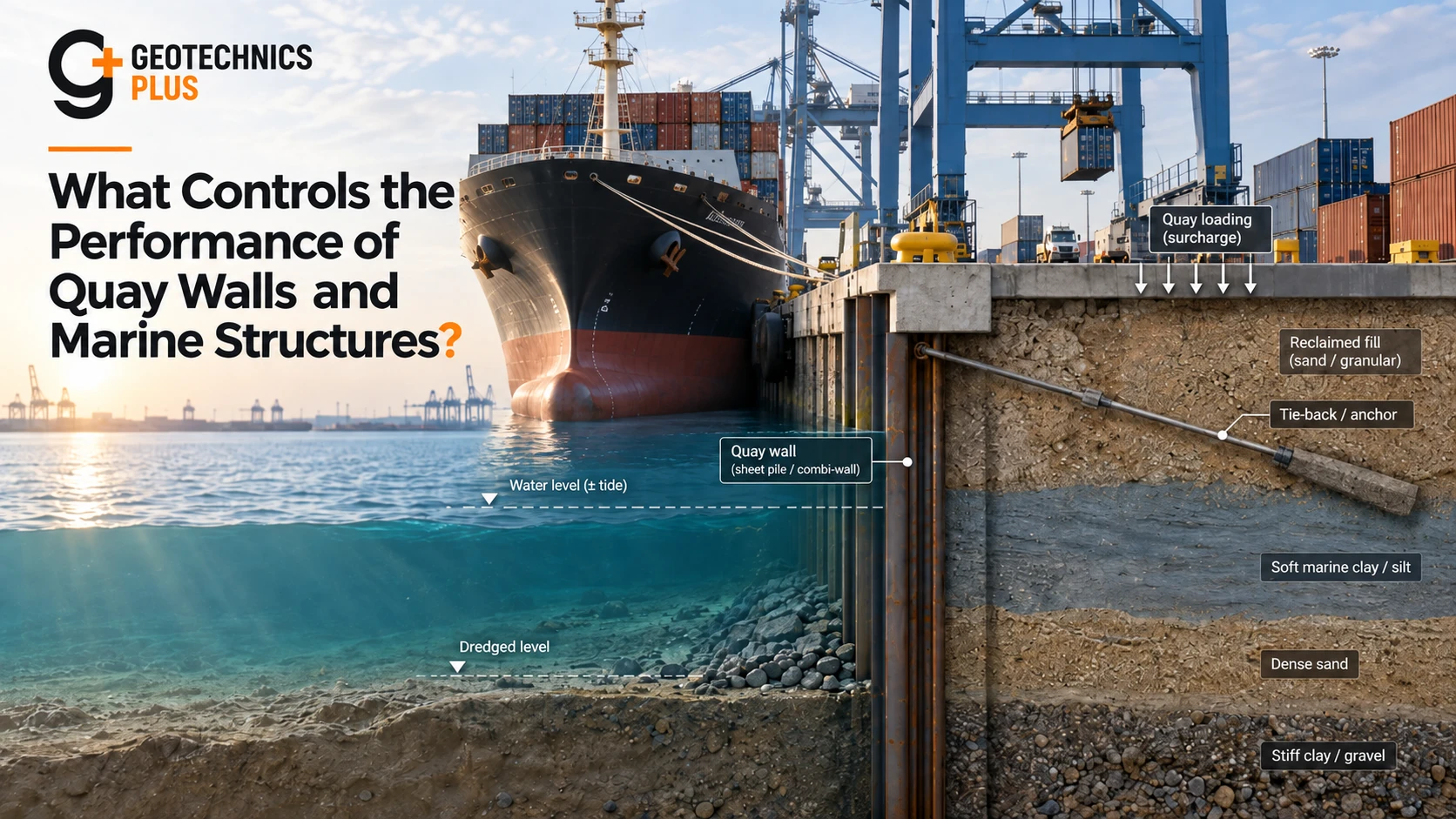
Quay walls and marine structures operate at the intersection of ground, water, structure and operations. Their performance is rarely controlled by one calculation or one load case. A wall that satisfies static earth-pressure checks may still be vulnerable to dredging, differential water levels, anchor response, cyclic loading, scour, settlement, seismic demand or construction-stage effects.
The engineering challenge is therefore not simply to determine whether a quay wall is stable. It is to identify which mechanisms can control performance over the structure’s full design life, how those mechanisms interact, and what evidence is needed to demonstrate that the wall, foundation system and adjacent port infrastructure will continue to function as intended.
A marine structure is a coupled system. Ground conditions, structural stiffness, water levels, dredging, surcharge, anchorage, seabed response and operational loading should be assessed together rather than as isolated design inputs.
Start with the performance mechanism, not the wall type
Quay walls may use sheet piles, combi-walls, diaphragm walls, gravity systems, caissons, piled decks or hybrid arrangements. The structural form matters, but the more important first question is: what mechanism could cause unacceptable movement, loss of capacity or loss of serviceability?
Depending on the site, the governing mechanism may be:
- excessive lateral wall movement;
- insufficient passive resistance or toe fixity;
- anchor or tie-rod demand;
- global instability through weak marine deposits;
- settlement of reclaimed fill behind the wall;
- pile downdrag or lateral ground movement;
- hydraulic gradients or differential water pressure;
- seabed scour or erosion;
- liquefaction or cyclic degradation;
- berthing, mooring or crane surcharge effects; or
- construction-stage instability before the permanent system is complete.
A robust design identifies the credible mechanisms first, then selects the analysis that is appropriate to each one.
Dredging can be a structural load case
Dredging is often treated as a geometric requirement for navigation, but for a quay wall it can materially change the geotechnical system. Lowering the seabed in front of a wall can reduce passive resistance, increase effective retained height, increase bending demand, increase anchor forces and alter the global stability mechanism.
Future berth deepening can be even more important. A wall designed for today’s dredge level may later be exposed to a deeper channel or berth pocket, larger vessels or changed propeller wash. If future dredging is credible, it should be considered during design rather than treated as an operational issue to be solved later.
The same applies to local over-dredging. Construction tolerances, maintenance dredging and irregular seabed levels can create conditions that are more demanding than the nominal design section.
Key point: the dredged level is not simply a drawing dimension. It directly affects wall demand, embedment, global stability and scour vulnerability.
The design water level is not the only hydraulic condition that matters
Marine retaining structures are affected by more than the external tide or still-water level. The critical condition can arise from a difference between water levels on the two sides of the wall, particularly where backfill drainage is restricted or water levels change rapidly.
Design should consider whether the retained fill can drain at the same rate as the harbour water level changes. If not, transient differential water pressure may increase wall and anchor demand. Relevant scenarios may include tide changes, storm surge, drawdown, rainfall infiltration, temporary pumping, blocked drains and construction-stage dewatering.
Seepage can also affect effective stresses and passive resistance near the toe. Where fine soils, hydraulic gradients or sensitive ground conditions are present, the pore-pressure regime should be treated as part of the geotechnical model rather than as a secondary hydraulic detail.
Surcharge is not just a uniform load
Port aprons may carry container stacks, mobile harbour cranes, rail systems, gantry cranes, heavy transporters, bulk storage, buildings and temporary construction loads. These loads can be large, concentrated and highly variable in position.
The relevant question is not only the magnitude of surcharge, but how that surcharge transfers through the ground and into the wall, anchors, piles and underlying soils.
For example, a crane load near the wall may increase lateral earth pressure, cause local settlement, change anchor demand or create differential movement between a piled crane rail and adjacent ground-supported pavement. A simplified uniform surcharge may be adequate for screening, but it can hide important local interaction when the load is concentrated or when soil stiffness varies significantly with depth.
Anchors and tie rods often control more than strength
Anchored quay walls depend on the complete load path: wall, waler, tie rod, connection, anchor wall or deadman, and the ground between them. A strength check on the tie rod alone does not demonstrate acceptable performance.
Important issues can include:
- anchor location relative to the active failure zone;
- interaction between wall movement and anchor mobilisation;
- loss of ground around buried anchor components;
- corrosion allowance and long-term durability;
- differential settlement between the quay wall and anchor system;
- connection detailing and local structural demand; and
- construction sequence before the tie-back system is fully engaged.
Where reclaimed ground consolidates over time, tie rods can also be subjected to additional bending or relative movement that is not captured by a simple axial-force model.
Global stability can govern even when the wall section looks adequate
Marine sites commonly include soft clay, loose hydraulic fill, compressible silt or layered deposits extending well behind and below the quay wall. In these conditions, the critical mechanism may pass beneath the wall and anchor system rather than through the structural section itself.
Global stability should therefore be checked using a ground model that extends far enough to capture deep failure surfaces and weak layers. This becomes especially important where the site includes soft marine clay, sloping seabed, deep dredging, high surcharge or reclamation placed rapidly behind the wall.
If staged filling or surcharging is proposed, the time-dependent development of strength and pore pressure may be as important as the final geometry.
Settlement behind the quay can become an operational problem
A quay wall can remain structurally stable while the port apron behind it experiences unacceptable settlement. Reclaimed fills, compressible marine deposits and newly placed backfill may continue to consolidate long after the wall is constructed.
Consequences can include:
- loss of pavement grade;
- steps or voids adjacent to the wall;
- distortion of crane rails;
- utility damage;
- approach slab movement;
- drainage problems; and
- additional demand on piles, tie rods or buried services.
The assessment should therefore distinguish wall movement from ground settlement and evaluate how both affect the operational systems that depend on them. The same principle applies to movement criteria near existing infrastructure: the acceptable deformation is defined by asset performance, not by a generic settlement value.
Scour changes the geotechnical boundary condition
Scour in front of a quay wall can reduce embedment, remove passive support and expose foundations that were assumed to remain confined. Propeller wash and thruster jets can be particularly important at berths used by large vessels.
PIANC guidance on protecting berthing structures from ship-induced scour emphasizes the need to evaluate propulsor-generated velocities and the corresponding seabed response. For the geotechnical designer, the key point is that the expected scour depth should be reflected directly in the structural and stability model.
Where scour protection is used, its own constructability, filter compatibility, inspection requirements and long-term maintenance should be considered.
Berthing and mooring loads connect operations to ground response
Fenders, bollards, dolphins and quay walls transfer vessel loads into the supporting structure and foundation system. These loads can be highly localized and may act in combination with earth pressure, surcharge and water-level effects.
The load path should be traced through the entire system. For a piled or anchored marine structure, the critical response may occur in the foundation, anchor system or surrounding soil rather than at the point where the vessel load is applied.
Port operational changes can therefore become geotechnical changes. Larger vessels, different mooring arrangements, higher bollard capacities, upgraded cranes or changed cargo handling may justify reassessment of an existing structure even if the wall itself has not visibly deteriorated.
Seismic loading can change both demand and resistance
At seismic sites, the design problem extends beyond applying a horizontal coefficient to the wall. Earth pressures can change, pore pressures can rise, loose fills may liquefy, soft soils may degrade under cyclic loading, and the retained ground may move relative to the structure.
Potential consequences include increased wall deformation, loss of passive resistance, anchor demand, lateral spreading, settlement of backfill and damage to utilities or crane systems.
Where liquefaction or significant permanent ground deformation is credible, performance-based assessment is often more useful than a simple force-based check. The objective is to understand the deformation mechanism and whether the structure can continue to satisfy life-safety, containment, operability or recovery requirements.
Construction sequence can control the critical condition
Some of the most demanding conditions occur before the permanent quay system is complete.
Examples include:
- excavation or dredging before anchors are installed;
- reclamation before adequate drainage or consolidation has occurred;
- temporary crane loads near an incomplete wall;
- pile installation effects on adjacent structures;
- dewatering that changes pore pressures outside the intended work zone; and
- temporary removal of passive support during marine works.
Construction-stage analyses should follow the actual sequence of works. A final-state model cannot demonstrate that the system remains safe at each intermediate stage.
When does soil–structure interaction become important?
For many quay walls, wall stiffness, anchor stiffness, soil stiffness and construction sequence interact strongly. The distribution of bending moment and tie force depends on how the wall deforms and how resistance is mobilised with movement.
This is a classic soil–structure interaction problem. Simplified methods remain valuable for screening and independent checks, but more advanced analysis may be justified when:
- the wall is deep or highly loaded;
- the soil profile is strongly layered;
- soft deposits or weak interfaces influence deformation;
- multiple anchors or props interact;
- construction sequence governs response;
- seismic deformation is important;
- adjacent piles, crane rails or structures interact with the wall; or
- small changes in movement materially affect operations.
In those situations, staged numerical modelling can provide useful insight into load redistribution, deformation, pore pressure and the interaction between the structural system and the ground. As with any advanced model, the objective should be to improve the engineering decision—not to add complexity for its own sake. See also When Does a Geotechnical Problem Need Advanced Numerical Modelling?
A practical example: deep-water anchored quay wall
Consider an anchored combi-wall supporting reclaimed fill at a container terminal. The berth is dredged deeply, the apron carries high surcharge and the ground profile includes loose granular fill over soft marine clay and denser material at depth.
A credible assessment would not stop at the static earth-pressure diagram. It would examine:
- wall and anchor response at the design and possible future dredge levels;
- global stability through the soft marine layer;
- settlement of the reclaimed apron;
- differential water levels and drainage behind the wall;
- ship-induced scour in front of the wall;
- crane and cargo surcharge;
- seismic deformation where relevant; and
- temporary conditions during wall installation, reclamation and dredging.
The governing case may not be the one with the largest nominal load. It may be the case where resistance is reduced at the same time that demand increases—for example, deeper dredging combined with scour, high surcharge and elevated pore pressure.
What should an independent technical review challenge?
For an important marine structure, an independent review should challenge the assumptions that have the greatest influence on performance, including:
- Is the ground model representative of the full failure mechanism?
- Are weak marine deposits and interfaces captured adequately?
- Is the dredge level conservative enough, including tolerances and future deepening?
- Are differential water pressures credible for drainage and tide conditions?
- Are surcharge loads represented realistically?
- Is the anchor system outside the active failure zone and compatible with expected movement?
- Has scour been treated as a change in the geotechnical boundary condition?
- Have settlement and operational tolerances behind the wall been assessed?
- Are seismic and liquefaction effects relevant to the site?
- Does the analysis follow the actual construction sequence?
- Are model sensitivities and uncertainties understood?
- Is there a monitoring and inspection strategy for the mechanisms that matter most?
Key takeaway: Quay-wall performance is governed by the interaction of ground, structure, water and operations. The strongest design does not rely on one stability check; it demonstrates that the complete system remains acceptable across dredging, surcharge, hydraulic, seismic, scour and construction-stage conditions.
Resolve the controlling mechanisms before they become operational constraints
Marine structures are difficult and expensive to modify once a terminal is operating. Ground improvement, anchor strengthening, underwater repairs, berth closures and dredging restrictions can all have major operational consequences.
Early geotechnical challenge is therefore most valuable when it is used to identify the controlling mechanisms before the wall type, dredge level, anchor layout, reclamation sequence or operational loading becomes fixed.
Geotechnics Plus supports port and marine infrastructure teams with specialist geotechnical and geo-structural review, quay-wall and foundation assessment, soil–structure interaction, advanced numerical modelling, settlement and deformation assessment, seismic geotechnics and construction-stage problem solving.
Selected references
- PIANC MarCom WG 180 — Guidelines for protecting berthing structures from scour caused by ships.
- PIANC Maritime Navigation Commission technical reports, including current guidance on fenders, mooring and marine structures.
- CIRIA C760 — Guidance on embedded retaining wall design.