
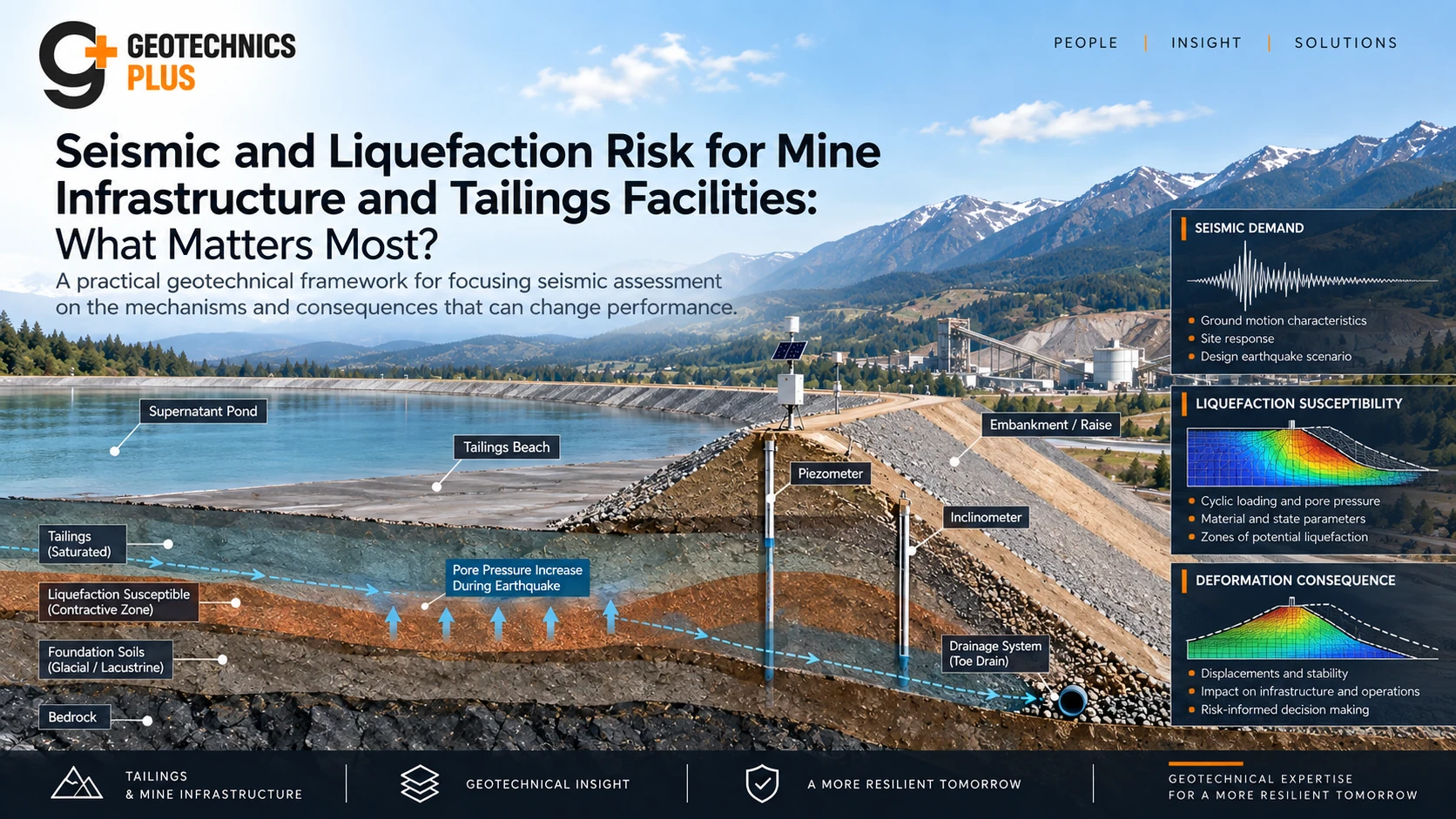
Seismic design for mining and tailings projects can become unnecessarily complicated—or dangerously simplified—when the analysis starts with a method rather than with the consequence that must be controlled.
A pseudo-static factor of safety, a liquefaction triggering ratio, a response spectrum or a dynamic finite-element model can each be useful. None of them, by itself, defines seismic performance.
The starting point should be the engineering question: what earthquake-induced mechanism could materially affect containment, stability, alignment, serviceability or safe operation—and what level of performance is required?
The key question is not: “Is liquefaction possible?”
It is: “If liquefaction, cyclic degradation or earthquake-induced deformation occurs, what changes in the performance of the facility—and is that consequence acceptable?”
Seismic risk is a performance problem, not a single calculation
Mining projects can include tailings storage facilities, waste rock facilities, process plants, crushers, mills, tanks, conveyors, buried services, slopes, retaining structures, pipelines and water-management infrastructure. Each asset can respond differently to the same earthquake.
A tailings embankment may be governed by deformation and post-seismic stability. A process plant may be governed by differential settlement or foundation–structure interaction. A buried pipeline may tolerate shaking but be vulnerable to permanent ground displacement. A mine slope may be controlled by structurally defined blocks rather than soil liquefaction.
The seismic assessment therefore needs to connect hazard → material response → deformation or instability mechanism → project consequence.
Eight questions that should guide the assessment
1. What seismic performance objective applies to the asset?
Before selecting an analysis method, the project team should define what acceptable seismic performance means. For some mine infrastructure, temporary loss of service may be tolerable. For containment structures or high-consequence tailings facilities, the required performance can be much more stringent.
The same ground motion can therefore lead to very different design decisions depending on whether the objective is life safety, containment, continued operation, repairability or limited deformation.
A technically sound seismic assessment should make the performance objective explicit and connect every subsequent calculation to that objective.
2. Is the hazard characterization appropriate for the mechanism being assessed?
Peak ground acceleration alone rarely describes everything that matters. Duration, spectral shape, frequency content, source type and ground-motion variability can influence cyclic demand and deformation.
For dynamic analyses, record selection and scaling should be consistent with the target hazard and the periods or response characteristics that control the facility. The selected motions should not be rejected simply because they produce the largest deformation; large response may be physically meaningful.
The important question is whether the ground-motion suite is representative of the hazard that the project is required to withstand.
3. Are potentially liquefiable or strain-softening materials actually present?
Liquefaction screening should begin with material type and state. Saturation, density, stress level, fines characteristics, depositional history, aging, cementation and drainage conditions all matter.
For tailings, loose hydraulic fills or young alluvial deposits, the potential for contractive response may be a central design issue. For well-compacted rockfill or dense, unsaturated engineered fill, the relevant mechanism may be very different.
Where static or cyclic liquefaction is credible, the assessment should distinguish between triggering susceptibility and post-trigger consequences.
4. If liquefaction triggers, what happens next?
A triggering calculation is not the end of the assessment. The project team must understand how much strength could be lost, where deformation may concentrate, whether lateral spreading or settlement could occur, whether containment could be compromised, and whether post-seismic stability remains acceptable.
For a tailings facility, this may require evaluation of residual or post-liquefaction strength, deformation demand and potential breach-related mechanisms. For mine infrastructure, consequences may include loss of foundation support, differential settlement, utility rupture or equipment misalignment.
Screening tells you whether a mechanism may be possible.
Performance assessment tells you whether that mechanism matters.
5. Does deformation matter more than factor of safety?
For some seismic problems, a conventional factor of safety remains useful. For others, the project decision depends primarily on permanent deformation.
An embankment may maintain global stability but deform enough to reduce freeboard or damage drains. A conveyor foundation may remain stable but experience differential movement that affects alignment. A buried pipeline may remain structurally intact but lose functionality because of permanent ground displacement.
Where deformation controls the consequence, the assessment should use methods capable of estimating deformation with a level of confidence appropriate to the decision.
6. Are pore-pressure generation and drainage being represented realistically?
Dynamic loading can generate excess pore pressure in saturated contractive materials, reducing effective stress and stiffness. The rate of generation, redistribution and dissipation depends on material behaviour, permeability, drainage path and loading duration.
In tailings and soft foundation materials, this can make seismic response inseparable from the hydraulic condition. A model that assumes a fixed phreatic surface but ignores cyclic pore-pressure generation may be inadequate where the resulting effective-stress change controls deformation or stability.
Conversely, sophisticated coupled analysis is not justified if the underlying material state and hydraulic properties are poorly constrained.
7. Does soil–structure interaction materially affect mine infrastructure?
Heavy process infrastructure can be sensitive to the interaction between structural stiffness, foundation flexibility and spatially variable ground response.
During earthquake loading, that interaction may change foundation reactions, rocking, sliding, settlement or the distribution of structural demand. It can be especially important for tanks, crushers, mills, transfer towers and connected conveyor systems where differential movement affects performance.
Our related Insight, When Does Soil–Structure Interaction Matter in Geotechnical Design?, discusses when explicit coupling becomes worthwhile.
8. What happens immediately after the earthquake?
Post-seismic performance is often overlooked. The facility may need to remain stable while pore pressures are still elevated, before drainage and reconsolidation occur.
Tailings and earth structures should therefore be assessed not only during shaking but also for the potentially weakened post-seismic condition. Mine infrastructure may need inspection, rapid re-entry criteria, temporary operating restrictions or monitoring before service resumes.
The design should identify what must be checked after a significant seismic event and what thresholds would trigger further action.
Liquefaction assessment should follow a hierarchy
Not every project requires an effective-stress dynamic model. A proportionate assessment can proceed through increasingly sophisticated levels as the consequence and uncertainty demand.
When does advanced dynamic modelling add value?
Advanced dynamic modelling is most useful when a simpler approach cannot represent the mechanism that governs the project decision.
Examples include cyclic pore-pressure generation in susceptible tailings, nonlinear deformation of staged embankments, seismic soil–structure interaction, wave-propagation effects in complex profiles, post-liquefaction deformation, or three-dimensional interaction where geometry materially changes load transfer.
But the model is only as credible as its inputs. Dynamic constitutive models generally require more specialized parameters, calibration and interpretation than static analyses. If the cyclic resistance, damping, small-strain stiffness, permeability or post-liquefaction strength are weakly constrained, model complexity can create an appearance of precision that the data do not support.
Our previous Insight, When Does a Mining or Tailings Project Need Advanced Numerical Modelling?, provides a broader framework for making that decision.
Ground motions deserve the same scrutiny as soil parameters
In dynamic analysis, selected earthquake records are design inputs—not background files. Their source characteristics, duration, spectral content, scaling and modification can materially influence the calculated response.
A technically defensible record set should be evaluated against the intended hazard representation and the periods or response quantities that matter to the facility. For nonlinear geotechnical problems, it is also important to understand whether duration, velocity, displacement demand or cumulative energy meaningfully influence response.
The most demanding record should not be removed merely because it produces a large deformation. Replacement should be justified on seismological and selection criteria, not on the attractiveness of the numerical outcome.
Monitoring and seismic design should be connected
A seismic assessment becomes more useful when it informs what the project should monitor before and after an event.
For a tailings facility, relevant data may include pore pressure, deformation, drain flow, pond position and freeboard. For mine infrastructure, survey control, settlement points, vibration monitoring and structural inspection may be appropriate.
The expected seismic mechanisms should inform post-event inspection priorities and trigger levels. Where monitoring data reveal behaviour inconsistent with the design assumptions, the analytical basis should be revisited.
What should an independent seismic review challenge?
A useful review should challenge the entire reasoning chain rather than only reproducing liquefaction calculations.
- Is the performance objective explicit and appropriate to the consequence?
- Does the seismic hazard characterization match the mechanism and asset being assessed?
- Are selected ground motions representative and appropriately processed?
- Is the material state sufficiently characterized to support liquefaction conclusions?
- Have static and cyclic liquefaction mechanisms been distinguished where relevant?
- Are residual or post-liquefaction strengths defensible?
- Does deformation matter more than a conventional factor of safety?
- Are pore-pressure generation and drainage conditions represented appropriately?
- Are SSI and spatial variability important for critical mine infrastructure?
- Have post-seismic conditions and inspection requirements been considered?
- Does the sophistication of the model exceed the quality of the available data?
- Would additional investigation, testing or monitoring change the decision more than additional modelling?
How recognized tailings frameworks influence seismic thinking
Recognized tailings-management frameworks emphasize lifecycle risk management, an evolving knowledge base, verification of design assumptions and monitoring of performance. Those principles are directly relevant to seismic assessment.
Seismic design should not be treated as a one-time calculation completed during initial design. If the facility geometry changes, new tailings are deposited, pore-pressure behaviour evolves, material characterization improves, or monitoring reveals unexpected response, the seismic basis should be revisited where those changes can affect performance.
The ICMM Tailings Management Good Practice Guide also identifies static and dynamic liquefaction, brittle materials, excessive differential settlement and seepage-related concerns as mechanisms requiring attention in tailings management.
Key takeaway: seismic and liquefaction risk should be assessed around the consequence of the mechanism, not around the availability of a particular calculation. The strongest assessment identifies what can happen, what that means for the asset, and what evidence is needed to make the decision with appropriate confidence.
Focus the analysis on the mechanism that can change the outcome
For mine infrastructure and tailings facilities, earthquake performance may be governed by liquefaction triggering, post-liquefaction strength, permanent deformation, cyclic pore-pressure generation, soil–structure interaction, slope movement or post-seismic stability.
Not every project needs an advanced dynamic model. Some can be resolved with disciplined screening and simplified deformation methods. Others require nonlinear or effective-stress analysis because the project decision depends on mechanisms that simpler approaches cannot represent adequately.
The technical objective is not maximum analytical complexity. It is a defensible understanding of the seismic mechanism, consequence and residual uncertainty.
Geotechnics Plus supports mining project teams with seismic and dynamic geotechnical assessment, liquefaction evaluation, advanced numerical modelling, soil–structure interaction analysis, specialist technical review and design assurance for complex ground and tailings-related decisions.
For related mine-development and tailings topics, see Geotechnical Risk in Mine Development and Tailings Storage Facilities: What Should Be Verified Before an Expansion or Raise?.