
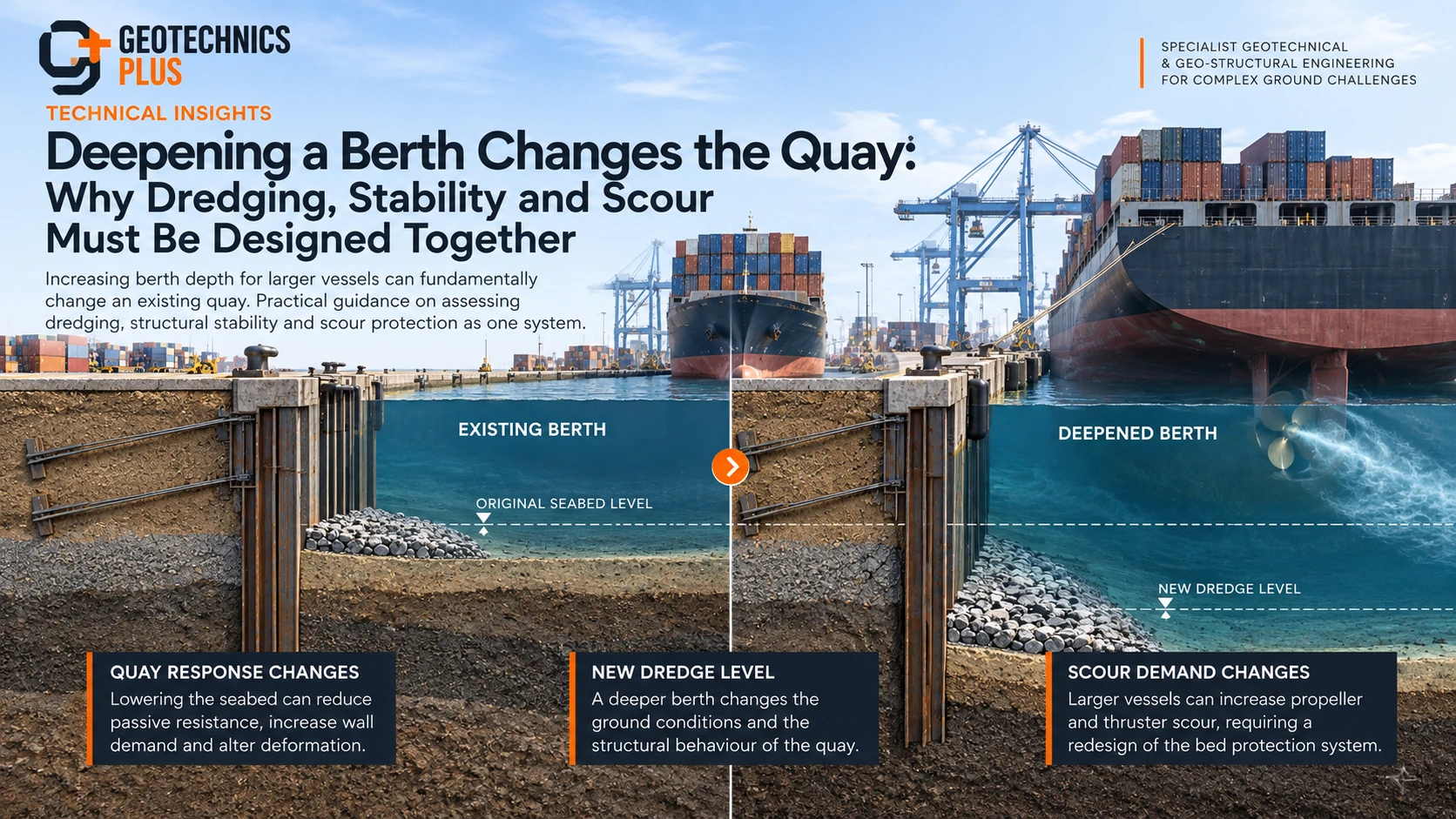
A deeper berth looks like a dredging problem.
For an existing quay, it may actually be a change to the structural system.
Lowering the seabed can change soil support, wall demand, embedment requirements and deformation. At the same time, the larger vessel that requires the additional depth may produce a different propeller or thruster scour environment.
The engineering problem is therefore not simply how deep to dredge. It is whether the existing berth can safely accommodate the new seabed level, new vessel and new hydraulic conditions as one interacting system.
1. The dredge level is part of the structural system
For an anchored sheet-pile or combi-wall quay, the soil in front of the wall can provide a significant component of passive resistance. Lowering the seabed can therefore do more than expose additional wall height.
Depending on the wall system and ground conditions, berth deepening may:
- reduce passive resistance in front of the embedded wall;
- increase the unsupported height of the structure;
- change earth-pressure distributions and the effective point of fixity;
- increase bending moments and anchor loads;
- increase lateral deformation; and
- change the embedment required for acceptable ultimate and serviceability performance.
The same principle applies to other quay systems, although the mechanism differs. Gravity structures may become more sensitive to toe conditions and foundation erosion, while piled structures can experience changes in exposed pile length, lateral response and local scour.
The key question is therefore not simply how much material will be removed? It is how the proposed dredge level changes the behaviour of the existing quay.
2. Start with the existing asset, not the proposed dredge profile
Existing berths often contain uncertainties that did not exist when the original design was prepared.
Before relying on an existing analysis, the project team should confirm the information that actually controls the reassessment, including:
- wall type, geometry and embedment;
- tie rods, anchors and anchor-wall configuration;
- pile or structural condition;
- corrosion and section loss where relevant;
- current seabed and bathymetric profile;
- ground conditions and groundwater or tidal regime;
- previous dredging, repairs or strengthening; and
- evidence of existing movement or distress.
For older assets, record drawings alone may not be sufficient. Targeted structural inspection, bathymetric survey, materials investigation and geotechnical verification can materially reduce the uncertainty in the design decision.
3. Reassess the quay at the proposed seabed level
The reassessment should reflect the future geometry rather than simply check the original structure against a deeper line on the drawing.
For embedded walls, the analysis may need to consider the revised soil profile in front of the wall, updated earth pressures, anchor forces, wall bending, deformation and available passive resistance. Where deformation compatibility matters, serviceability behaviour can be as important as ultimate resistance.
USACE EM 1110-2-2504, Design of Sheet Pile Walls explicitly treats sheet-pile walls as wall-soil systems and recognizes that differences in soil surface elevation may be created by excavation or dredging. It also includes soil-structure interaction analysis among the available analytical approaches.
Simple methods can provide an efficient first screening. More advanced soil-structure interaction analysis becomes valuable where wall flexibility, staged dredging, nonlinear soil response, anchor interaction or deformation materially influence the decision.
4. The new design vessel changes the hydraulic problem too
The vessel that drives the need for a deeper berth may also impose more severe loading on the seabed.
Changes may include:
- larger propeller diameter;
- greater installed propulsion power;
- bow or stern thrusters;
- different manoeuvring procedures;
- different propeller-to-bed clearance; and
- greater local jet velocities at the seabed.
PIANC MarCom WG 180 addresses scour at berthing structures caused by ship propulsion, including propellers, podded propulsors and water jets. The relevant design question is therefore not whether the old protection can physically be reconstructed at a lower elevation, but whether it remains adequate for the future vessel and operating condition.
5. The old scour protection should not simply be lowered
When the berth is deepened, the bed-protection system should be reassessed as a new design condition.
The revised design may need to reconsider:
- armour size and gradation;
- protection thickness;
- filter layers or geotextile requirements;
- plan extent;
- toe and edge transitions;
- details around piles, walls and structures; and
- constructability adjacent to the existing quay.
The existing protection was developed for a particular combination of seabed elevation, vessel type, propulsion system and clearance. Once those variables change, the erosion demand and required protection can change as well.
6. Distinguish bed protection from soil relied upon for structural support
An important distinction is required here.
Ordinary armour stone or a protection mattress should not automatically be assumed to provide meaningful structural resistance to a quay wall. However, some quay configurations rely on a soil berm, retained bed geometry or other material in front of the wall as part of the passive-resistance mechanism.
If dredging or erosion removes material that the structural model relies upon, wall stability can be affected.
This means the geotechnical and hydraulic assessments have to use consistent geometry. The structural model cannot assume a supporting berm that the dredging or scour design subsequently removes.
7. Temporary stages can govern the design
The final deepened section is only one design condition.
A typical construction sequence might include removal of existing bed protection, interim dredging, strengthening works, final dredging and installation of the new scour-protection system.
The least stable condition can occur during one of these temporary stages. For example, removing an existing berm or lowering the seabed before strengthening is installed may temporarily reduce passive support or increase wall demand.
Construction sequence should therefore be analysed explicitly rather than treated as a contractor-only issue after the permanent design has been completed.
8. If strengthening is required, design it with the dredging solution
Where the existing berth cannot accommodate the proposed depth, a range of strengthening concepts may be possible depending on the structure, ground conditions and operating constraints.
Options can include:
- additional anchors or tie systems;
- supplementary piles or king-pile strengthening;
- local structural reinforcement;
- ground improvement;
- modified or retained berm geometry;
- local restrictions on dredge depth; or
- combinations of structural and geotechnical measures.
The preferred option is not necessarily the one with the highest theoretical capacity. Marine access, underwater construction, interruption to terminal operations, durability, inspection and future expansion can be equally important.
9. Soil-structure interaction may become central to the decision
Berth deepening is a classic situation in which the ground and structure cannot always be separated cleanly.
For flexible embedded walls, the response depends on the interaction between wall stiffness, anchor restraint, soil stiffness, dredging stage and the evolving stress state. In complex cases, staged numerical analysis can help evaluate deformation, load redistribution and strengthening alternatives.
That does not mean every berth-deepening project requires advanced numerical modelling. The appropriate level of analysis should be proportional to the uncertainty, consequence and sensitivity of the structure.
See also: When Does Soil–Structure Interaction Matter in Geotechnical Design?
10. Monitoring should support the construction decision
Where the existing quay is sensitive to movement, baseline and construction-stage monitoring can provide an important check on the design assumptions.
Depending on the project, this may include:
- wall survey points;
- inclinometers;
- anchor-load monitoring;
- settlement surveys;
- bathymetric surveys;
- underwater inspection; and
- post-construction seabed monitoring.
The monitoring plan should define expected behaviour, trigger levels, responsibilities and actions before dredging begins. Data without an agreed response framework is not the same as risk control.
11. A better design sequence
The design sequence should not be:
Dredge first → strengthen later
A more robust sequence is:
Design vessel
→ Required berth depth
→ Existing asset verification
→ Quay reassessment at the new dredge level
→ Soil–structure interaction / deformation check
→ Propeller and thruster scour assessment
→ Strengthening + bed-protection design
→ Temporary works and construction sequence
→ Monitoring and verification
The engineering decision
Berth deepening should not be viewed as an isolated dredging project.
The new seabed level can change the behaviour of the quay. The new vessel can change the scour demand. The dredging and scour geometry can alter the soil relied upon by the structure. And the construction sequence can create temporary conditions that are more critical than the final configuration.
The better engineering approach is therefore to treat vessel requirements + dredging + quay behaviour + soil–structure interaction + scour protection + construction sequencing as one integrated marine geotechnical system.
Related Geotechnics Plus insights:
- Quay Wall Systems for Ports: How Do You Choose the Right Solution?
- What Controls the Performance of Quay Walls and Marine Structures?
- How Should Pile Foundations for Marine Terminals Be Designed for Ground, Water and Operational Loads?
References
- BS 6349-2:2019 — Maritime works: Code of practice for the design of quay walls, jetties and dolphins.
- PIANC MarCom WG 180 — Guidelines for Protecting Berthing Structures from Scour Caused by Ships.
- USACE EM 1110-2-2504 — Design of Sheet Pile Walls.
- PIANC MarCom WG 164 — Upgrade of Port Berths by Increasing Dredged Depth (listed by PIANC as an ongoing working group).